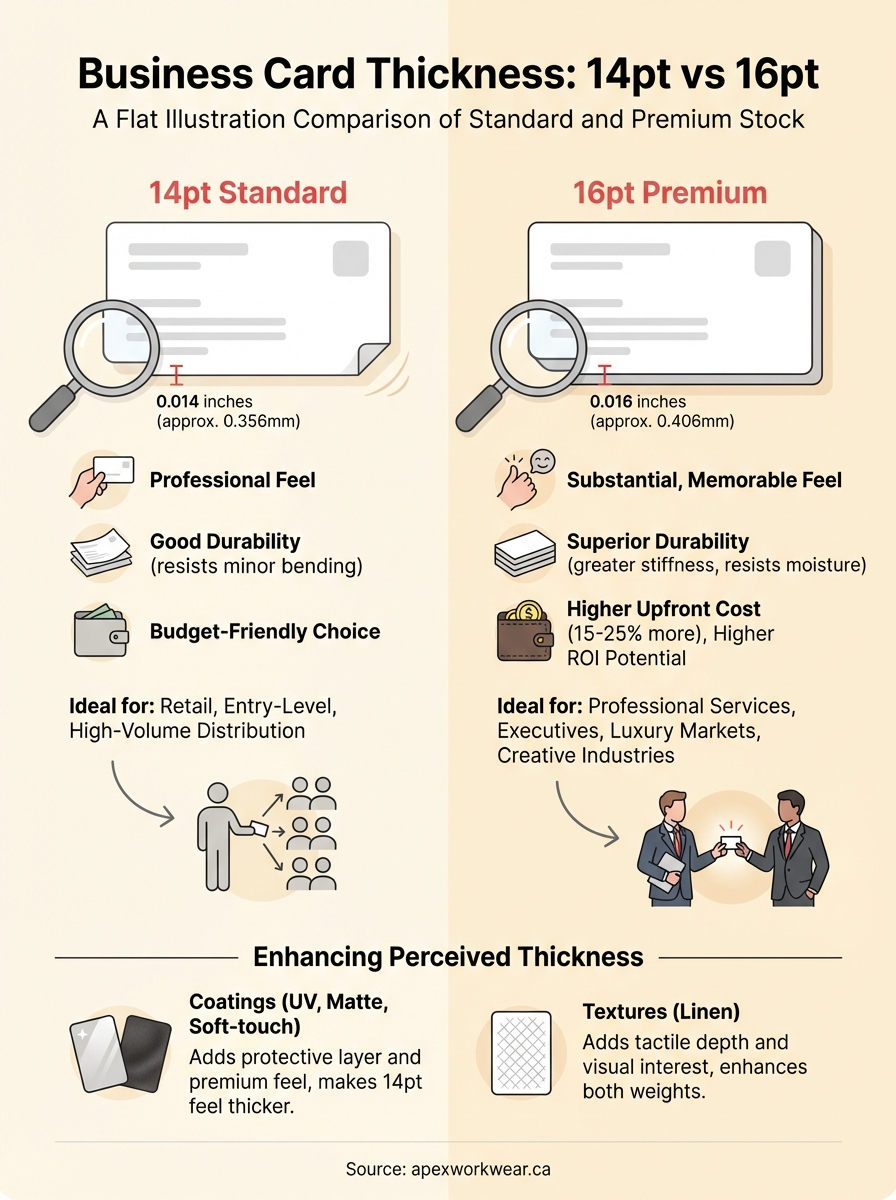
When you order business cards, business card thickness 14pt vs 16pt refers to the weight of the cardstock measured in points. One point equals 0.001 inches, so 14pt stock measures 0.014 inches thick while 16pt measures 0.016 inches. This small difference creates a noticeable change in how your cards feel and how durable they are. The thicker option costs more but delivers a premium impression that can set you apart from competitors handing out flimsy cards.
This guide breaks down the practical differences between these two popular cardstock weights. You’ll learn how thickness affects durability, what each option feels like in your hand, and which industries benefit most from each weight. We’ll also cover how coatings and finishes change the perceived quality of your cards, helping you make a cost-effective choice that aligns with your brand and budget. By the end, you’ll know exactly which thickness works best for your business networking needs.
Why card thickness matters for professional networking
The moment someone hands you a business card, you make an instant judgement about their professionalism based on how that card feels. Your brain processes this tactile information in milliseconds, forming opinions about the person’s attention to detail, financial stability, and commitment to quality. Research shows that people remember brands better when they experience a physical interaction, and a sturdy card creates a more memorable impression than a thin one. When you choose between business card thickness 14pt vs 16pt, you’re not just picking paper; you’re deciding how potential clients and partners will perceive your brand before they even read your name.
First impressions start before you speak
Your business card often reaches someone’s hand before you finish your introduction. A flimsy card that bends easily signals that you cut corners, while a thicker stock communicates that you invest in quality. This split-second assessment affects whether your contact files your card carefully or tosses it in a drawer with dozens of others. Premium cardstock stands out in a stack because it takes up more physical space and feels different to the touch.
The weight difference between standard and premium stock might seem minor on paper, but the perceived value changes dramatically. When you hand someone a 16pt card, they notice the substance immediately. Their fingers register the extra weight, and many people will even flex the card slightly to test its durability. This unconscious behaviour creates a lasting impression that reinforces your professional image long after the networking event ends.
Physical presence in a digital world
Despite predictions that digital contact sharing would eliminate paper cards entirely, physical cards remain a networking staple in 2026. The reason is simple: a tangible card creates a psychological connection that a smartphone contact cannot replicate. When you exchange cards, you participate in a ritual that signals mutual respect and interest. The thickness of your card enhances this ritual by making the exchange feel more significant.
A thicker card resists being forgotten in a pocket or purse because it creates a physical reminder of your meeting.
Cards printed on heavier stock survive the journey from event to office without arriving bent or damaged. You’ve likely pulled a crumpled card from your wallet and struggled to read the contact details. This problem disappears with 16pt cardstock, which maintains its shape through daily handling. Your card stays crisp and professional, ensuring your information remains accessible and legible when your contact finally returns to their desk.
Memory retention through tactile experience
Neuroscience research confirms that physical objects create stronger memory traces than digital equivalents. When someone holds your card, their brain encodes not just the visual information but also the weight, texture, and resistance of the material. This multi-sensory experience helps your contact remember you days or weeks later when they sort through their collection of cards. A 14pt card provides a decent tactile experience, but 16pt stock creates an even more distinctive sensory signature that helps you stand out.
The thickness also affects how people store and organize your card. Heavier cards are less likely to get lost or damaged in a cardholder or desk drawer. They resist dog-earing and stand upright more easily when displayed on a desk. Your contact might keep your card visible as a reminder to follow up, but only if it has enough structural integrity to serve as a standalone display piece.
Understanding the technical specifications of card stock
Card stock specifications use standardized measurements that help you compare products across different printers and suppliers. The point system measures thickness in thousandths of an inch, while an alternative measurement called GSM (grams per square metre) weighs paper density. When you’re deciding between business card thickness 14pt vs 16pt, understanding these technical specifications helps you predict exactly how your cards will perform. Most Canadian printers use the point system because it provides a direct measurement of thickness that customers can visualize easily.
How point measurements translate to physical thickness
One point equals 0.001 inches, creating a simple conversion that you can verify with a standard ruler or caliper. A 14pt card measures 0.014 inches thick, which sits slightly thicker than standard copy paper but thinner than a credit card. The 16pt option at 0.016 inches approaches credit card thickness, though it remains flexible enough to fit in standard wallets and cardholders. This two-point difference might sound minimal, but it represents a 14% increase in thickness that your fingers detect immediately upon contact.

Manufacturers achieve these specific thicknesses by compressing multiple layers of paper fibres during production. Your cards might use a solid core of compressed paper or a layered construction with different materials sandwiched together. The construction method affects not just thickness but also how the card resists bending and whether it shows wear patterns along the edges after extended use. Premium suppliers often use higher-quality fibres that compress more uniformly, resulting in consistent thickness across every card in your batch.
The actual thickness of your finished cards can vary by up to 0.001 inches depending on humidity and storage conditions.
GSM versus point weight systems
European and Asian suppliers often specify cardstock using GSM instead of points, measuring paper weight rather than thickness. A 14pt card typically weighs around 350 GSM, while 16pt stock reaches approximately 400 GSM. These numbers tell you how much one square metre of the paper weighs in grams, which indicates density but not exact thickness. Two cards with identical GSM ratings can measure different thicknesses if one uses denser compression or different fibre composition.
Understanding both measurement systems helps you compare quotes from international suppliers or when sourcing specialty stocks. You might find that a 380 GSM stock from one supplier feels identical to a 15pt stock from another. The relationship between GSM and points remains approximate because paper density varies based on manufacturing processes, fibre types, and coating applications. When precision matters, always request physical samples rather than relying solely on technical specifications.
Comparing the durability and feel of 14pt versus 16pt
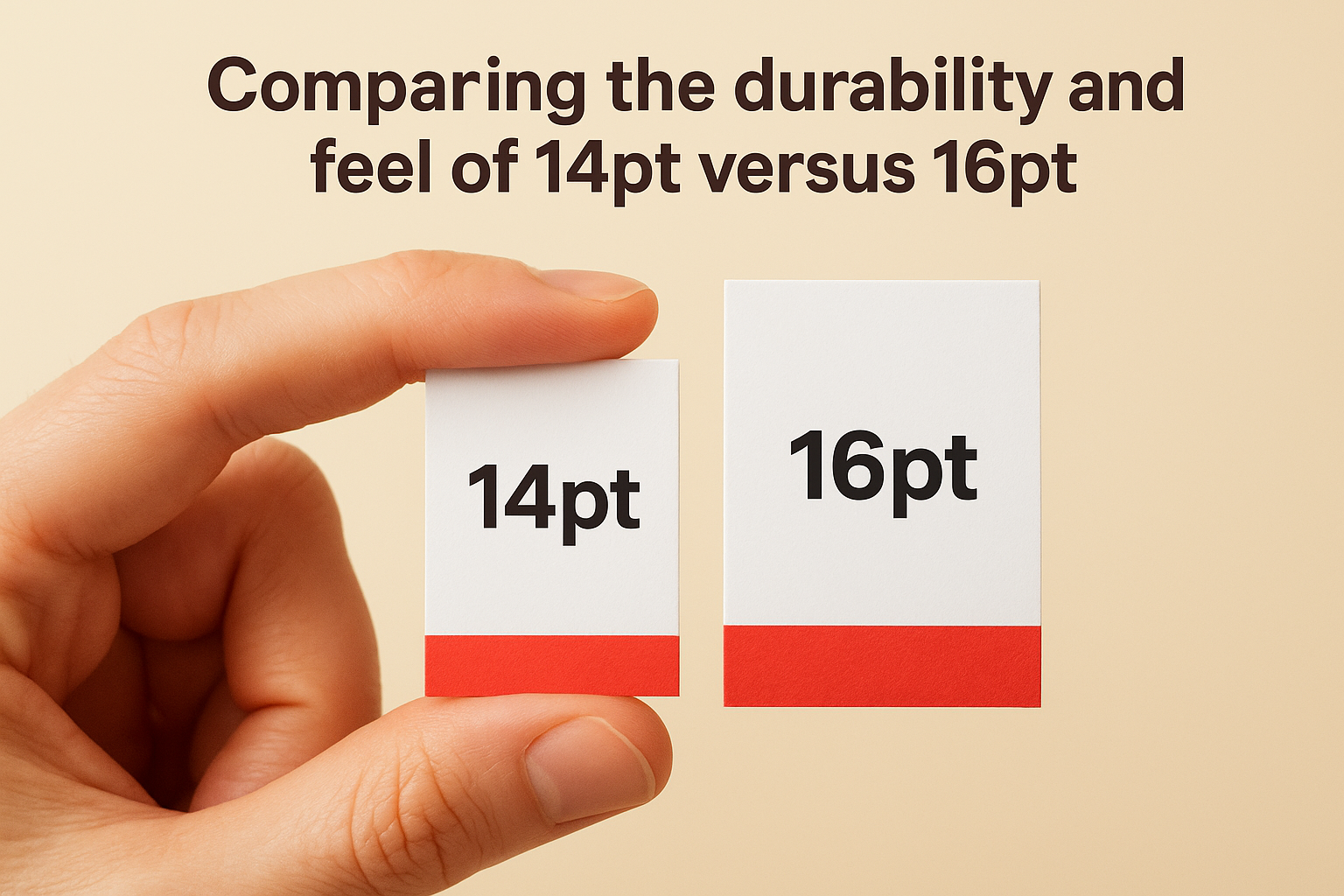
When you physically compare business card thickness 14pt vs 16pt side by side, the differences become immediately apparent. Both stocks resist typical handling scenarios, but the 16pt option provides noticeably greater stiffness that you feel the moment you pick up the card. Your thumb and forefinger detect the extra weight and substance, signalling premium quality before you even read the printed information. The practical question becomes whether this enhanced durability justifies the price increase for your specific networking situations.
Physical resistance to daily handling
The 14pt stock handles normal wear patterns effectively when your cards spend most of their time in a cardholder or desk drawer. You can expect these cards to maintain their shape through standard exchanges at networking events, client meetings, and trade shows. They resist minor bending when slipped into a jacket pocket or briefcase compartment, though repeated flexing will eventually create permanent creases. Cards at this weight typically show visible wear after passing through five or six hands, with corners developing slight dog-ears and surfaces accumulating micro-scratches from friction against other cards.
Stepping up to 16pt cardstock provides superior resilience against the same handling conditions. These cards spring back to their original shape after moderate bending, maintaining a professional appearance even after being stored in a wallet or pocket for extended periods. The extra thickness prevents the card from conforming to curved surfaces, which means your contact details remain easily readable without having to flatten the card first. Construction workers, outdoor professionals, and anyone working in demanding environments appreciate how 16pt stock resists moisture damage and structural failure better than thinner alternatives.
A 16pt card survives the washing machine cycle better than 14pt stock, though neither option performs well when soaked.
Tactile experience and perceived quality
Your recipients form immediate judgements based on how your card feels in their hand. The 14pt option delivers a professional tactile experience that meets expectations for standard business communication, comparable to what most people receive at conferences and networking events. Recipients notice the quality without necessarily being impressed by it, as this weight represents the current market baseline for professional cards.
Cards printed on 16pt stock create a memorable tactile signature that distinguishes your brand from competitors. The added substance makes recipients pause slightly during the exchange, triggering a conscious recognition that your cards differ from typical offerings. This momentary attention increase helps your contact remember the interaction when they review collected cards later.
How to determine the ideal thickness for your industry
Your industry influences which business card thickness 14pt vs 16pt creates the right impression with your target audience. Different professional sectors carry distinct expectations about card quality, where financial advisors and lawyers typically distribute heavier cards than retail workers or entry-level professionals. The wrong choice signals that you either misunderstand your market or prioritize cost savings over professional standards. Selecting cardstock based on your industry norms helps you meet expectations while standing out appropriately among competitors.
Professional services and corporate environments
Corporate executives, accountants, financial planners, and legal professionals benefit from 16pt cardstock because their clients associate heavier cards with stability and trustworthiness. When you manage someone’s money or legal matters, your business card serves as a tangible representation of your reliability. Clients in these sectors often compare your card against others they’ve collected from professionals in similar roles, making consistency with industry standards critical for establishing credibility.

Real estate agents occupy a unique position where card quality directly correlates with property values in their market. You might choose 14pt stock when working primarily with first-time buyers or rental properties, but 16pt becomes essential when targeting luxury home sales. Your card communicates whether you operate in budget markets or premium segments, helping potential clients self-select before they contact you.
Medical professionals, consultants, and insurance brokers face similar expectations where card weight signals professional competence.
Creative industries and skilled trades
Graphic designers, photographers, and marketing professionals often select 16pt cardstock to demonstrate their understanding of quality materials and attention to detail. Your card becomes a portfolio piece that showcases your design sensibilities and commitment to excellence. Creative industries allow more experimentation with textures and finishes, where the heavier base stock provides better support for specialty coatings that enhance visual impact.
Contractors, electricians, and tradespeople traditionally used lighter cardstock because their clients prioritized practical information over perceived luxury. This pattern has shifted as competition increased and homeowners began comparing multiple quotes for projects. You now compete more effectively with 14pt cards that survive job site conditions while projecting professional credibility, though 16pt options work well for specialty trades charging premium rates.
Evaluating the cost-effectiveness of premium stocks
The price gap between business card thickness 14pt vs 16pt varies depending on your printer and order volume, but you typically pay 15-25% more for the heavier stock. This cost increase might seem substantial when you multiply it across 500 or 1,000 cards, but the actual dollar difference often amounts to less than the price of a single business lunch. Your decision should balance immediate printing costs against the long-term value each card generates through networking and client acquisition. Cards that get discarded or forgotten waste money regardless of their thickness, while premium cards that lead to profitable relationships deliver returns that dwarf their initial cost.
Price differences and order quantities
Most Canadian printers charge between $45-65 for 250 cards printed on 14pt stock, while the same quantity on 16pt stock runs approximately $55-80. You save more per card when ordering larger quantities, with bulk orders of 1,000 cards reducing the per-unit cost by 30-40% compared to smaller batches. The percentage difference between cardstock weights remains relatively consistent across order sizes, meaning you don’t gain proportional savings by ordering more premium cards at once.
Your total investment includes more than just cardstock thickness. Design complexity, colour options, and finishing treatments affect your final price more dramatically than the two-point thickness difference. You might spend an additional $20 moving from 14pt to 16pt stock, but adding UV coating or metallic foils increases costs by $40-100 depending on coverage area.
Comparing quotes from multiple suppliers helps you identify realistic pricing rather than accepting inflated rates that exploit unfamiliarity with industry standards.
Return on investment for business development
Calculate your cost per card by dividing your total order price by the quantity received. A $70 order for 250 cards on 16pt stock costs $0.28 per card, while 14pt cards at $55 work out to $0.22 each. This six-cent difference becomes irrelevant if the premium card generates even one additional client conversation or partnership opportunity. Your cards serve as marketing assets that work continuously throughout their lifespan, making their initial cost negligible compared to advertising expenses or trade show booth fees.
Professional services billing $100-500 per hour recover cardstock investments immediately when a single card leads to new business. You need only one consulting contract, legal retainer, or design project to justify printing your entire year’s card supply on premium stock.
Enhancing card weight with coatings and textures
Coatings and finishes transform how your cards feel without changing the actual cardstock thickness underneath. You can make 14pt cards feel nearly as substantial as 16pt stock by adding the right surface treatments, or you can push 16pt cards into ultra-premium territory with specialty finishes. These enhancements affect not just tactile perception but also durability, with most coatings adding protective layers that resist scratches, moisture, and fingerprints. Your choice between coatings often matters as much as the base cardstock when creating the impression you want.
Common coating options that add perceived thickness
UV coating applies a liquid gloss or matte finish that cures under ultraviolet light, creating a hard protective shell on your card surface. This coating adds minimal actual thickness but dramatically changes how your cards feel, making them smoother and more rigid. You can choose between flood coating that covers the entire card or spot UV that highlights specific design elements like logos or text. The coating prevents ink from smudging and gives your cards a finished quality that uncoated stock lacks, regardless of whether you start with business card thickness 14pt vs 16pt.
Aqueous coating provides a water-based alternative that creates a softer finish compared to UV treatments. This option costs less than UV coating while still protecting your cards from everyday handling damage. You sacrifice some of the rigidity that UV coating provides, but aqueous finishes work well when you want protection without excessive shine. Most printers offer aqueous coating as a standard upgrade that adds negligible cost to your order.
Matte coatings reduce glare and fingerprints while creating a sophisticated tactile experience that premium brands favour.
Textured finishes for tactile enhancement
Linen texture embossing creates a fabric-like surface that adds visual interest and tactile depth to your cards. This finish works particularly well on heavier cardstock where the embossing pattern remains crisp and defined. You notice the crosshatch pattern immediately when running your thumb across the surface, creating a distinctive feel that separates your cards from smooth alternatives. Linen finishes suit professional services and creative industries where subtle sophistication matters more than bold statements.
Soft-touch coating applies a velvet-like laminate that creates an almost suede texture on your card surface. This premium finish costs significantly more than standard coatings but delivers an unforgettable tactile experience. Your recipients often comment directly on the feel of soft-touch cards, making them conversation starters that extend your networking interactions beyond typical exchanges.
Final thoughts on choosing your business card stock
Your decision between business card thickness 14pt vs 16pt depends on your industry standards, budget constraints, and the impression you want to create. The 14pt option delivers professional quality that satisfies most networking situations while keeping costs manageable, particularly when you’re distributing cards frequently or ordering in smaller batches. You gain adequate durability and a respectable feel that won’t embarrass you in standard business settings.
Stepping up to 16pt stock makes sense when your target clients expect premium materials or when you operate in competitive markets where differentiation matters. The modest price increase becomes insignificant when a single card leads to new business opportunities. Your cards represent your brand long after networking events end, making quality investments that pay dividends through enhanced credibility and memorability.
Whether you need custom business cards or other printed materials to build your brand, Apex Workwear delivers professional results with fast turnaround times and expert guidance throughout the design process.