Every product, package, or piece of equipment you see has a label on it, and someone had to print it. So what is label printing, exactly? At its core, it’s the process of producing adhesive or non-adhesive labels using various printing methods, each suited to different materials, quantities, and end uses. Whether you’re marking inventory, branding retail packaging, or organising your workspace, labels do a surprising amount of heavy lifting for your business identity.
At Apex Workwear, we print custom labels and stickers for small businesses, contractors, and teams across Canada, so we work with these materials and methods daily. That hands-on experience gives us a practical perspective on what actually matters when choosing a label printing approach, and what you can skip worrying about.
This article breaks down the main printing methods, the materials involved, and the real-world use cases where each option makes sense. By the end, you’ll have a clear picture of how label printing works and enough context to make a confident decision for your next project.
Why label printing matters
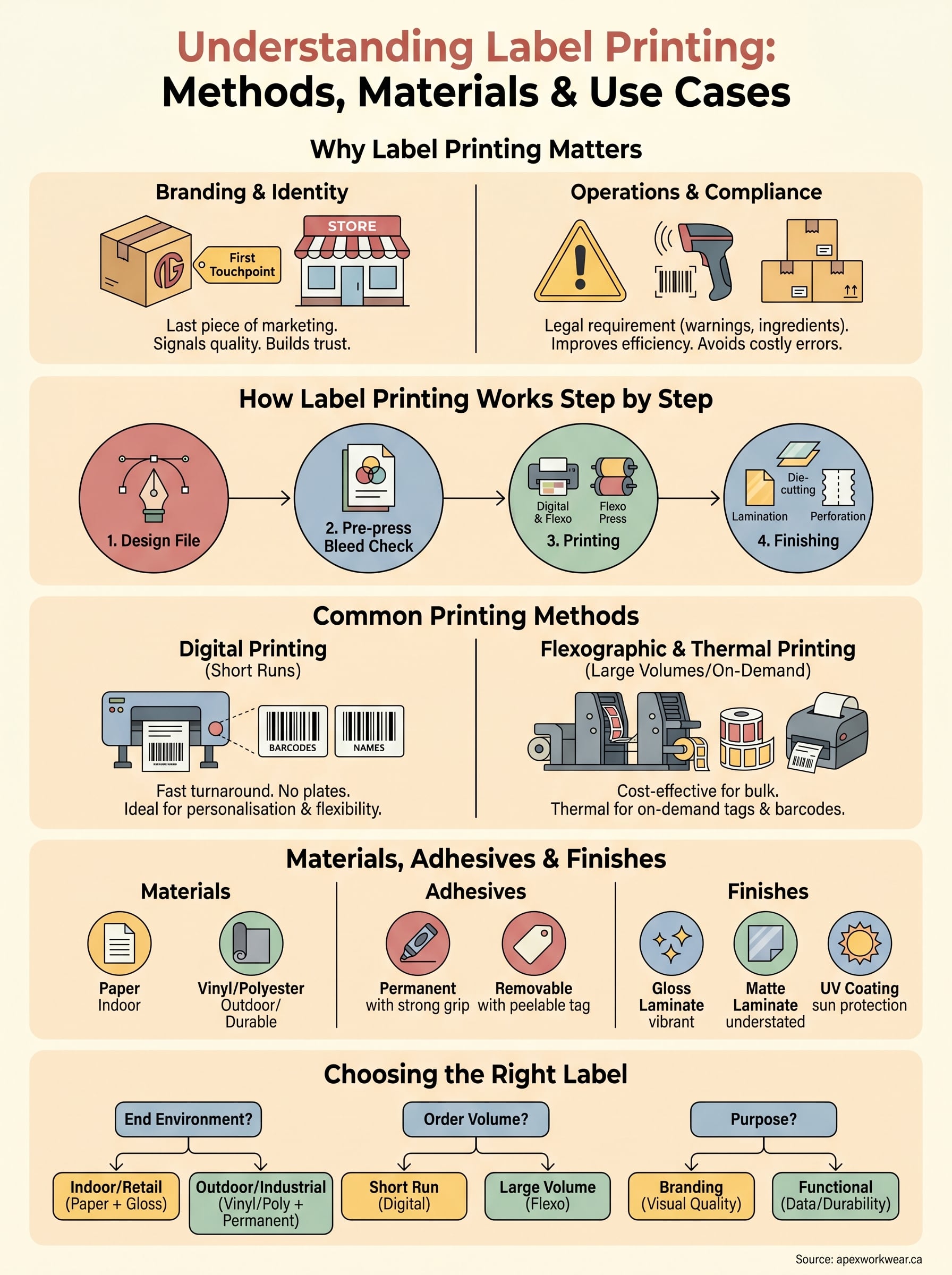
Labels are often the first physical touchpoint a customer has with your product. Before someone reads your website or sees your social media, they hold your product in their hands, and the label tells them everything about what is inside and who made it. Understanding what is label printing and how to use it well can be the difference between a product that looks professional and one that looks rushed. That distinction matters at every stage, from a market stall to a retail shelf.
Labels as a branding tool
Your label carries your brand identity in a compact, practical format. A well-printed label with consistent colours, clear typography, and sharp graphics signals quality before the customer even opens the package. For small businesses especially, investing in custom-printed labels levels the playing field with larger competitors, giving your products the same shelf presence as brands with much bigger marketing budgets. That perception of quality is difficult to build through other means, but a label delivers it immediately.
A label is not just identification. It is the last piece of marketing your customer sees before they decide whether to trust your product.
Labels in operations and compliance
Labels do more than build brand awareness. In many industries, they are a legal requirement for safety warnings, ingredient lists, barcode tracking, or hazard identification. Getting these details right means choosing a print method and material that holds up under the conditions your product faces, whether that is cold storage, outdoor exposure, or chemical contact.
Beyond compliance, your operational labels, such as shipping labels, asset tags, and inventory markers, directly affect how efficiently your business runs. Poorly printed or illegible labels slow down fulfilment, create picking errors, and frustrate staff. Choosing the right label printing approach from the start saves you real time and reduces costly mistakes further down the line.
How label printing works step by step
Understanding what is label printing becomes clearer when you follow the process from start to finish. Every label job moves through the same core stages: design, material selection, printing, and finishing. Each stage affects the final result, so knowing what happens at each point helps you give your printer the right information and avoid costly reprints.
From artwork to print-ready file
Your label starts as a design file. Vector-based artwork (such as an AI or EPS file) gives your printer clean, scalable lines, while low-resolution images produce blurry results once printed. Before any printing begins, your printer will review the file for colour profiles, bleed, and safe zones to confirm the finished label matches what you approved on screen.
Getting your file right before it goes to press saves you time, money, and the frustration of a reprint.
Printing and finishing
Once your file is approved, the press run begins. The chosen printing method determines speed, colour accuracy, and minimum quantities. After printing, labels go through finishing steps that shape the final product:
- Lamination adds a protective coating for durability
- Die-cutting trims labels to a custom shape
- Perforation or slitting prepares them for roll or sheet delivery
Common label printing methods
Once you understand what is label printing at a process level, knowing which method fits your needs is the next step. Each printing method has distinct strengths depending on your order volume, material, and budget, so picking the right one upfront avoids costly reprints or unexpected lead times.
Digital printing
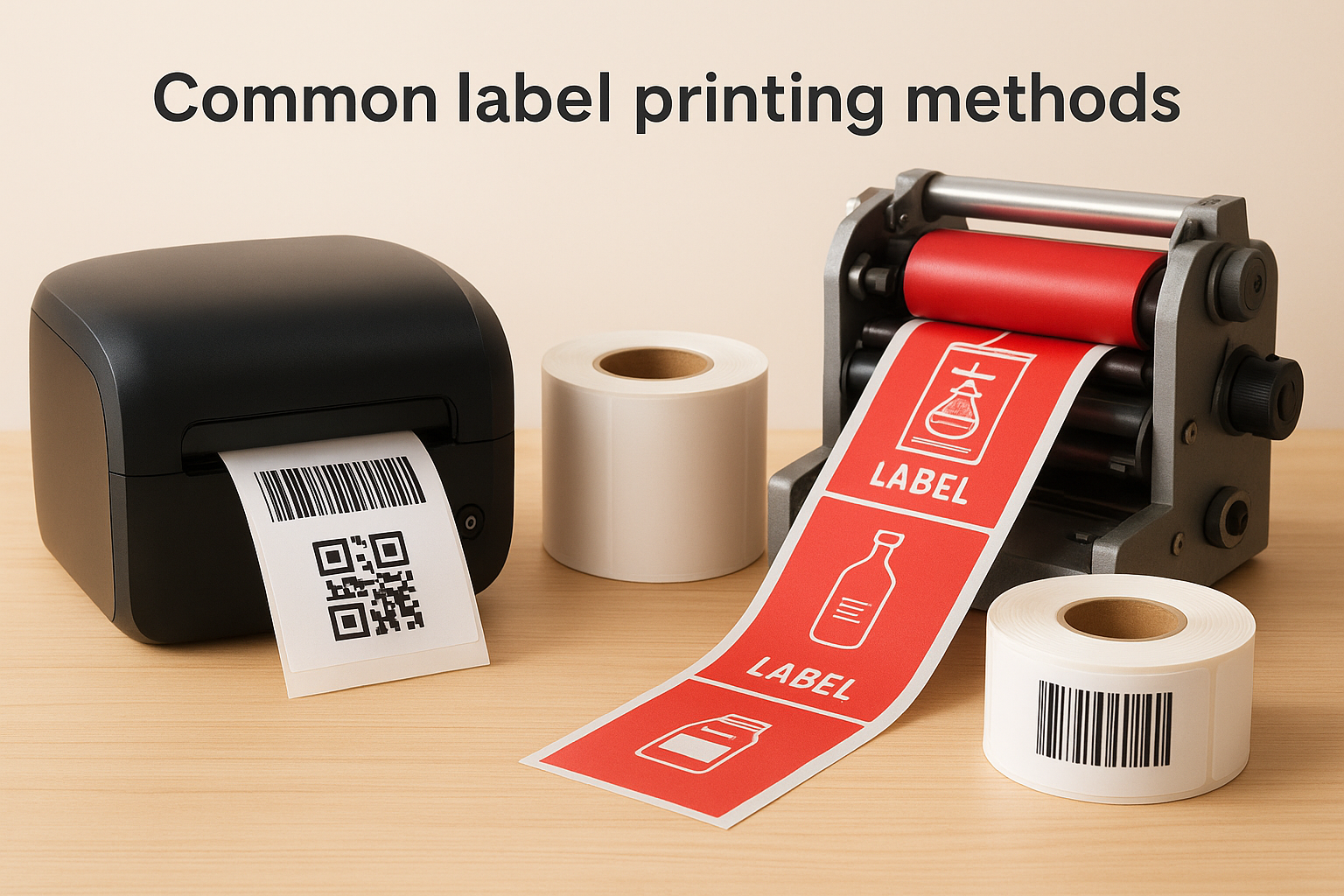
Digital printing transfers your design directly from file to press, with no plates needed. This makes it the go-to option for short runs, variable data, and fast turnarounds. If you need labels with unique barcodes, sequential numbers, or personalised names, digital handles all of that without any setup fee.
For small businesses ordering under a few hundred labels, digital printing delivers professional results without large minimum quantities.
Short-run digital labels work well for product packaging, event use, and seasonal promotions where you need flexibility to update artwork between orders.
Flexographic and thermal printing
Flexographic printing uses polymer plates to apply ink at high speed, making it the most cost-effective choice for large-volume production runs. Setup costs are higher, but the per-unit price drops sharply with quantity, which is why most consumer goods manufacturers rely on it.
Thermal printing, covering both direct thermal and thermal transfer, is the standard for on-demand labels such as shipping labels, asset tags, and barcodes that you print in-house as needed.
Label materials, adhesives and finishes
When you dig into what is label printing, the substrate and adhesive you choose matter just as much as the printing method itself. Your material selection directly affects durability, cost, and appearance, so getting it right before you order avoids disappointment when labels start peeling or fading ahead of schedule.
Materials and adhesives
Paper stock works well for dry, indoor environments like retail tags, jar labels, and product packaging. Vinyl and polyester handle moisture, extreme temperatures, and outdoor exposure without cracking or fading, making them the right choice for equipment tags, outdoor signage labels, and anything that faces harsh conditions. Adhesive strength is equally important: permanent adhesives grip firmly and resist removal, while removable formulas let you reposition or peel cleanly without leaving residue behind on surfaces.
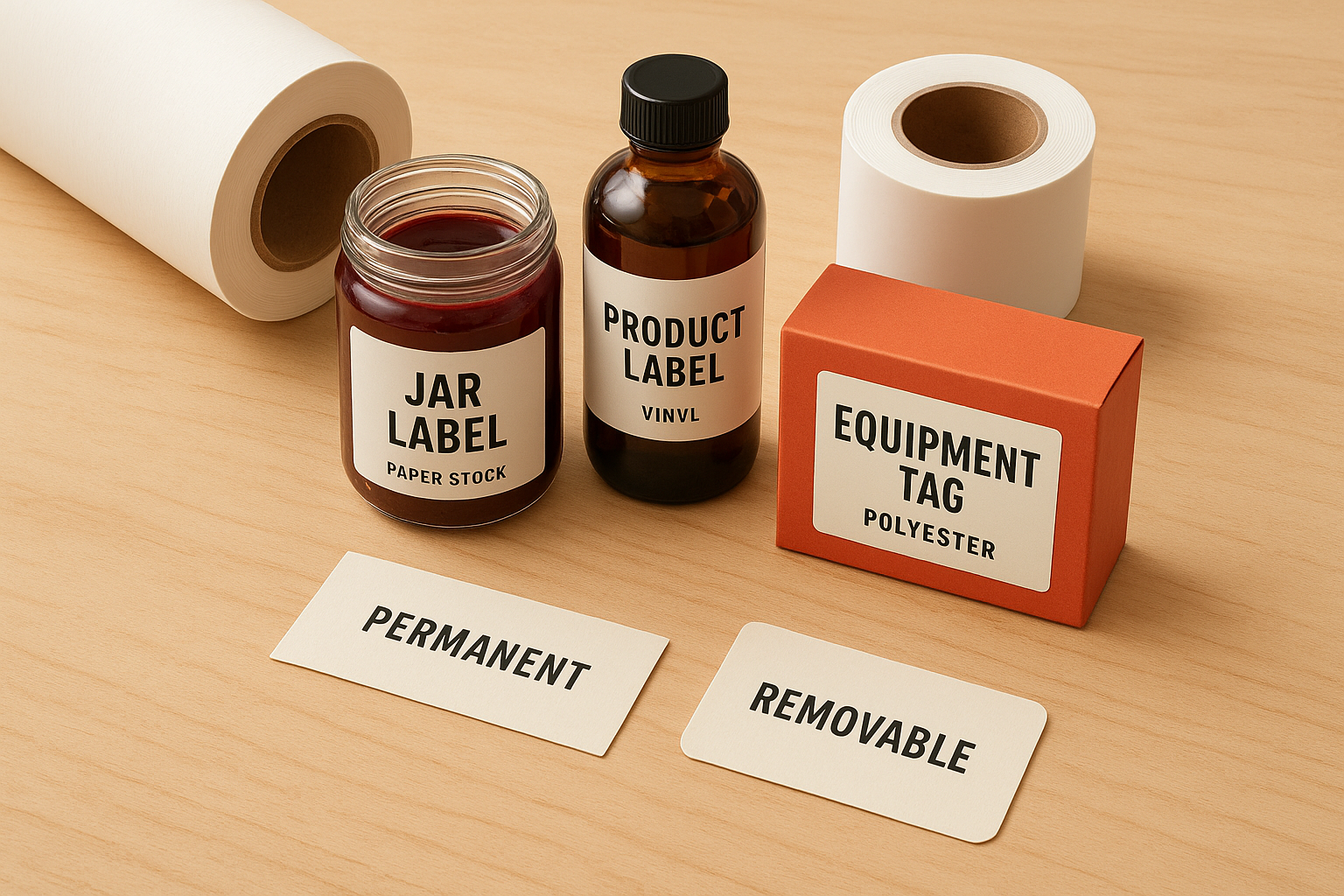
Match your adhesive to the surface texture and environment your label will face, not just what looks convenient on a spec sheet.
Finishes
Gloss laminate intensifies colour vibrancy and shields labels from scuffs and moisture, making it a popular choice for product packaging. Matte laminate reduces glare and delivers a cleaner, more understated look that suits premium or minimalist branding. UV coating adds a further layer of protection for labels that face direct sunlight or frequent handling in the field.
Choosing the right label for your use case
Once you understand what is label printing and the full range of options available, the real work is matching the right method and material to your specific situation. Your decision comes down to three factors: your end environment, your order volume, and whether your label needs to carry branding, data, or both.
Product packaging and retail
For retail-facing products, visual quality and colour accuracy are your top priorities. Digital printing on gloss-laminated paper or vinyl stock delivers sharp, vibrant results with no plate setup costs. Keeping your order quantities flexible means you can update artwork between print runs without sitting on outdated stock.
Test your design with a short digital run before committing to a larger order, as colours can shift noticeably between screen and print.
Industrial, outdoor, and functional labels
For equipment tags, outdoor use, or anything facing moisture or extreme temperatures, choose vinyl or polyester stock with a permanent adhesive. Thermal printing suits on-demand functional labels where you print as needed rather than in batches. Consider these three checkpoints before placing your order:
- Will the label face heat, moisture, or direct sunlight?
- Do you need to print variable data like barcodes or serial numbers?
- Is this a branded label or a purely functional marker?
Next steps
Now that you know what is label printing and how each method, material, and finish stacks up, the next step is applying that knowledge to your actual project. Start by identifying your end environment: indoor or outdoor, short run or bulk, branded or functional. That single decision narrows your options quickly and points you toward the right stock and print method before you spend time on design details.
From there, get your artwork into a vector-based file with correct bleed and colour profiles. If you are unsure about file setup or material choice, a good print partner will review your design and flag issues before anything goes to press. That saves you reprints and unexpected delays.
If you need custom labels and stickers printed in Canada with fast turnaround, honest pricing, and no minimum order headaches, get a free quote from Apex Workwear and have your order moving within 24 hours.