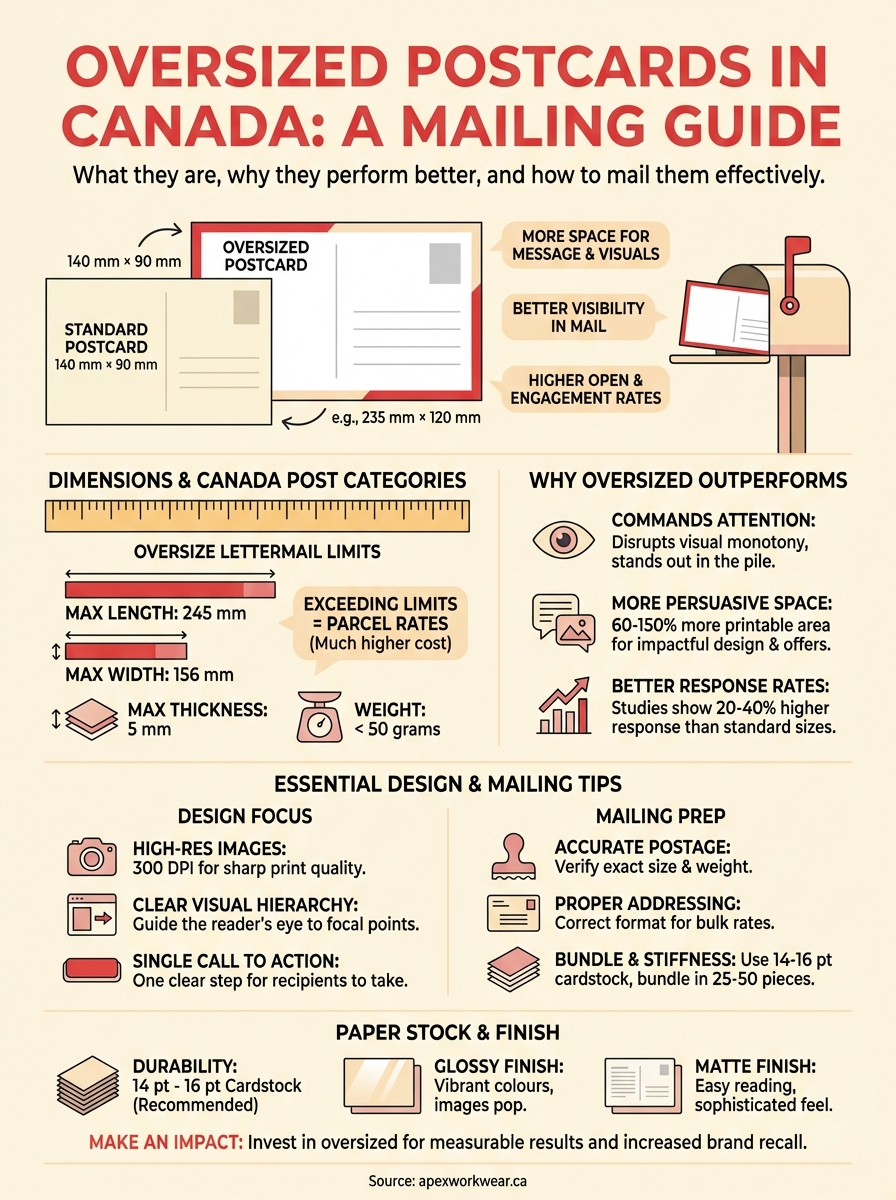
Oversized postcards are marketing materials that exceed Canada Post’s standard postcard dimensions of 140 mm × 90 mm. These larger format cards typically measure between 152 mm × 102 mm and 235 mm × 120 mm, offering more space for your message and better visibility in a pile of mail. They cost slightly more to send but grab attention far more effectively than regular postcards. The extra real estate lets you showcase products, display compelling offers, or tell your brand story without cramping your design into a tiny space.
You need to understand the size categories, postage requirements, and design considerations before ordering your first batch. This guide covers everything from Canada Post’s dimensional limits to paper stock selection, helping you create oversized postcards that get noticed and drive results for your business. You’ll learn how to design them properly, calculate accurate postage, and avoid common mistakes that waste money or cause delivery issues.
Why oversized postcards outperform standard mail
Your mail recipients sort through their post in seconds, not minutes. Oversized postcards immediately catch the eye because they disrupt the visual monotony of standard envelopes and bills. The larger format forces recipients to handle them differently, creating a tactile interaction that standard mail rarely achieves. This physical difference translates directly into higher open rates and better engagement.
They command attention in the mailbox
Standard postcards get lost among letters, flyers, and other small format pieces. Your oversized card sits on top of the pile or leans against the side of the mailbox, making it impossible to ignore. The size difference creates an instant visual hierarchy that positions your message as more important than competing mail. Recipients process larger items first, giving you a critical advantage in the battle for attention.
The extra surface area lets you include high-impact visuals that would look cramped on a standard card.
More room for persuasive messaging
You gain 60% to 150% more printable space compared to standard postcards, depending on which oversized format you choose. This extra real estate lets you add compelling product photos, detailed service descriptions, or multiple calls to action without sacrificing readability. Your design can breathe, with proper white space that guides the reader’s eye through your message instead of overwhelming them with cramped text.
Better response rates justify the cost
Studies consistently show that larger direct mail pieces generate response rates 20% to 40% higher than standard sizes. The increased postage cost typically adds only pennies per piece, while your response rate improvement can double or triple your campaign’s return. You pay slightly more to mail them, but you reach more customers who actually take action on your offer.
Understanding dimensions and Canada Post categories
Canada Post divides mail into specific size categories that determine postage rates and handling requirements. Your oversized postcards fall into the Lettermail category when they stay within certain dimensional limits, but pricing jumps once you exceed standard card dimensions. Understanding these categories helps you choose the right size without paying unnecessarily high postage or triggering parcel classification.
Standard vs oversized specifications
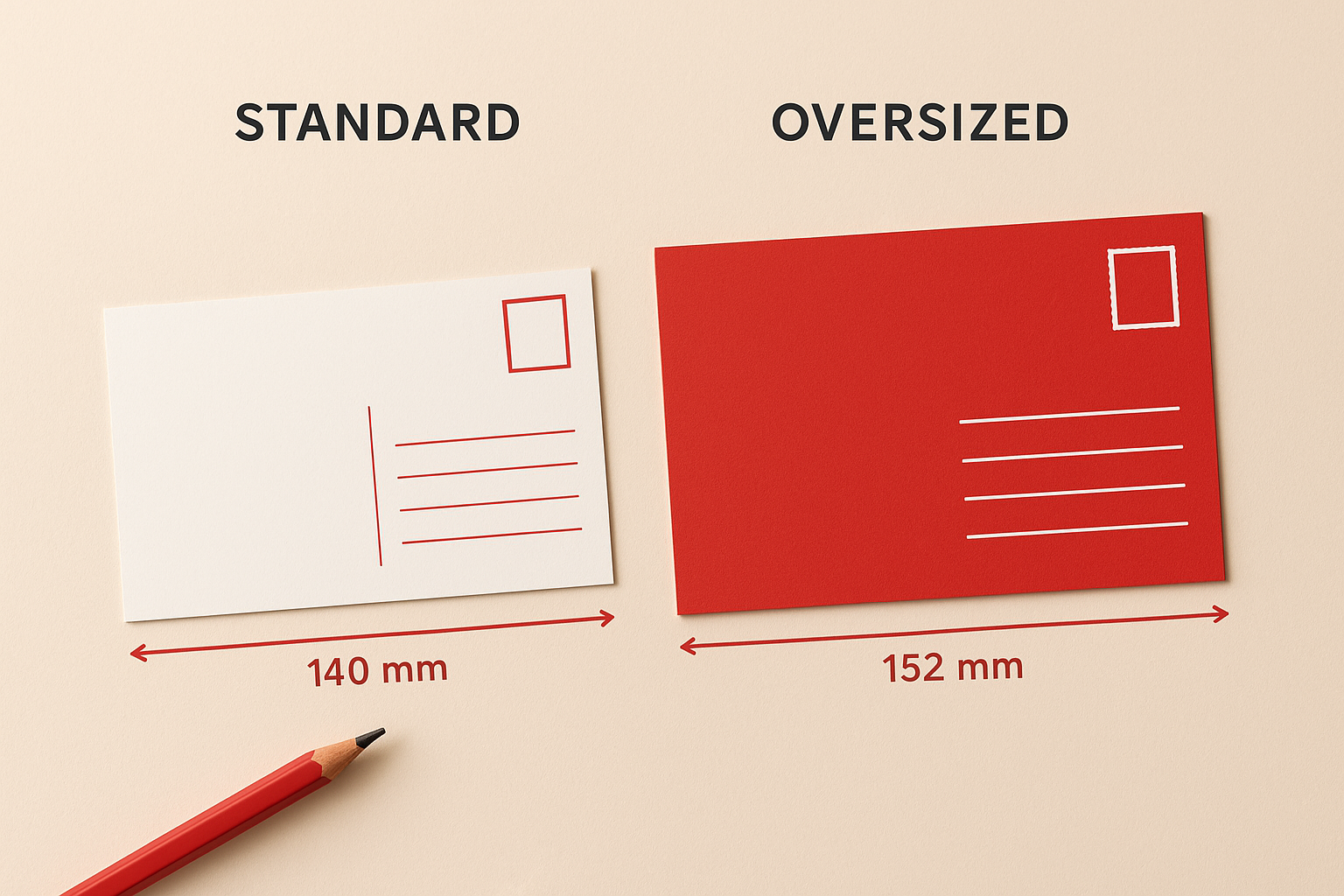
Standard postcards measure up to 140 mm × 90 mm and qualify for the lowest postage rate. Oversized postcards range from 152 mm × 102 mm to the maximum Lettermail dimensions, giving you substantially more design space. You need to keep your cards under 245 mm in length, 156 mm in width, and 5 mm in thickness to avoid moving into the more expensive parcel category. These measurements apply to the finished card, not your artwork file.
Oversize lettermail category
Canada Post charges Oversize rates when your postcard exceeds standard dimensions but stays within Lettermail limits. Your card must weigh less than 50 grams to qualify for this category, which covers most cardstock options. Cards measuring 235 mm × 120 mm represent the practical maximum for most marketing campaigns, offering substantial space while keeping postage costs reasonable.
Staying just under the maximum dimensions saves you from parcel rates that can cost three to five times more per piece.
How to mail oversized postcards in Canada
Mailing oversized postcards requires accurate postage calculation and proper preparation to avoid returns or delivery delays. You need to measure your cards precisely, weigh them correctly, and apply the right postage before dropping them at the post office or mailbox. Canada Post processes oversized mail differently than standard postcards, so following their requirements ensures your marketing investment reaches your intended recipients.
Calculate accurate postage before printing
You must determine your card’s exact dimensions and weight to select the correct postage rate. Visit your local Canada Post outlet with a sample card to verify the postage amount, as online calculators sometimes misclassify borderline sizes. Buying postage in bulk through a Canada Post Small Business account typically saves 10% to 15% compared to counter rates. Your printer can usually provide accurate weight estimates based on your chosen paper stock and finish.
Prepare your mail properly
Canada Post requires proper addressing with postal codes in the correct format to qualify for bulk mail rates. Your return address must appear on each card, typically in the upper left corner of the address side. Bundle your cards in groups of 25 to 50 pieces with rubber bands when dropping off bulk quantities at the post office. Cards need sufficient stiffness to move through sorting equipment without bending or jamming, which means using 14 pt cardstock or heavier.
Properly prepared oversized postcards move through Canada Post’s system faster than improperly formatted mail.
Essential design tips for large format cards
Your design approach changes significantly when working with larger formats. Oversized postcards give you more space, but that extra room can work against you if your design lacks focus. You need to balance visual impact with message clarity, ensuring your card communicates effectively without overwhelming recipients with too much information or cluttered layouts.
Use high-resolution images
Your images must maintain sharpness and clarity at larger print sizes, which means using files with at least 300 DPI resolution. Low-resolution photos that look acceptable on screen will appear pixelated and unprofessional when printed large. Select one or two strong images rather than cramming multiple small photos onto your card, as this creates visual confusion that dilutes your message.
Create clear visual hierarchy
Large format cards need defined focal points that guide the reader’s eye through your content. Place your most important element (headline, product image, or offer) in the upper third of your card where recipients look first. Your secondary information should follow a logical flow, using size variation and strategic placement to create natural reading paths.

Readers process well-organized large format cards 40% faster than cluttered designs with competing elements.
Include a single call to action
Multiple calls to action confuse recipients and reduce response rates on any direct mail piece. Your oversized card should feature one clear action you want recipients to take, whether that’s visiting your website, calling for a quote, or redeeming a specific offer.
Choosing the right paper stock and finish
Your paper selection affects durability, visual appeal, and postage costs for oversized postcards. Heavier cardstock survives postal handling better and feels more substantial in recipients’ hands, increasing perceived value. You need to balance thickness with weight limits to avoid pushing your cards into higher postage brackets while maintaining professional quality.
Weight and durability matter
Choose 14 pt to 16 pt cardstock for most campaigns, as this thickness withstands postal sorting equipment without bending or tearing. Lighter stocks save on postage but risk arriving damaged, while heavier options like 18 pt add minimal weight but significantly improve durability. Your cards must survive mechanical sorting, transport trucks, and mail carrier handling before reaching recipients.
Selecting proper cardstock thickness reduces delivery damage by up to 80% compared to lightweight options.
Finish options that enhance impact
Glossy finishes make colours pop and images appear more vibrant, ideal for product-focused campaigns or appetite appeal marketing. Matte finishes reduce glare, provide easier reading, and feel more sophisticated for professional services. You can also specify UV coating on one side to create contrast between a glossy image area and matte text sections, guiding attention to specific card elements.
Making an impact with oversized mail
Your oversized postcards deliver measurable results when you combine the right size, quality materials, and focused design. The extra postage cost pays for itself through higher response rates and increased brand recall that standard mail cannot match. Recipients remember larger format pieces longer because they create physical and visual disruption in daily mail routines. Your message stays visible on countertops and desks instead of disappearing into recycling bins with standard envelopes.
Planning your campaign around proper dimensions and Canada Post requirements prevents costly mistakes while maximizing your marketing investment. You gain competitive advantage simply by choosing a format most businesses overlook, standing out in mailboxes dominated by bills and standard advertisements. The combination of size, quality cardstock, and strategic design creates tangible value that recipients notice immediately.
Get started with professionally printed oversized postcards that capture attention and drive customer action. Request your free quote from Apex Workwear and receive expert guidance on dimensions, material selection, and design optimization for your direct mail campaign.