Every construction job runs on paperwork and visibility. From the moment a crew arrives on site to the final invoice, there’s a constant need for printed materials that hold up under real working conditions. That’s why printing for construction companies, particularly NCR forms and site signs, isn’t just a nice-to-have. It’s part of how a professional operation runs day to day.
NCR (no carbon required) forms keep your documentation clean, consistent, and duplicated on the spot. Think work orders, inspection reports, change orders, and invoices, all produced in duplicate or triplicate without fumbling with carbon paper. Site signs, on the other hand, handle everything from safety compliance to branding your presence at a job location. Together, they cover two of the most practical printing needs in the construction industry.
At Apex Workwear, we produce both. As a Canadian-based print provider, we work directly with contractors, trades, and construction firms across the GTA and beyond to deliver custom NCR forms and durable signage, with no minimums and fast turnaround. This article breaks down what these products are, how they’re used on construction sites, and what to look for when ordering them.
What construction printing covers
Printing for construction companies (NCR + signs) spans a wider range than most people expect. Beyond those two main categories, there are supporting materials that keep a professional operation looking sharp and running smoothly. Understanding the full scope helps you identify what your business actually needs before placing an order.
Document-based printing
The core of construction documentation is paperwork that travels between the office, the site, and the client. NCR forms sit at the centre of this. A single NCR form set can capture a daily site report, a change order, a material delivery receipt, or a client sign-off, and instantly produce a copy for every party involved. Beyond NCR books, notepads and duplicate invoices are also common in this category, giving your crew quick, professional ways to record information in the field.
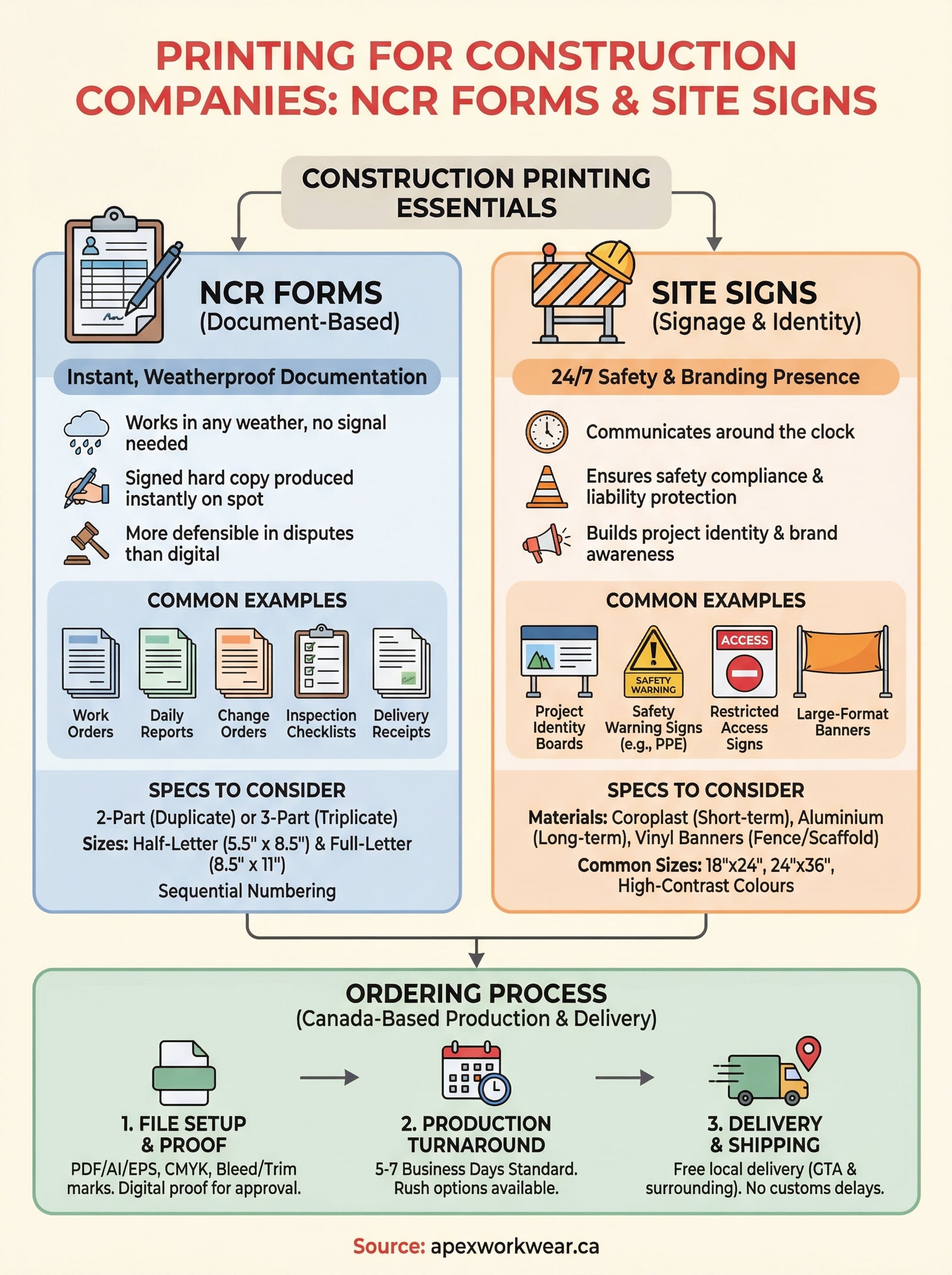
The advantage of NCR forms over digital alternatives on a job site is that they work in any weather, require no signal, and produce a signed hard copy on the spot.
Here is a quick look at common document-based print products for construction:
- NCR work order books (duplicate or triplicate)
- Daily site report forms
- Change order pads
- Inspection checklists
- Delivery receipt books
Site and project signage
Signs serve two distinct functions on a construction site: safety and identity. Safety signage keeps workers and visitors informed of hazards, restricted areas, and required protective equipment. Project identity signs tell the surrounding neighbourhood who is doing the work and how to reach you. Both types need to hold up to outdoor conditions, which means material choice matters as much as the design itself.
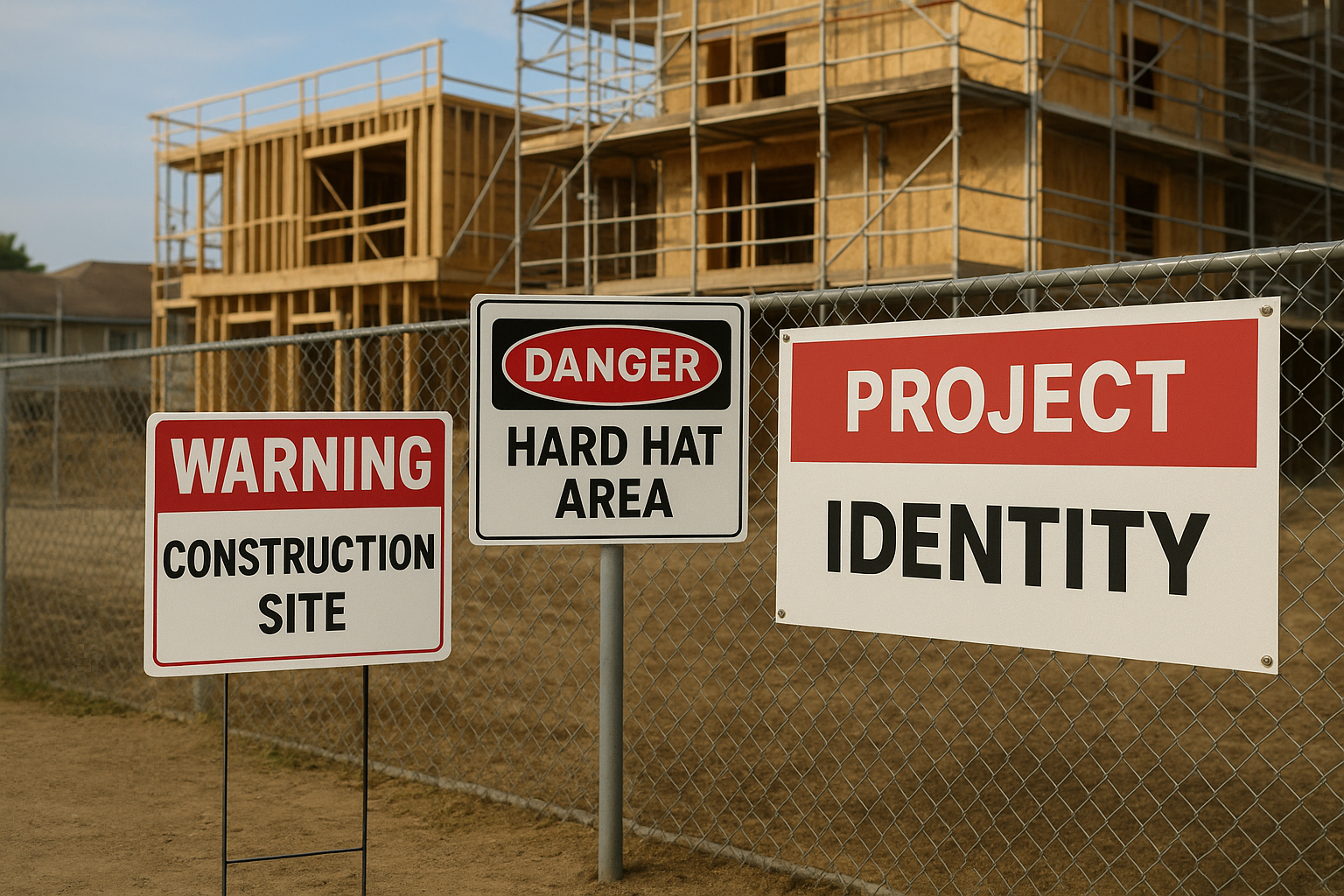
Your signage options typically include coroplast yard signs for short-term installs, aluminium signs for long-term placement, and large-format banners for fencing or scaffolding. Each format serves a different budget and durability requirement, so matching the sign type to its expected lifespan saves you money across a project cycle.
Why NCR forms and site signs still matter
Digital tools have changed how construction projects are managed, but they haven’t replaced the need for physical printed materials on an active job site. Connectivity drops out, devices get damaged, and not every worker or client carries a smartphone. Printed forms and signs fill those gaps reliably, every single time.
The case for paper documentation
NCR forms give your business a signed, dated, hard copy the moment a transaction or inspection happens. There is no syncing, no battery, and no waiting for a PDF to arrive by email. For contractors focused on printing for construction companies (NCR + signs), this immediacy is exactly what keeps disputes from escalating. When a client questions the scope of work or a delivery date, a signed NCR form settles it on the spot.
Paper documentation produced on site is often more defensible in a dispute than a digital record created after the fact.
The case for physical signage
Signs communicate around the clock without any human involvement. A coroplast yard sign on your fence line generates brand awareness while your crew works and long after they leave for the day. Safety signs protect you from liability on site by clearly marking hazards and restricted zones. Both functions deliver real, ongoing value for the cost of a single print run. Common uses include:
- Project identity boards to brand your crew’s presence
- Safety warning signs for hazard zones and PPE requirements
- Restricted access signs for areas off-limits to visitors
How to spec NCR forms for job sites
Specifying NCR forms correctly the first time saves you from reprinting costs and wasted turnaround time. When you order printing for construction companies (NCR + signs), the forms side of the package requires a few clear decisions before any artwork is prepared or sent to print.
Choose your part count
The most common options are duplicate (2-part) and triplicate (3-part) sets. Duplicate works well for straightforward transactions where you keep one copy and hand one to the client. Triplicate suits situations where a third copy goes to a site supervisor, a head office file, or a subcontractor.
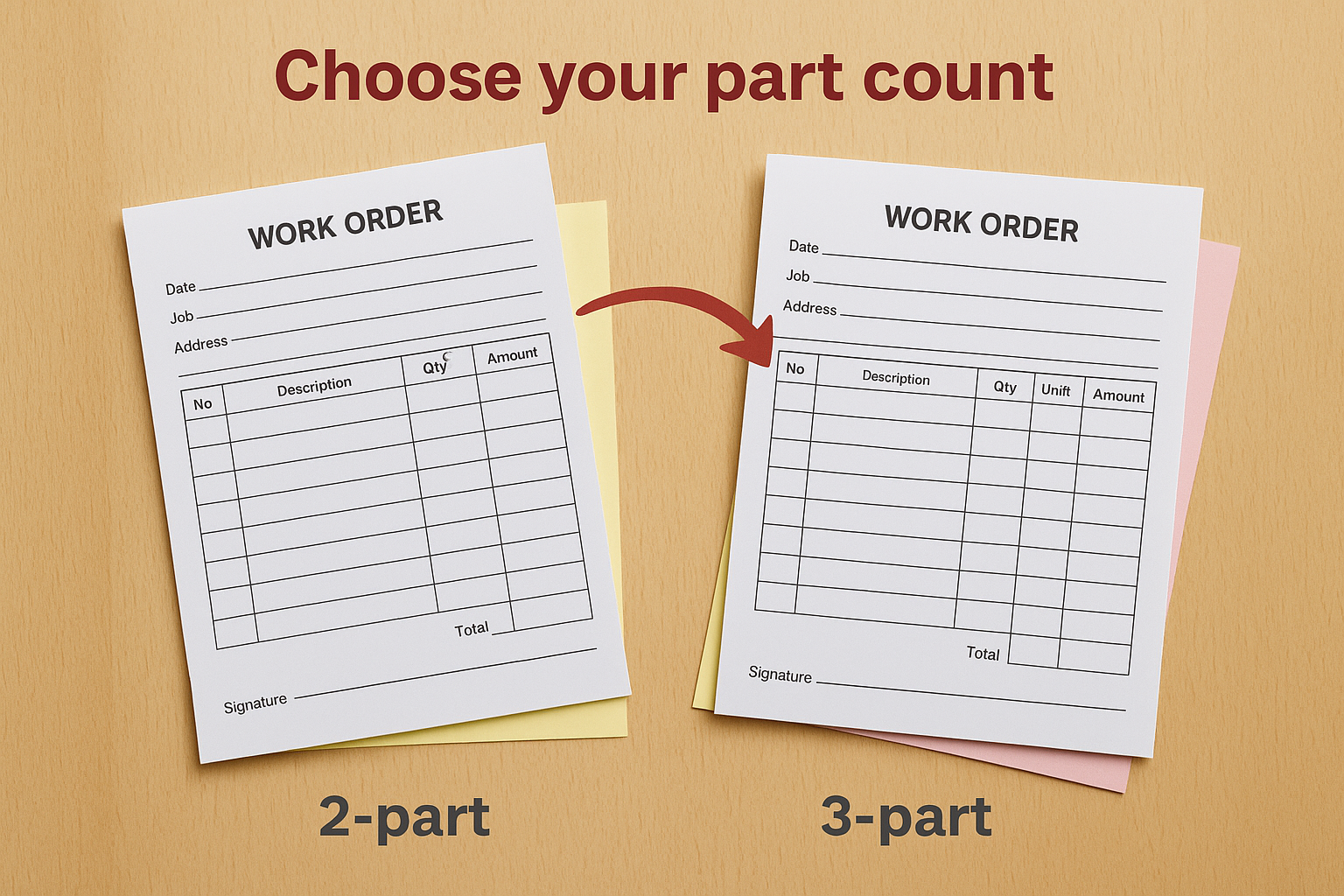
Getting the part count right upfront means every party always has a physical copy without anyone chasing paperwork later.
- 2-part sets: client copy + your file copy
- 3-part sets: client + site supervisor + head office
- 4-part sets: useful for larger projects with multiple stakeholders
Set your size and binding
Standard sizes for construction NCR forms are 5.5" x 8.5" (half-letter) and 8.5" x 11" (full letter). Half-letter books fit easily into a work belt pouch or a truck glovebox, while full-letter forms give you more space for itemised line descriptions, pricing columns, and signature blocks. Binding options include glued pads, stapled booklets, or sequentially numbered sets. Sequential numbering is worth the small added cost because it makes tracking and auditing each completed form straightforward, especially if a form goes missing during a busy project phase.
How to spec construction site signs
Specifying signs for a job site follows the same logic as specifying forms: make the decision before you brief your printer, not during. When you approach printing for construction companies (NCR + signs), the signage side depends on two factors above everything else: how long the sign needs to last and where it will be installed.
Choose your material first
Coroplast (corrugated plastic) suits short-term installations of up to a few months. It is lightweight, easy to stake into the ground, and cost-effective for project-specific identity signs that change between contracts. Aluminium signs handle longer placements and resist wind, rain, and physical contact far better than coroplast. For fence lines or scaffolding, a large-format vinyl banner with grommets lets you cover more surface area at a lower cost per square metre.
Match the sign material to the expected installation period. Overspending on aluminium for a six-week project wastes budget; underspending on coroplast for a permanent safety notice creates a replacement cycle.
Set your dimensions and content
Standard yard sign sizes run from 18" x 24" up to 24" x 36" for most site applications. Safety signs benefit from high-contrast colour combinations (black on yellow, white on red) that meet common site visibility standards. Keep your content focused: company name, contact number, and any required safety language. Cluttered signs lose their impact at a distance.
Ordering, files, and turnaround in Canada
When you order printing for construction companies (NCR + signs) from a Canadian provider, the process runs much smoother when you arrive prepared. Knowing what file formats to submit and what turnaround timelines look like saves you from unexpected delays mid-project.
File formats and artwork setup
Most Canadian print providers accept PDF, AI, or EPS files as the preferred formats for both forms and signage. Set up your artwork at actual print size with a minimum resolution of 300 DPI for form content and 150 DPI for large-format signs. Apex Workwear offers basic design edits and layout adjustments at no extra cost, and sends a digital proof for your approval before anything goes to press. Common file requirements to have ready include:
- Bleed and trim marks on signs (typically 0.125" bleed)
- Outlined fonts to prevent substitution errors
- CMYK colour mode rather than RGB for accurate print output
Submitting a print-ready file at the correct resolution cuts at least one full revision round from your order timeline.
Turnaround times and rush options
Standard production runs 5 to 7 business days for most NCR form and signage orders, with rush options available when your project schedule is tight. Free local delivery covers eligible orders within the GTA and surrounding areas. Canada-based production means your materials ship domestically, so there are no customs delays or cross-border wait times stretching into your build schedule.
Next steps for your construction print kit
Now that you understand how printing for construction companies (NCR + signs) works in practice, the next step is pulling together your specific requirements. Start by listing the documents your crew uses most often on site, then identify the signs your current projects are missing. Both categories feed into a single print order, which keeps your costs lower and your turnaround consolidated.
Once you have your list, gather your artwork or any existing logos in the correct file format. If your files need layout work or basic edits, Apex Workwear handles that at no extra cost before sending you a digital proof for sign-off. You are never printing blind. Ready to put together a kit that works on site? Request a free quote from Apex Workwear and get a response within 24 hours, seven days a week, with Canada-based production and free local delivery across the GTA.