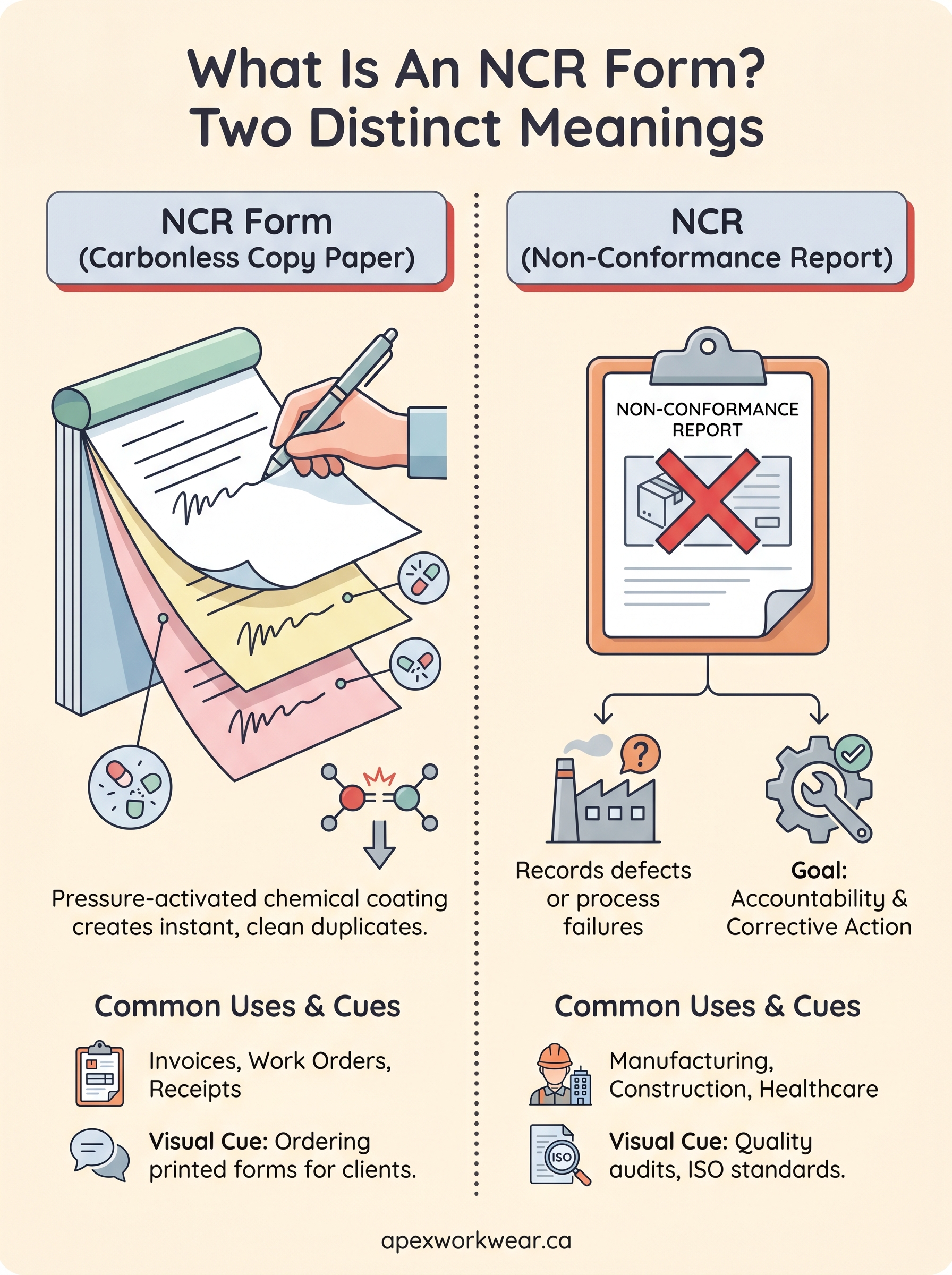
If you’ve ever searched what is an NCR form, you’ve probably run into two very different answers. One refers to carbonless copy paper, the multi-part forms used for invoices, receipts, and work orders that create duplicate copies without carbon sheets. The other refers to a Non-Conformance Report, a quality management document used to flag defects or process failures.
Both meanings show up in the same search results, which makes things confusing, especially when you’re trying to order the right product or build the right process. At Apex Workwear, we print custom NCR forms (the carbonless kind) for small businesses, contractors, and teams across Canada, so we field questions about this mix-up regularly.
This article breaks down both definitions, explains how each type works, and helps you figure out which one actually applies to your situation, so you can move forward with clarity instead of guesswork.
NCR forms for carbonless copy paper
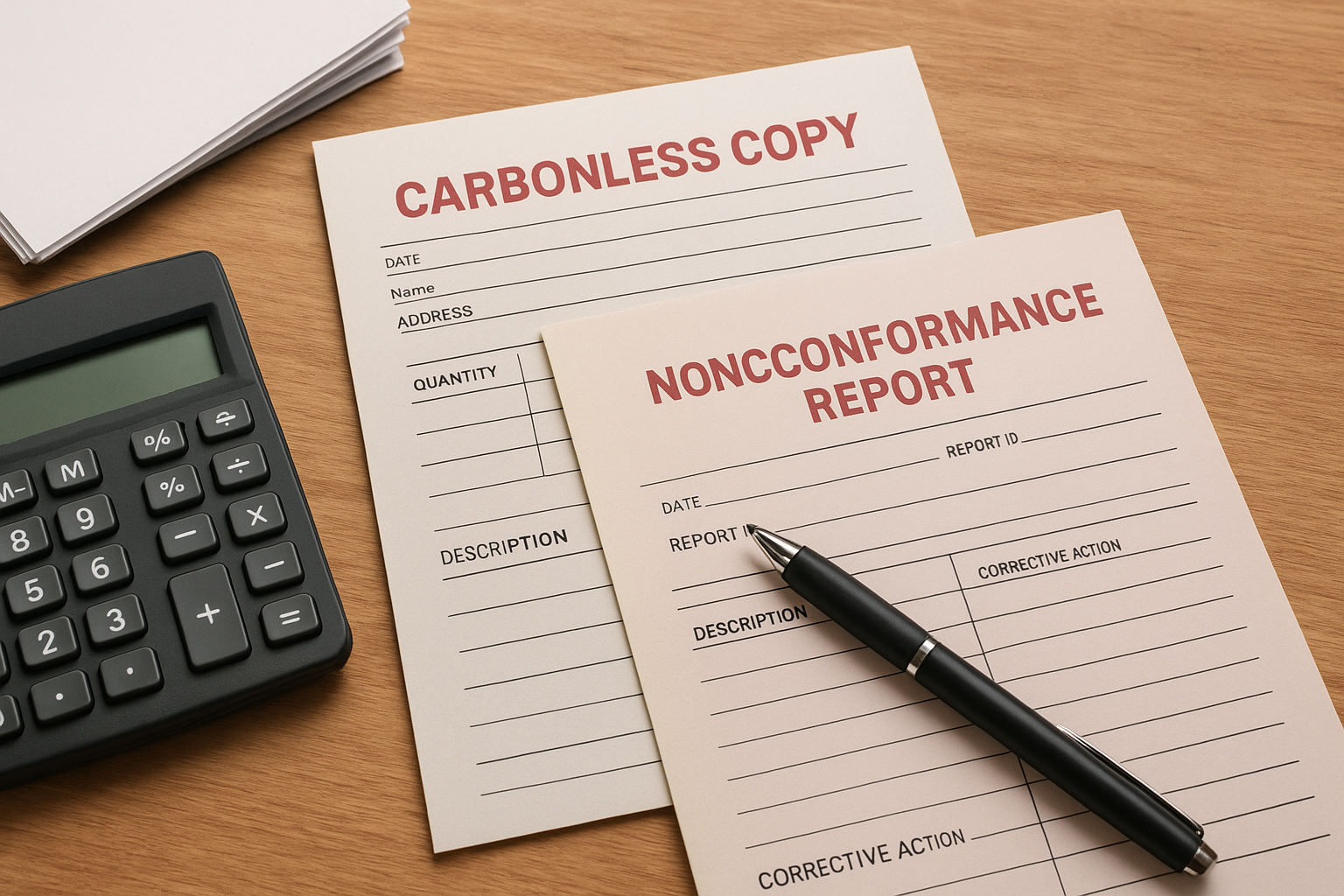
When most small business owners and contractors ask what is an NCR form, this is the meaning they’re after. NCR stands for "No Carbon Required", a term that describes a carbonless paper technology that lets you write or print on one sheet and have that information transfer automatically to every sheet beneath it. There is no messy carbon paper to insert, no extra steps to take, and no risk of losing a copy before you get back to the office to file it. The result is a clean, instant duplicate made right at the point of transaction.
NCR forms let you create multiple copies of a document in a single write-through, which makes them a practical tool for any business that needs a reliable paper trail on the spot.
How carbonless NCR forms create copies
The copying process relies on a chemical reaction built directly into the paper. The underside of each sheet is coated with microcapsules containing a colourless dye, and the surface of the sheet beneath it is coated with a clay-based developer. When you apply pressure with a pen or stylus, those capsules break open and the dye reacts with the developer to produce a visible mark. Every layer records the same information at the same time, without any ink transfer, scanning, or additional equipment on your part.
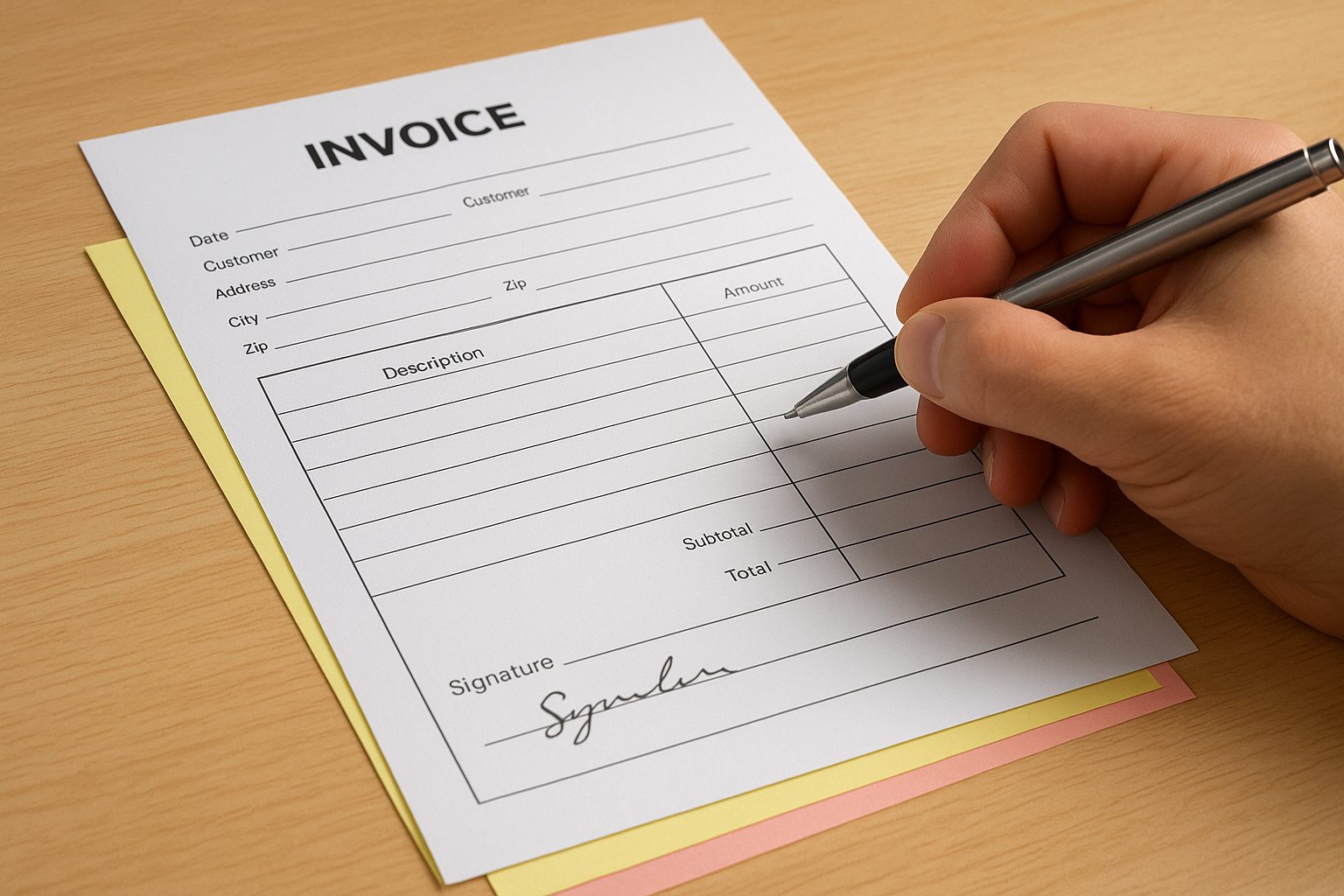
NCR sets come in two-part, three-part, and four-part configurations, with each part typically printed on a different colour of paper so you can tell them apart at a glance. White is usually the top original, yellow is the second copy, and pink is the third.
Common business uses for carbonless forms
You will find NCR forms in use across a wide range of industries. Contractors use them for work orders and job sign-offs. Retailers use them for sales receipts. Delivery companies use them to confirm drop-offs and get client signatures. Common applications include:
- Invoices and receipts for services or product sales
- Work orders for tradespeople and field technicians
- Delivery notes and proof-of-receipt documents
- Rental agreements and equipment sign-out sheets
- Purchase orders for internal procurement tracking
NCR forms for nonconformance reports
The second answer you’ll find when you search what is an NCR form comes from a completely different world: quality management. In this context, NCR stands for "Non-Conformance Report," a formal document that records any instance where a product, process, or service fails to meet a defined standard. If a batch of components does not meet the required specifications, or a step in a workflow gets skipped, someone fills out an NCR to document the deviation and trigger a corrective response. The goal is accountability, not duplication.
A nonconformance report creates an official record of a defect or failure, which means your team can trace what went wrong, when it happened, and how it was resolved.
Where nonconformance reports are used
Non-Conformance Reports are standard practice in industries that operate under strict quality or regulatory frameworks. You will typically find them in sectors such as:
- Manufacturing, where product defects must be tracked and corrected before distribution
- Construction, to document failures against build specifications or safety codes
- Aerospace and defence, where compliance with technical standards is mandatory
- Healthcare, to flag process deviations that could affect patient safety
Unlike carbonless copy forms, these NCRs are not ordered from a commercial print shop. Organisations manage them through quality management software or internal document control systems, often aligned with standards such as ISO 9001. If you are looking to order custom forms for your business, the carbonless copy version is almost certainly what you need.
How to tell which NCR form someone means
The easiest way to figure out which type someone is referring to is to look at the context around the question. If you are a contractor, a small business owner, or anyone asking what is an NCR form because you need to document transactions or hand clients a copy of a job on the spot, you are almost certainly talking about carbonless copy paper. If you work in a regulated industry and someone mentions NCRs alongside audits, quality control, or ISO compliance, they mean a Non-Conformance Report.
The industry or setting someone comes from will almost always tell you which NCR form they need before they finish the sentence.
Signals that point to each type
A few specific cues make it straightforward to identify which definition applies. If the conversation involves ordering printed forms, invoices, or work orders, it is the carbonless copy version. If the discussion involves defect tracking, corrective actions, or quality audits, it is the nonconformance report. Here is a quick reference:
| Signal | NCR type |
|---|---|
| Ordering custom forms for clients | Carbonless copy |
| Documenting a production defect | Nonconformance report |
| Needs duplicate receipts on-site | Carbonless copy |
| References ISO 9001 or internal audits | Nonconformance report |
Most small businesses and contractors will never need the quality management version of an NCR form. If you are shopping for printed business forms, carbonless copy is the one to focus on.
How carbonless NCR forms work
Understanding the mechanics behind carbonless copy paper helps you choose the right format and handle your forms correctly once they arrive. Each sheet in an NCR set plays a specific role, and the system depends on a straightforward chemical reaction triggered the moment pressure hits the top sheet. No ink, no extra equipment, and no additional steps are required on your end.
The quality of every copy you produce depends directly on how firmly and evenly you write or print on the top sheet.
The chemical coating system
Each sheet in an NCR set carries a specific coating on one or both sides, depending on its position in the stack. The top sheet, called the CB sheet, has microcapsules on its underside that contain a colourless dye. The sheet directly below is coated on its face with a clay-based developer, known as the CF sheet. Middle sheets carry both coatings and are referred to as CFB sheets.
| Sheet position | Coating | Label |
|---|---|---|
| Top | Coated back only | CB |
| Middle | Coated front and back | CFB |
| Bottom | Coated front only | CF |
What pressure actually does
When you write or stamp on the top sheet, the applied pressure breaks those microcapsules open and releases the dye onto the developer coating of the sheet below. That reaction produces a readable impression on every layer at the same time, without any transfer of traditional ink.
The bottom copy in a four-part set will always be slightly lighter than the top, so consistent, firm pressure matters most when your forms have multiple parts. Storing your NCR pads flat and away from direct heat also helps keep the coating intact before use.
How to choose the right carbonless NCR form
Once you understand what is an NCR form and how it works, the next decision is picking the right configuration for your situation. The number of parts you need and the workflow you are designing around will shape everything from the paper colours you choose to whether you want a pad or a book format.
Ordering the wrong part count is the most common mistake businesses make, and it either leaves you paying for copies you do not use or short of records when a dispute comes up.
Pick the right number of parts
Each additional sheet in an NCR set creates one more copy for a different person or department. Use this as a starting point to match part count to your actual needs:
- Two-part: one copy for your client, one for your records
- Three-part: adds a copy for a site manager, head office, or supplier
- Four-part: suits complex jobs where multiple departments each need their own record
Match the form to your daily use
Think about where your team fills out these forms and what happens to each copy afterward. If your crew works on job sites, a bound NCR pad is easier to manage than loose sets because the sheets stay flat and together until you pull them apart on-site. If you process high volumes, adding sequential numbering to each form lets you track every transaction without extra admin effort.
Next steps
Now that you know what is an NCR form and how each version works, you can move forward with the right tool for your situation. Carbonless copy forms are a simple, reliable way to keep your business documented at every transaction, and choosing the correct part count before you order saves you time and money down the line.
The next practical step is to think through your workflow: how many people need a copy of each form, where those copies go after the job is done, and whether a pad or book format suits your team’s daily habits.
If you are ready to order custom carbonless forms, Apex Workwear prints two-part, three-part, and four-part NCR sets with no minimum order requirements and fast turnaround across Canada. Get a free quote on custom NCR forms and have your order reviewed by an expert within 24 hours.