Standard rectangular business cards do the job, but they rarely make someone pause and take a second look. Die cut business cards change that, they use custom shapes, rounded edges, or cutout details to create something that feels different the moment it hits someone’s hand. Instead of blending into a stack on a desk, they stand out, spark a conversation, and stick in memory longer.
The idea is straightforward: a steel die (essentially a custom blade) cuts each card into a shape you choose, whether that’s a subtle rounded corner or a full silhouette of your logo. But getting the design, finish, and file setup right takes some planning. Poor choices at the design stage lead to wasted material, higher costs, or cards that look clever but don’t hold up in a wallet or card holder.
This guide breaks down everything you need to know, from the most popular die cut shapes and finishing options to practical design tips that keep your cards both striking and functional. And when you’re ready to move forward, Apex Workwear offers custom business card printing right here in Canada, with expert design review, digital proofs before production, and no minimum order requirements on select products. Whether you need 50 cards or 5,000, we make the process simple.
Why die cut business cards stand out
When you hand someone a card, you have about three seconds before they decide whether to keep it or forget it. Most rectangular cards get filed away without a second thought, while an unusual shape prompts someone to actually look at what you’ve given them. That initial reaction is not a nice bonus; it is the entire point of a business card in a competitive environment where nearly everyone shows up with the same 3.5 x 2 inch rectangle.
The first impression problem
Business cards are a physical introduction to your brand, and the shape of that card communicates something before the person reads a single word. A standard rectangle says nothing beyond "I have a card." A custom shape tied to your trade, logo, or brand identity tells someone you invested real thought into how you present yourself. That difference registers immediately and subconsciously, which is exactly what you want when someone is meeting dozens of vendors, contractors, or suppliers in a single day.
The problem with standard cards is not quality; it is sameness. You can print a beautifully designed rectangular card on premium stock, and it will still look nearly identical to the one sitting next to it in a cardholder. Die cut business cards solve the sameness problem by giving your card a physical identity that no amount of font choice or colour palette alone can achieve.
Shape is the one design element that works before the card is even fully visible, which means die cuts earn attention before your name does.
What makes shape so effective
There is a reason product packaging designers obsess over form: humans process shape faster than text. When your card is circular, leaf-shaped, or cut into the silhouette of a tool you use every day, the brain categorises it differently from a flat rectangle. Different things get remembered, and that distinction matters weeks after the initial meeting when someone is sorting through a stack and trying to recall who gave them what.
Recognition and recall are closely linked to distinctiveness, and a shaped card gives someone a concrete anchor to associate with your name and business. Three weeks after a trade show or networking event, yours is the one that catches their eye because it physically looks different from everything else in the pile.
Industries that benefit most
Die cut cards are not exclusively for creative industries, though designers, photographers, and agencies were among the first to adopt them widely. Any business where trust, professionalism, and memorable first impressions drive sales can benefit from the format. The key is matching the shape to something relevant, whether that is your logo, your service, or a product you sell.
Here are industries where custom shapes consistently deliver results:
- Contractors and tradespeople: House-shaped or tool-shaped cards reinforce what you do before anyone reads a word
- Food and hospitality: Fork, cup, or ingredient-shaped cards align with the business instantly
- Real estate agents: Key or door-shaped cards are subtle and on-brand without feeling gimmicky
- Fitness and wellness: Bold rounded or geometric shapes signal energy and a modern outlook
- Creative agencies and designers: Any shape works here; the card itself becomes a portfolio piece
The common thread across all of these is relevance. A shaped card that connects directly to your work reads as clever and intentional. One that uses shape purely for novelty, without any connection to the brand, can feel random. The goal is always to align the shape with what you actually do so the card reinforces your identity rather than distracting from it.
How die cutting works and what to expect
The process starts with a steel rule die, which is essentially a custom blade formed into the exact shape your card will take. A press forces that blade through a sheet of printed card stock, cutting every card to the same precise outline in a single pass. The result is clean, consistent edges across the entire order, whether you are printing 50 cards or 5,000.
The cutting process explained
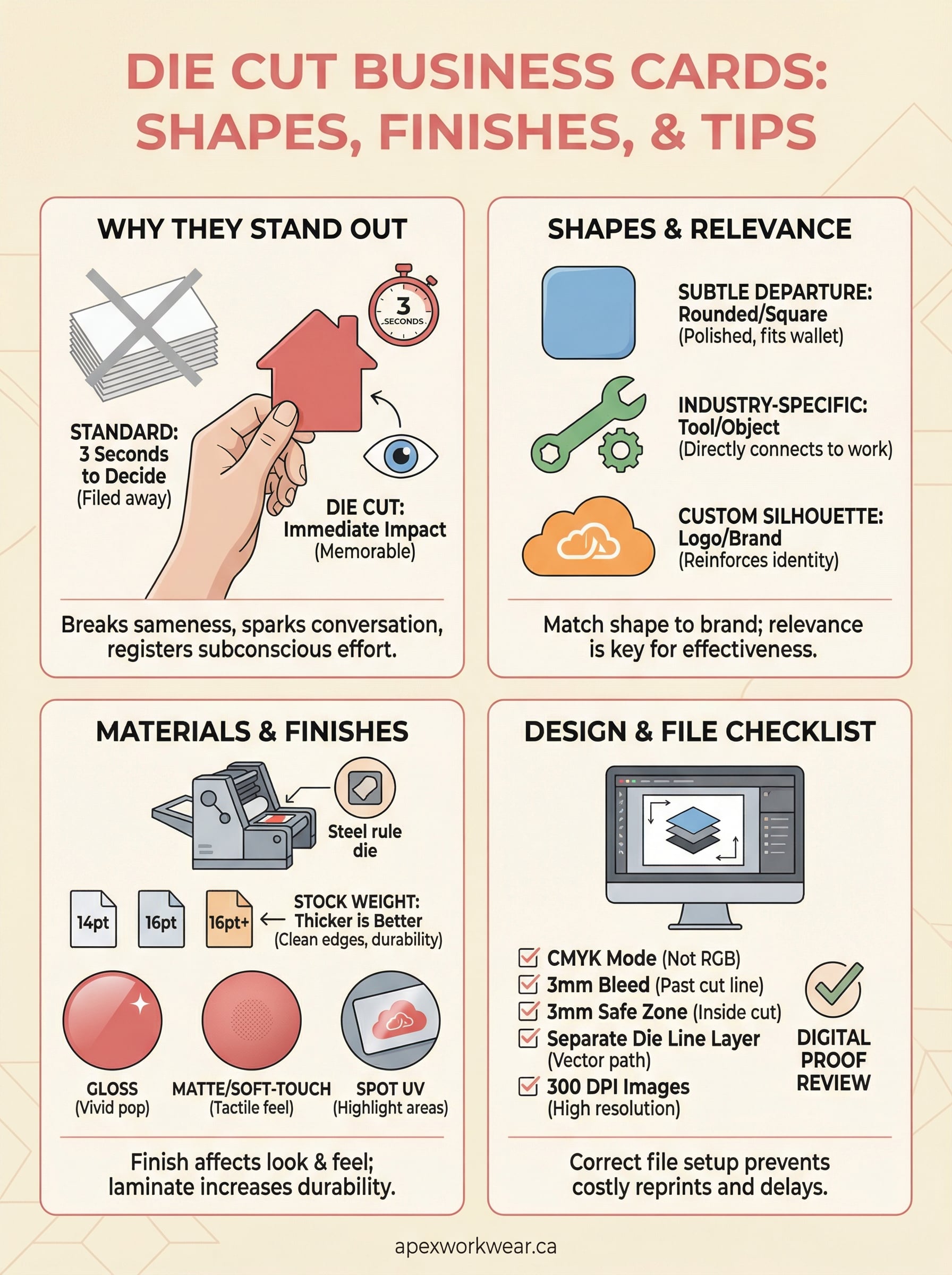
Before any cutting happens, your printer needs a finished print file and a separate die line, which is a vector path that tells the machine exactly where to cut. Most printers supply a template you open in design software, and you place your artwork on one layer with the cut path on another. Die cut business cards that skip this step often come back with cropped text or artwork sitting too close to the edge, so keeping at least 3mm of clearance between your design elements and the cut line is a firm rule, not a suggestion.
Getting your bleed and die line set up correctly in the file saves you from a reprint and keeps your timeline intact.
The press applies significant pressure during the cut, which means paper stock choice directly affects edge quality. Thicker, denser stocks such as 16pt or 18pt coated card hold a clean edge far better than thin stocks, which can feather or compress along the cut path. Ask your printer what stock weights they recommend for the specific shape you want, because tight curves and sharp angles behave differently than a simple rounded corner.
What to expect during production
Production time for die cut cards runs slightly longer than standard cards because the die setup adds a step before printing begins. At Apex Workwear, most orders ship within 5 to 7 business days, and you receive a digital proof before anything goes to press, so you can confirm the cut line sits exactly where you want it. Rush options are available if your timeline is tight.
Costs scale with complexity, meaning a simple rounded corner card is cheaper to produce than a fully custom silhouette shape. Always ask for a quote that separates the print cost from any die setup fee upfront, so there are no surprises when your invoice arrives.
Popular shapes and when to use them
Not every die cut card needs to be a dramatic custom silhouette. Choosing the right shape is about matching the format to your brand, your industry, and your practical needs. Some shapes work quietly and professionally, while others make a bold statement the moment someone picks up the card.
Subtle departures: rounded corners and squares
Rounded corners are the most accessible starting point for anyone moving away from a standard rectangle. A 3mm to 6mm corner radius is enough to differentiate your card while still fitting neatly into a wallet or cardholder. The result looks polished and intentional without requiring someone to rethink how they store it.
Square cards take things one step further. They are bold and symmetrical, photograph cleanly, and work especially well for photographers, designers, or any brand built around a strong visual identity. The format feels balanced and deliberate, and because it is still a simple geometric shape, production costs stay close to standard die cut pricing.
Custom silhouettes and logo shapes
This is where die cut business cards genuinely separate themselves from everything else in a pile. A custom silhouette ties your card directly to your trade: a house shape for a real estate agent, a wrench outline for a plumber, a coffee cup for a café owner. The shape communicates your work before the reader even finds your name.
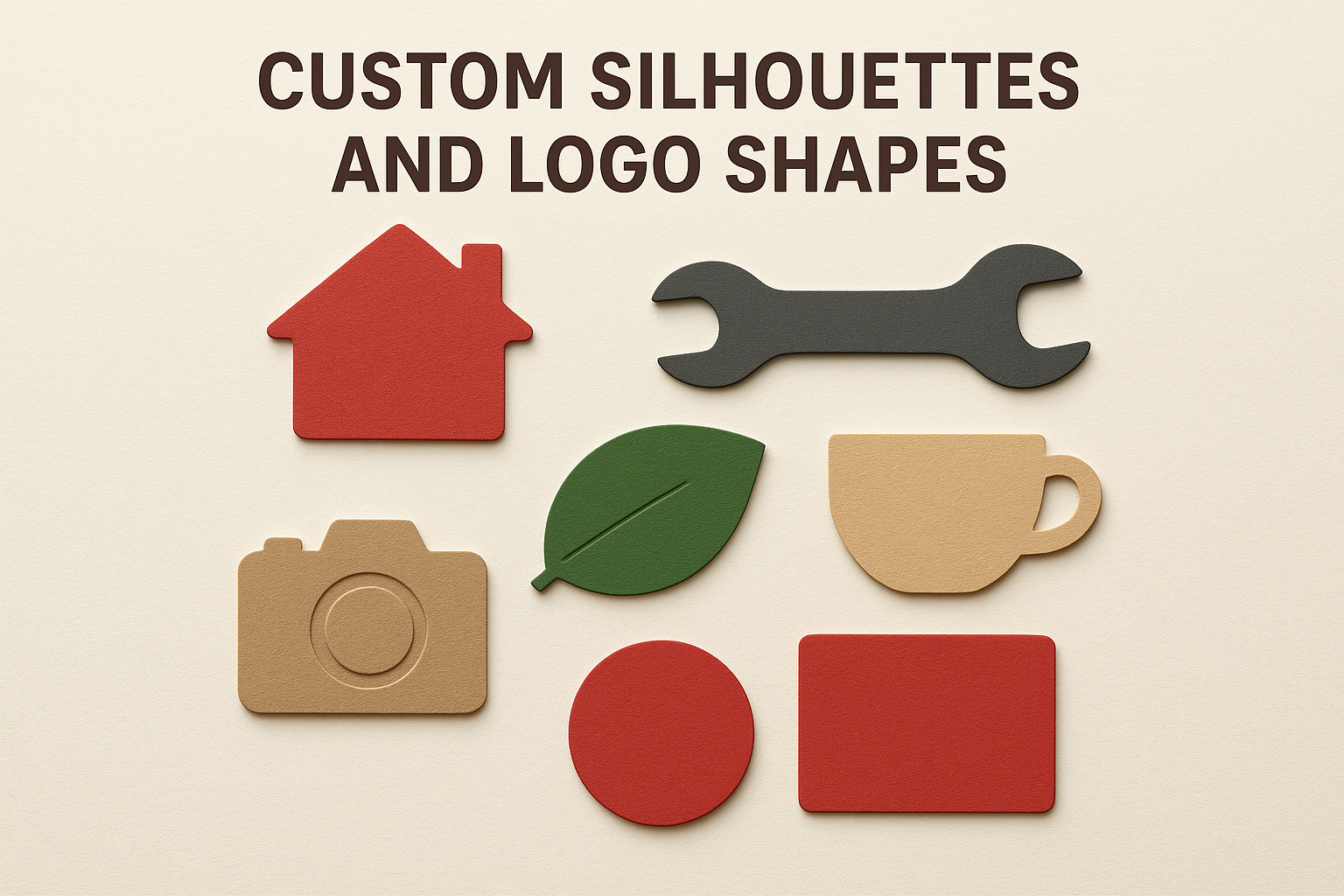
Here are common custom shapes and the industries they suit:
| Shape | Works well for |
|---|---|
| House or key | Real estate, property management |
| Tool or wrench | Contractors, tradespeople |
| Leaf or circle | Wellness, nutrition, eco-focused brands |
| Camera or lens | Photographers, videographers |
| Fork or cup | Food, hospitality, catering |
| Logo silhouette | Any brand with a clean, simple mark |
The most effective custom shapes connect directly to the business, so the card reinforces identity rather than simply looking unusual.
The main rule with silhouettes is simplicity: tight curves, sharp points, and intricate cutouts add cost and can weaken the card along stress points. Stick to shapes with clean, continuous outlines and avoid anything with narrow tabs or bridging sections that might snap under normal handling.
Finishes, paper stocks, and durability
The finish and stock you choose affect how your card feels, how long it lasts, and how well the print holds up over time. Getting these decisions right matters even more with die cut business cards because the card’s shape already draws attention, so the tactile experience needs to match the visual one. A poorly finished card on thin stock undercuts the impression a great shape creates.
Choosing the right paper stock
Stock weight is the single most important variable for durability on a shaped card. Thicker card holds clean cut edges, resists bending, and survives a few months in a wallet without looking worn. The most common weights for custom shaped cards are:
| Stock weight | Best for |
|---|---|
| 14pt | Budget-conscious orders, simpler shapes |
| 16pt | Most standard die cut work, good durability |
| 18pt | Premium feel, handles tight curves cleanly |
| 32pt ultra-thick | Maximum impact, luxury presentation |
Anything below 14pt tends to feather or compress along cut edges, especially on complex silhouettes or tight curves. If your budget allows, 16pt is the minimum worth ordering for a card you plan to hand out regularly.
Surface finishes and what they do
Your finish choice changes both the look and the feel of the card in someone’s hand. Gloss lamination gives colours a sharp, vivid pop and provides a moisture-resistant layer that holds up well over time. Matte lamination does the opposite; it creates a soft, flat surface that feels more tactile and tends to read as high-end or understated, depending on your brand.

Soft-touch matte lamination consistently gets the strongest reaction during in-person handoffs because the texture alone prompts comment before the person reads anything on the card.
Spot UV is another strong option for die cut work. It applies a glossy coating to selected areas only, so you can highlight a logo or name while keeping the rest of the card in matte. The contrast between the two surfaces draws the eye exactly where you want it.
Keeping cards functional over time
Laminated cards hold up significantly better than uncoated ones in daily use. An uncoated stock absorbs oils from fingertips, picks up scuffs, and softens at the corners within weeks. A laminate layer adds a physical barrier that keeps the print crisp and the edges firm through repeated handling, which is exactly what you want from a card designed to be remembered.
Design tips and print file checklist
Good design and a correctly prepared file are what separate a die cut business card order that arrives perfectly from one that needs reprinting at your cost. Before you send anything to production, you need to understand how artwork interacts with a cut path, because the rules that apply to rectangular cards are not strict enough for shaped ones.
Setting up your artwork
Your die line is a separate vector path that sits on its own layer in your design file, and it must align precisely with your artwork before you export anything. Keep all text and critical brand elements at least 3mm inside the cut line, not at the edge of it. With die cut business cards, the cut itself becomes part of the design, so anything that bleeds to the edge needs to extend fully past the cut path, typically by 3mm, to avoid white borders appearing on the finished card.
Treating the die line as an afterthought rather than a core part of your layout is the single most common cause of reprints on shaped card orders.
Colour mode matters as much as placement. Set your file to CMYK before you design, not after, because converting from RGB at the export stage shifts colours in ways that are difficult to predict, especially with deep blacks and saturated brand colours. If your brand uses specific Pantone references, confirm with your printer whether they can match them within the print method they use.
Print file checklist
Running through a checklist before you submit takes five minutes and prevents delays that can cost you days. Use the points below to confirm your file is production-ready:
- File format: Export as a print-ready PDF with all fonts embedded and images at 300 DPI minimum
- Colour mode: Set to CMYK, not RGB
- Bleed: Extend background artwork 3mm past the cut line on all sides
- Safe zone: Keep all text and logos at least 3mm inside the cut line
- Die line layer: Place the cut path on its own clearly labelled layer, set to a spot colour such as "Die Cut"
- Image resolution: All placed images at 300 DPI or higher at final print size
- Proof review: Confirm the digital proof before approving production
Submitting a file that meets all these points means your printer can move straight to production without back-and-forth, which keeps your turnaround on schedule.
Next steps
You now have everything you need to move forward with confidence. Die cut business cards work when the shape connects to your brand, the stock and finish match the impression you want to leave, and the print file is set up correctly before it goes anywhere near a press. Every decision you make at the design stage directly affects what lands in someone’s hand weeks later, so taking the time to get it right from the start is always worth it.
When you’re ready to place an order, Apex Workwear handles the entire process from design review through to production and delivery, right here in Canada. You get a digital proof before anything prints, expert guidance on file setup, and no minimum order requirements on select products. Whether you need a small first run or a bulk order, the process is straightforward. Get a custom business card quote from Apex Workwear and have your design in hand within days.