
You’ve decided to get business cards printed, smart move. But now comes the question everyone gets stuck on: how many business cards should I order? Too few and you’re constantly reordering. Too many and you’re sitting on a box of cards with outdated info gathering dust in a drawer. Either way, you’re wasting money.
The right number depends on a handful of real factors: what you do for a living, how often you network, whether your business details are likely to change soon, and how you actually use your cards. A freelance photographer and a real estate agent won’t burn through cards at the same rate, and your order quantity should reflect that.
This guide breaks it all down. We’ll walk you through how to estimate your ideal order size, avoid common over-ordering mistakes, and make sure every card you print actually ends up in someone’s hand. At Apex Workwear, we print business cards right here in Canada with no minimum order requirements, so whether you need 50 cards or 5,000, you’ll get exactly what makes sense for your situation.
The factors that decide your card quantity
Before you can figure out how many business cards you should order, you need to look at what actually drives card consumption. Most people pick a number at random, go with 250 or 500, and either run out within a month or still have half the box two years later with outdated information on them. Four key variables shape the right quantity for your situation, and getting clear on each one will save you money and prevent you from making an order you immediately regret.

How often you network
Your networking frequency is the single biggest driver of card volume. If you attend trade shows, industry events, client meetings, or community gatherings several times a month, you’ll burn through cards fast. A real estate agent who meets 15 new prospects every week needs a very different supply than a freelance copywriter who attends one or two conferences a year and does the rest of their outreach online.
If you hand out more than five cards a week on average, set your baseline at 500 cards per year minimum and scale up from there.
Think honestly about both your current schedule and your planned activity over the next six months. If you’re ramping up sales efforts, launching a new service, or signing up for exhibition booths in the coming season, factor that growth in now. Reordering in a panic two weeks before a big event is never ideal.
Whether your details are likely to change soon
Ordering 1,000 cards sounds like a solid deal until you move offices, change your phone number, or rebrand three months later. Before committing to a large print run, audit your contact information for stability. Go through your email address, phone number, website URL, job title, and business name, and ask yourself honestly how likely each one is to change within the next 12 months.
If you’re a new business or a freelancer still refining your positioning, keep your first order smaller. A conservative run gives you room to update your details, tweak your design, or adjust your title without throwing away a full box. Once your information has stayed consistent for at least six months, a larger order makes much more financial sense.
Your business stage and budget
Where your business sits right now makes a real difference. A startup or sole trader in the first year often benefits from ordering 250 to 500 cards, watching how quickly they move, and then scaling up on the next order with confidence. An established company with a steady client-acquisition process can commit to 1,000 or 2,500 cards without hesitation.
Budget matters too, though not quite in the way most people expect. Unit costs drop noticeably with larger print runs, so the cost-per-card on 250 cards will be significantly higher than on 1,000. That said, ordering far more than you’ll use in 12 to 18 months rarely pays off. The goal is to balance the per-unit savings against the risk of ending up with a large stack of cards you can no longer use.
How you distribute your cards
Not every card leaves your hand in a face-to-face conversation. Many people leave cards at reception desks, slip them into product packaging, include them with invoices, or drop a stack at local partner businesses. Each of these passive channels adds to your total card usage in ways that are easy to overlook when you’re placing your order.
Take five minutes to list every place you currently leave or send cards outside of direct meetings. If you drop ten cards at three different locations every month, that adds 360 cards per year before you’ve shaken a single hand. Passive distribution quietly multiplies your usage, so build it into your estimate from the start rather than discovering the gap after you’ve already run out.
Step 1. Work out your annual card usage
The most reliable way to figure out how many business cards you should order is to start with a number grounded in actual behaviour, not a guess. Most people skip this step entirely and just pick 250 or 500 because it sounds reasonable. Working from a real usage estimate means your order will match your actual needs rather than leaving you scrambling to reorder mid-conference or drowning in surplus stock.
Count your weekly handoffs
Start by thinking about your average week. How many people do you hand a card to directly in meetings, on job sites, at events, or in passing conversations? Be honest and realistic rather than optimistic. If you typically meet three new prospects a week, your direct handoffs sit at around three cards.
Write that number down. Then multiply it by 50 (a reasonable working-year figure that accounts for holidays and slower periods). A freelancer handing out three cards a week ends up at 150 direct cards per year. A contractor meeting ten new clients a week lands at 500.
Add your passive distribution
Passive channels are easy to overlook but they add up quickly. Think about every location where you leave a stack of cards without a direct handshake: reception desks, retail counters, supplier trays, envelopes with invoices, or product packaging. Count those locations and estimate how many cards leave each spot per month.
If you place cards at even three passive locations and refresh each one monthly with just five cards, that adds 180 cards to your annual total without a single in-person meeting.
Multiply your monthly passive total by 12 and add it to your direct handoff number. That combined figure becomes your baseline annual usage estimate.
Use a quick calculation template
Run through this formula before placing any order:
| Input | Your number |
|---|---|
| Cards handed out per week (direct) | ___ |
| Multiplied by 50 working weeks | ___ |
| Cards left at passive locations per month | ___ |
| Multiplied by 12 months | ___ |
| Total estimated annual usage | ___ |
Once you have that total, add a 15 to 20 percent buffer to account for events you haven’t booked yet, unexpected networking opportunities, or cards damaged in transit. That final number is your informed starting point before you look at quantity ranges.
Step 2. Pick a quantity using common ranges
Once you have your annual usage estimate from Step 1, you can match it against standard print quantities to land on a number with confidence. Most printers offer cards in set increments, typically 250, 500, 1,000, 2,500, and 5,000. Knowing where each range is designed to land stops you from defaulting to whatever sounds cheapest and helps you order exactly what you need.

250 to 500 cards: starting out and moderate networking
A run of 250 cards suits anyone whose annual estimate sits below 300, including freelancers, part-time business owners, and people launching a new venture who aren’t yet certain their details will stay consistent for 12 months. At this range, you get professional cards without locking into a large volume you might not fully use.
If your contact information or job title might change within the year, treat 250 cards as a deliberate pilot run rather than a compromise.
Move up to 500 when your estimate sits between 300 and 450. This quantity covers a full year of moderate networking with a buffer for passive distribution, and it keeps the per-unit cost reasonable. For most small business owners and contractors, 500 is the most practical starting point before they have a clear picture of how quickly they burn through cards.
1,000 cards and above: active networkers and established businesses
When your estimate lands between 500 and 800 cards per year, 1,000 is the logical next step. The cost-per-card drops noticeably at this quantity, and you remove the risk of scrambling for a reorder in the middle of a busy season. This range suits real estate agents, sales professionals, and event-heavy service providers who move through cards quickly and distribute consistently.
For annual estimates above 800 cards, 2,500 or 5,000 card runs start to make financial sense. At that volume, the per-unit savings are substantial, and the investment pays off provided your business details remain stable.
Matching your estimate to a print run
Use this reference table to move from your Step 1 calculation directly to a recommended order quantity:
| Annual usage estimate | Recommended quantity |
|---|---|
| Under 300 cards | 250 |
| 300 to 450 cards | 500 |
| 450 to 800 cards | 1,000 |
| 800 to 2,000 cards | 2,500 |
| Over 2,000 cards | 5,000+ |
This table is the fastest way to answer how many business cards should I order once you have a real usage number in hand. Pick the row that matches your annual figure, apply your 15 to 20 percent buffer from Step 1, and you have a print quantity ready to submit.
Step 3. Decide if you should buy in bulk
Once you’ve matched your annual estimate to a print quantity, the next question is whether ordering a larger run makes financial sense for your situation. Bulk pricing can cut your per-unit cost significantly, but only when your circumstances support it. Buying more than you’ll use in 18 months is one of the most common ways people waste money on printed materials.
When bulk buying saves you real money
Bulk orders pay off when three conditions align: your contact details are stable, your annual usage is consistent, and the per-unit savings over 12 to 18 months outweigh the extra upfront cost. If you’re attending multiple trade shows, expanding your sales team, or ramping up client outreach, locking in a larger print run at a lower cost-per-card is a straightforward win.
If your details haven’t changed in over six months and your networking schedule is steady, moving up one quantity tier almost always makes financial sense.
Use this comparison template with your printer’s actual quotes to see where the numbers genuinely work in your favour:
| Quantity | Estimated cost | Cost per card | Cards used in 18 months | Leftover |
|---|---|---|---|---|
| 500 | $45 | $0.09 | 500 | 0 |
| 1,000 | $65 | $0.065 | 750 | 250 |
| 2,500 | $110 | $0.044 | 750 | 1,750 |
The table makes clear that bulk savings disappear fast when your actual usage doesn’t match the volume you ordered. Plug in your real usage estimate from Step 1 before committing to a larger run, and the right choice usually becomes obvious.
When bulk buying works against you
Bulk orders become a liability when your details are uncertain or your usage is low. If you’re in your first year of business, considering a rebrand, or likely to change your phone number or address soon, ordering 2,500 cards to save a few cents per unit is a poor trade. Ordering 250 to 500 cards twice will cost less overall, even at a higher per-unit price, if any of those details shift mid-year.
The question of how many business cards should I order always comes back to real usage, not theoretical savings. A smaller, accurate order beats a large run with hundreds of cards you eventually recycle. Tie your bulk decision to what you’ll actually hand out, not what looks like the best deal at checkout.
Step 4. Set a reorder and update plan
Ordering the right quantity is only half the job. Running out of cards mid-conference or handing out a card with an old phone number both cost you credibility, and both are easy to avoid with a simple system. Setting a reorder trigger and a regular review schedule means you stay stocked and current without thinking about it every time you reach into your wallet. This is also what separates businesses that always look prepared from those that scramble for a pen to write their number on a receipt.
Set a reorder trigger
Don’t wait until your card holder is empty before placing your next order. Instead, pick a stock level that signals it’s time to reorder, typically 20 to 25 percent of your original quantity. If you ordered 500 cards, your trigger sits at around 100 to 125 cards remaining. When you hit that number, place your next order immediately so the new batch arrives before you exhaust your supply.
Wrap a rubber band around your remaining stack at your trigger point so you notice it without counting cards every time you reach for one.
Most Canadian printers turn around standard business card orders within five to seven business days. Factor that lead time into your trigger calculation so you’re never card-free during a busy period, and consider a slightly earlier trigger if you order around a holiday window when production schedules can shift.
Schedule an annual information audit
Your reorder trigger handles volume, but it won’t catch outdated contact details before they reach someone’s hands. Once a year, block 15 minutes to check every piece of information on your current card against your actual details. Run through this checklist before approving your next print run:
- Email address
- Phone number
- Website URL
- Physical address or service area
- Job title or business name
- Social media handle (if included)
Update any field that has changed and flag any that might shift in the next 12 months. If two or more items look uncertain, place a smaller order and revisit the full run once your details stabilise. Reprinting 500 cards because your URL changed is a manageable cost. Discarding 2,500 cards with incorrect information is not.
Pairing a stock trigger with an annual audit answers the question of how many business cards should I order on an ongoing basis, not just at the point of your first print run. You’ll always have accurate cards in the right quantity, ready to hand out with confidence.
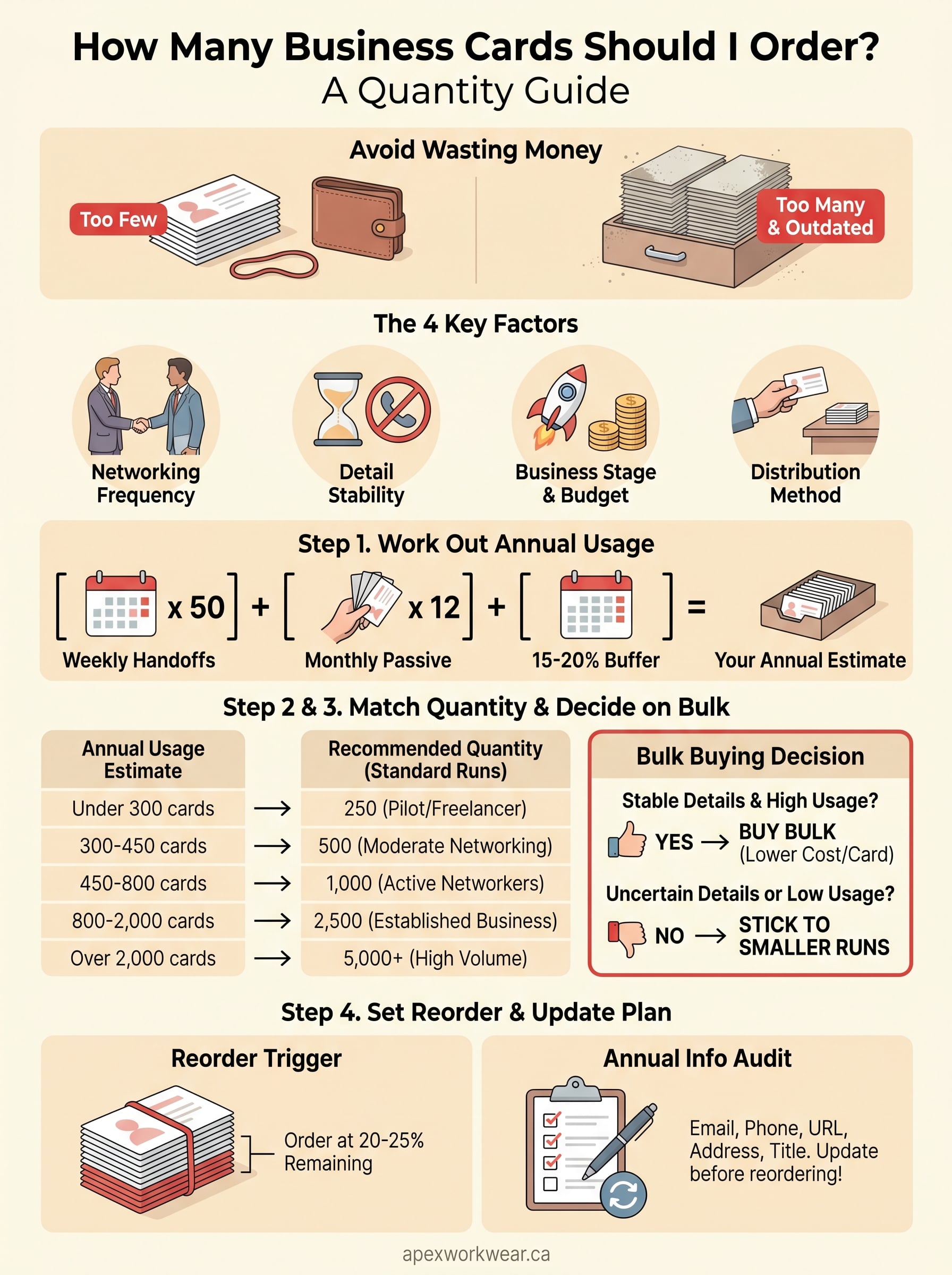
A simple way to decide today
The answer to how many business cards should I order comes down to four inputs: your networking frequency, the stability of your contact details, your business stage, and where your cards actually end up. Work out your annual usage estimate, match it to a standard print quantity, check whether bulk pricing genuinely applies, and set a reorder trigger so you never run out at the wrong moment.
Start with the quantity that covers your real annual usage, not the largest run that looks like a bargain. A 500-card order you fully use beats a 2,500-card order you end up recycling two years later with an old address printed on every one. Once your details are stable and your usage is consistent, scaling up is straightforward.
Ready to print? Order custom business cards at Apex Workwear with no minimum order requirement, production done right here in Canada, and free local shipping across the GTA.