Choosing between vinyl stickers vs paper stickers might seem like a small decision, but it has a real impact on how your brand looks, and how long it lasts. Pick the wrong material, and you could end up with labels that peel, fade, or fall apart weeks after you apply them. Pick the right one, and your stickers do exactly what they’re supposed to: represent your business professionally, wherever they end up.
The core difference comes down to durability, cost, and where you plan to use them. Vinyl holds up against rain, sunlight, and daily wear, making it a go-to for outdoor applications. Paper stickers cost less and work well for indoor use, like product labels and packaging inserts. But those are just the broad strokes, the details matter when you’re spending money on something that carries your brand name.
At Apex Workwear, we print both vinyl and paper stickers right here in Canada, with no minimum order requirements and free shipping across the GTA. We’ve helped small businesses, contractors, and event coordinators figure out exactly which sticker material fits their project and budget. This guide breaks down the real differences between vinyl and paper stickers, covering durability, cost, finish options, and best-use scenarios, so you can make a confident choice before placing your order.
Why sticker material matters for your project
Most people focus on the design when ordering stickers, which makes sense. But the material you print on determines whether that design survives a week or lasts for years. Sticker material affects adhesion, water resistance, colour vibrancy, and physical durability, so getting it wrong means spending money twice on something that should have worked the first time.
Surface type and application environment
The surface where you apply a sticker plays a huge role in which material works. Smooth, clean surfaces like glass, metal, or finished plastic hold both vinyl and paper stickers reasonably well indoors. But rough, textured, or outdoor surfaces are a different story. Vinyl stickers use a more flexible backing and a stronger adhesive that conforms to slight curves and uneven textures, while paper stickers are rigid and tend to lift at the edges when applied to anything that isn’t flat and dry.
If your stickers are going on water bottles, vehicle panels, tools, or outdoor signage, the surface alone is enough reason to choose vinyl over paper.
Think about where your sticker ends up once it leaves your hands. A product label on a jar that sits on a bathroom shelf gets splashed with water regularly. A sticker on a hard hat sits through sun, sweat, and rain. These environments demand a material with physical resilience built in, and paper simply isn’t designed for that kind of exposure.
Longevity expectations
Your budget and project timeline should both factor into your material choice. Paper stickers cost less to produce, and if you’re using them for short-term purposes, like an event, a seasonal promotion, or inside packaging, that lower cost makes complete sense. You don’t need a five-year sticker for a product that ships once.
Vinyl stickers are built to last considerably longer. Most quality vinyl stickers handle three to five years outdoors without significant fading or peeling, which matters when you’re putting your logo on equipment, vehicles, or storefronts. In the vinyl stickers vs paper stickers comparison, longevity is often the deciding factor for businesses that need consistent, professional branding in demanding conditions.
Finish and print quality
Finish options differ between the two materials in ways that affect how your brand looks in practice. Vinyl is available in gloss, matte, and clear varieties, and colours tend to appear more vivid and saturated because of how the material holds ink. Paper stickers come in gloss or matte as well, but the surface is more prone to scratching and moisture damage over time, which dulls the finish faster than most people expect.
If your stickers serve a visual marketing purpose, where someone is supposed to look at them and immediately connect with your brand, the print quality on vinyl gives you a sharper, more durable result. Paper works well for text-heavy labels or simple logos where longevity isn’t a priority and cost needs to stay low.
Vinyl stickers explained
Vinyl stickers are printed on a synthetic plastic film made from polyvinyl chloride (PVC), which gives them a flexible, waterproof base that paper simply cannot match. The material is designed to handle physical stress, UV exposure, and moisture without cracking, fading, or peeling away from the surface. That combination of properties makes vinyl the go-to choice when you need a sticker to survive contact with the real world rather than sit safely behind glass.
What vinyl stickers are made of
The PVC film used in vinyl stickers comes with a pressure-sensitive adhesive backing that bonds firmly to most surfaces, including curved or slightly textured ones. Most vinyl stickers also receive a laminate coating on top of the printed surface, which adds an extra layer of protection against scratching and UV damage. This layered construction is what separates vinyl from paper in terms of physical resilience, and it directly explains why vinyl stickers maintain their appearance far longer under the same conditions.
The laminate layer on quality vinyl stickers is often what makes the difference between a sticker that looks sharp after two years outdoors and one that fades within a few months.
Vinyl stickers are available in gloss, matte, and clear finishes, giving you real control over how your final product looks. Gloss vinyl produces vivid, high-contrast colours that catch the eye, while matte gives a more subtle, professional look. Clear vinyl lets the surface underneath show through, which works well for window graphics and product packaging where a no-label appearance suits the design.
Where vinyl stickers perform best
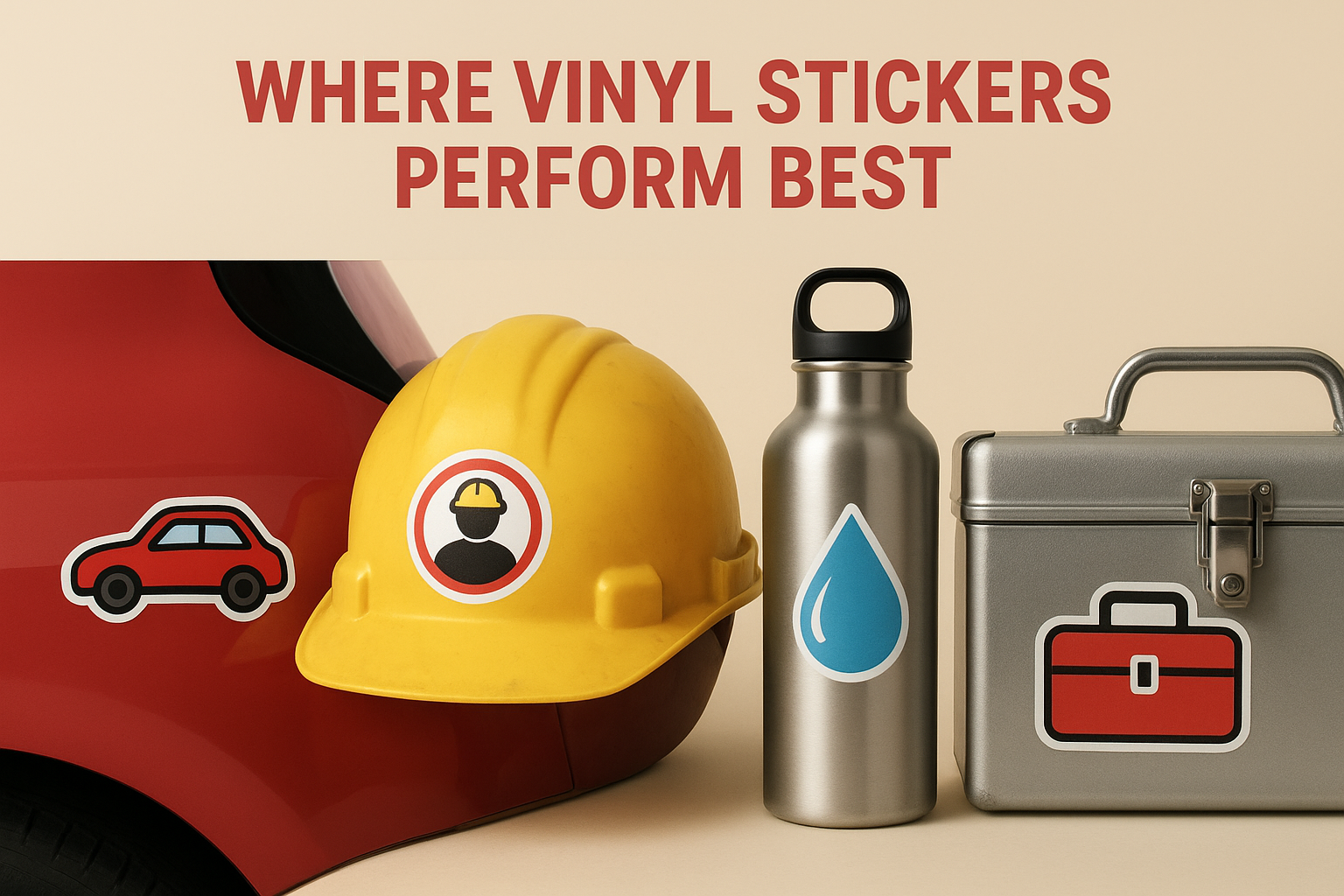
When you compare vinyl stickers vs paper stickers on real-world applications, vinyl wins clearly in outdoor and high-contact environments. Vehicle decals, hard hat labels, outdoor signage, water bottles, and tool cases all benefit from vinyl’s resistance to rain, sun, and regular handling. You can also apply vinyl stickers to glass and metal surfaces without worrying about edge lifting or moisture getting underneath the adhesive. For any application where the sticker faces regular exposure or physical contact, vinyl is the practical choice.
Paper stickers explained
Paper stickers are printed on coated or uncoated paper stock with a pressure-sensitive adhesive backing, the same basic construction used for product labels, postage stamps, and office labels. They’re considerably less expensive to produce than vinyl, which makes them a practical choice when you need a high volume of stickers for a short-term purpose. The trade-off is that paper doesn’t hold up to moisture, physical abrasion, or prolonged sun exposure the way vinyl does.
What paper stickers are made of
The substrate in paper stickers is cellulose-based rather than plastic film, which makes them more affordable and easier to produce at scale. Most paper stickers come in gloss or matte finishes, and while a gloss coating adds some surface protection, it won’t stop the label from absorbing moisture or creasing under pressure. If a paper sticker gets wet, the material can bubble, tear, or lift from the surface entirely.
The adhesive on paper stickers is generally repositionable or permanent, depending on the specific product, but in either case it bonds less aggressively than vinyl adhesive. Because the backing itself has no flexibility, paper stickers also tend to crack or peel at the edges when applied to curved or textured surfaces, which limits where you can realistically use them.
Paper stickers are designed for controlled indoor environments, not for anything involving regular water exposure or rough handling.
Where paper stickers work best
In the vinyl stickers vs paper stickers comparison, paper holds its own in specific, lower-stress situations. If your stickers are going on surfaces that stay dry and indoors, and you need a large quantity at a lower price point, paper delivers exactly what you need without paying for durability you won’t use. Strong use cases include:
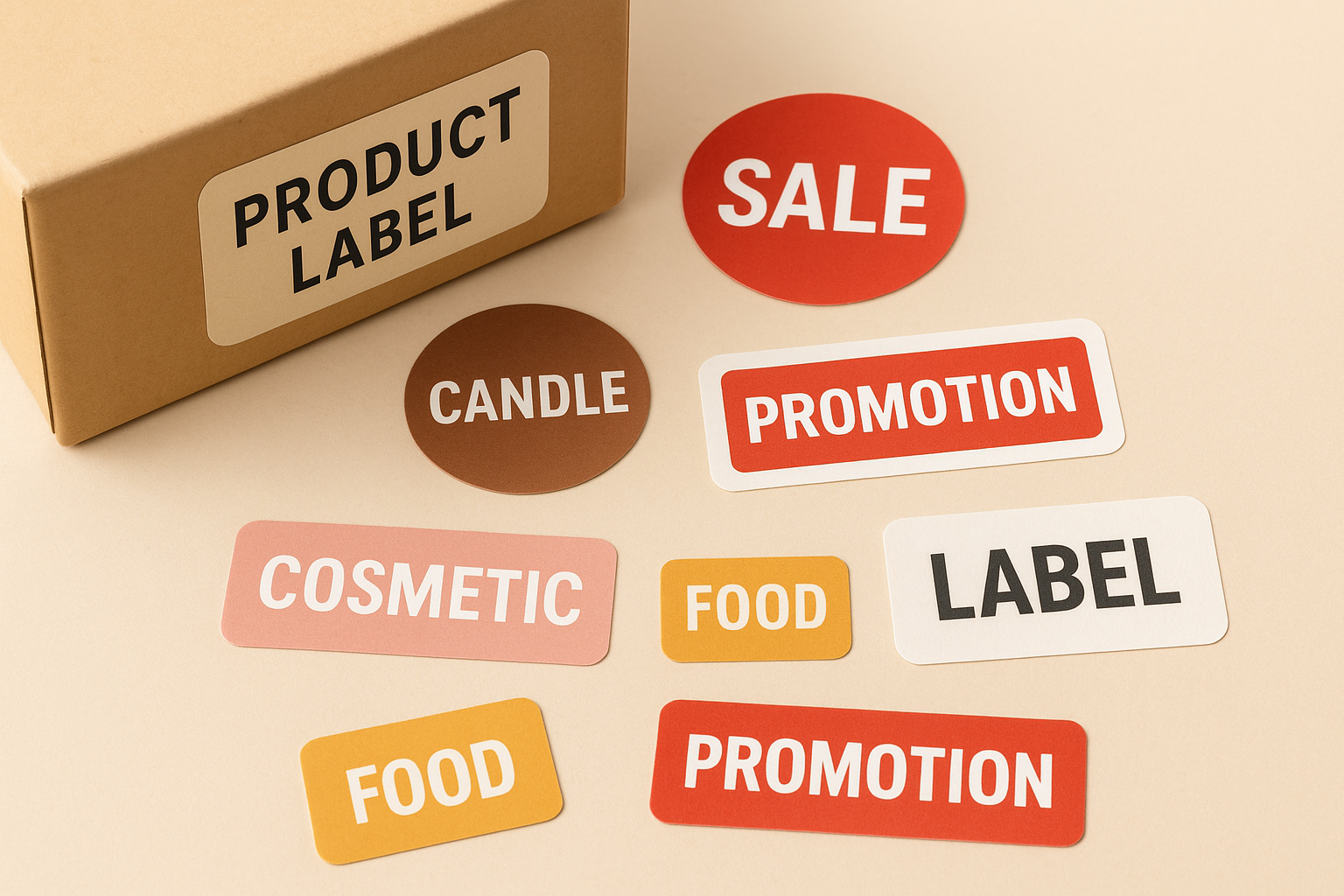
- Product labels on dry retail packaging
- Candle, cosmetic, or food labels in controlled retail environments
- Promotional handouts at events or trade shows
- Packaging inserts and office filing labels
Many businesses choose paper stock for product labels specifically because the sticker’s lifespan matches the product’s lifespan, which makes spending extra on vinyl unnecessary.
How to choose between vinyl and paper
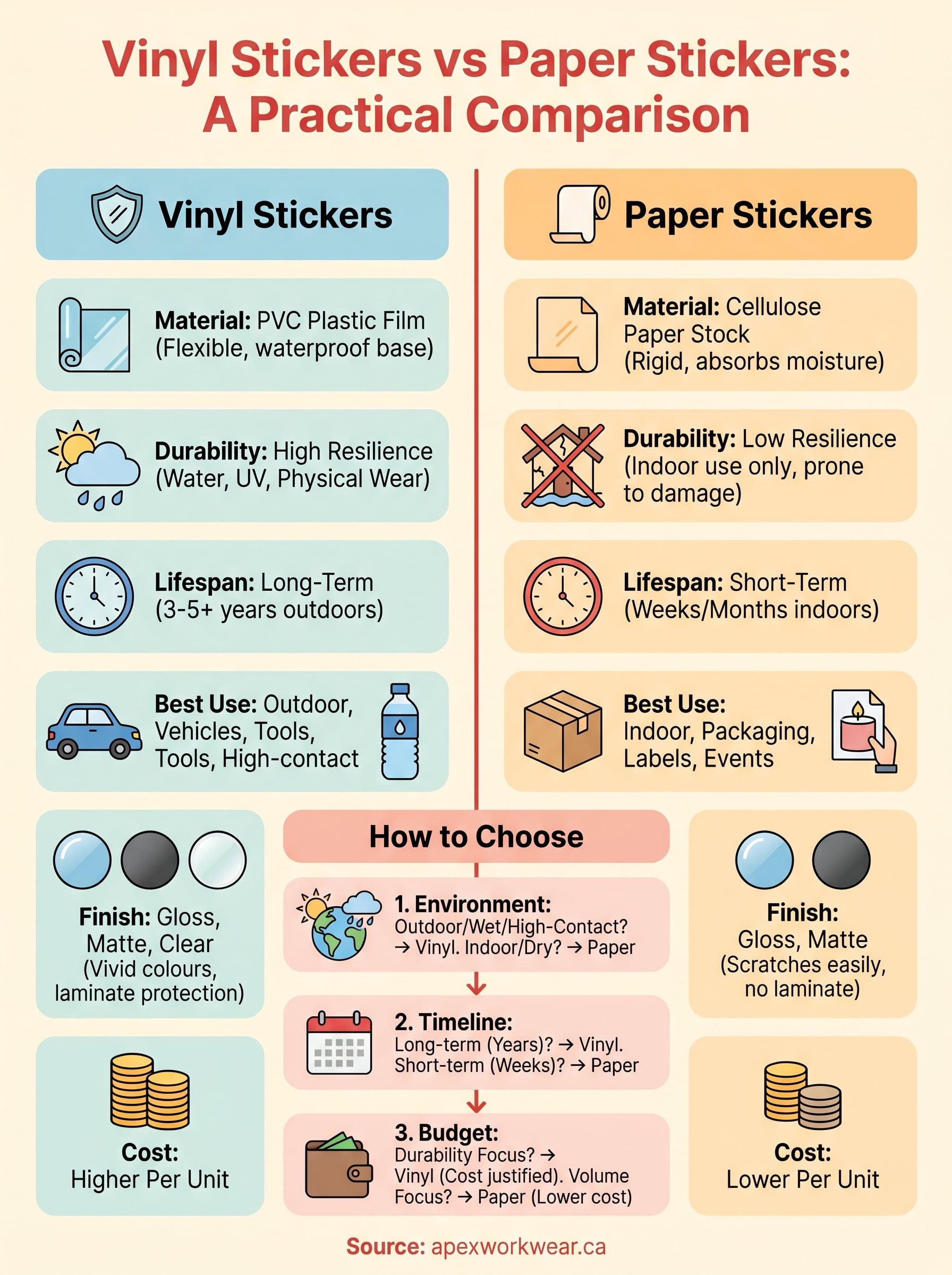
The right choice between vinyl stickers vs paper stickers comes down to three practical questions: where the sticker lives, how long it needs to last, and what you’re willing to spend. Answer those honestly and the decision becomes straightforward.
Consider your environment and timeline
Start with where the sticker ends up after you apply it. If it goes outdoors, on a surface that gets wet, or in a high-contact area, vinyl is the right call without question. If it stays indoors in a dry, controlled setting, paper handles the job cleanly at a lower cost.
Your project timeline matters just as much as location. A sticker on a water bottle used every day needs to look presentable for months or years. A sticker going inside a mailer or on an event display might only need to hold up for a day or two. Matching the material’s lifespan to the sticker’s actual purpose saves you money on durability you don’t need.
If your sticker faces anything beyond a clean, dry, indoor surface, vinyl is worth the extra cost every time.
Use this checklist to guide your decision:
- Outdoor use, water exposure, or UV light: choose vinyl
- High-contact surfaces like bottles, tools, or vehicles: choose vinyl
- Indoor dry surfaces, packaging, or retail labels: paper works well
- Short-term promotions, events, or handouts: paper is the practical choice
- Large volumes at lower cost: paper reduces your spend significantly
Think about your budget
Budget shapes the final decision when both vinyl and paper would technically work for your application. Vinyl costs more per unit, but that cost is justified when the sticker needs to last and represent your brand in demanding conditions. Paper keeps costs down for high-volume, short-term orders where longevity simply isn’t a priority.
A useful approach is to calculate the cost per impression over the sticker’s expected lifespan. A vinyl sticker that lasts three years on a tool case delivers far more value per dollar than a paper sticker replaced every few months.
Printing and finishing tips for better results
Whether you go with vinyl or paper, the quality of your final sticker depends heavily on how you prepare your artwork and which finishing options you select. Getting these details right before you place your order saves you from reprints and gives you a result that looks as sharp in print as it does on screen.
Prepare your artwork correctly
Resolution and file format make a bigger difference to sticker quality than most people expect. Submit your artwork at 300 DPI minimum in a vector format like PDF or AI where possible, since vector files scale without losing clarity. Raster images sent at low resolution print with visible pixelation, which is particularly noticeable on small stickers where every detail needs to stay crisp.
Always set your design to CMYK colour mode before sending it to print, since RGB colours can shift noticeably when converted during the printing process.
When weighing vinyl stickers vs paper stickers, both materials benefit equally from clean, high-resolution artwork. However, colour saturation tends to appear more vivid on vinyl, so if your design uses rich or dark tones, you’ll likely get a stronger result on vinyl stock than on paper.
Choose the right finish for your application
Gloss finishes enhance colour contrast and give stickers a polished, high-impact look, which works well for product labels and promotional stickers where you want the design to stand out immediately. Matte finishes reduce glare and create a more understated appearance, making them a strong choice for cosmetics, candles, and packaging where the aesthetic leans toward simplicity.
For outdoor applications on vinyl, ask specifically about UV laminate coating, which adds a protective layer over the printed surface and extends how long colours stay vibrant under direct sunlight. Paper stickers don’t support the same laminate options, so if your environment demands UV protection and long-term colour stability, that factor alone points you clearly toward vinyl as the right material for the job.
Next steps for your sticker order
Now that you understand the core differences between vinyl stickers vs paper stickers, you’re in a much better position to place an order that actually fits your project. The decision comes down to your environment, timeline, and budget, and none of those are complicated once you think them through clearly. Outdoor or high-contact applications call for vinyl every time. Indoor, short-term, or high-volume needs are where paper earns its place.
Before you order, pull together your final artwork file at 300 DPI or higher in CMYK, confirm which finish suits your application, and have a clear sense of how many stickers you need. If you’re unsure about any of those details, you don’t have to figure it out alone. Apex Workwear’s team reviews every order and offers basic design support at no extra cost, so you get a result that represents your business well. Get a free sticker quote and hear back within 24 hours.