
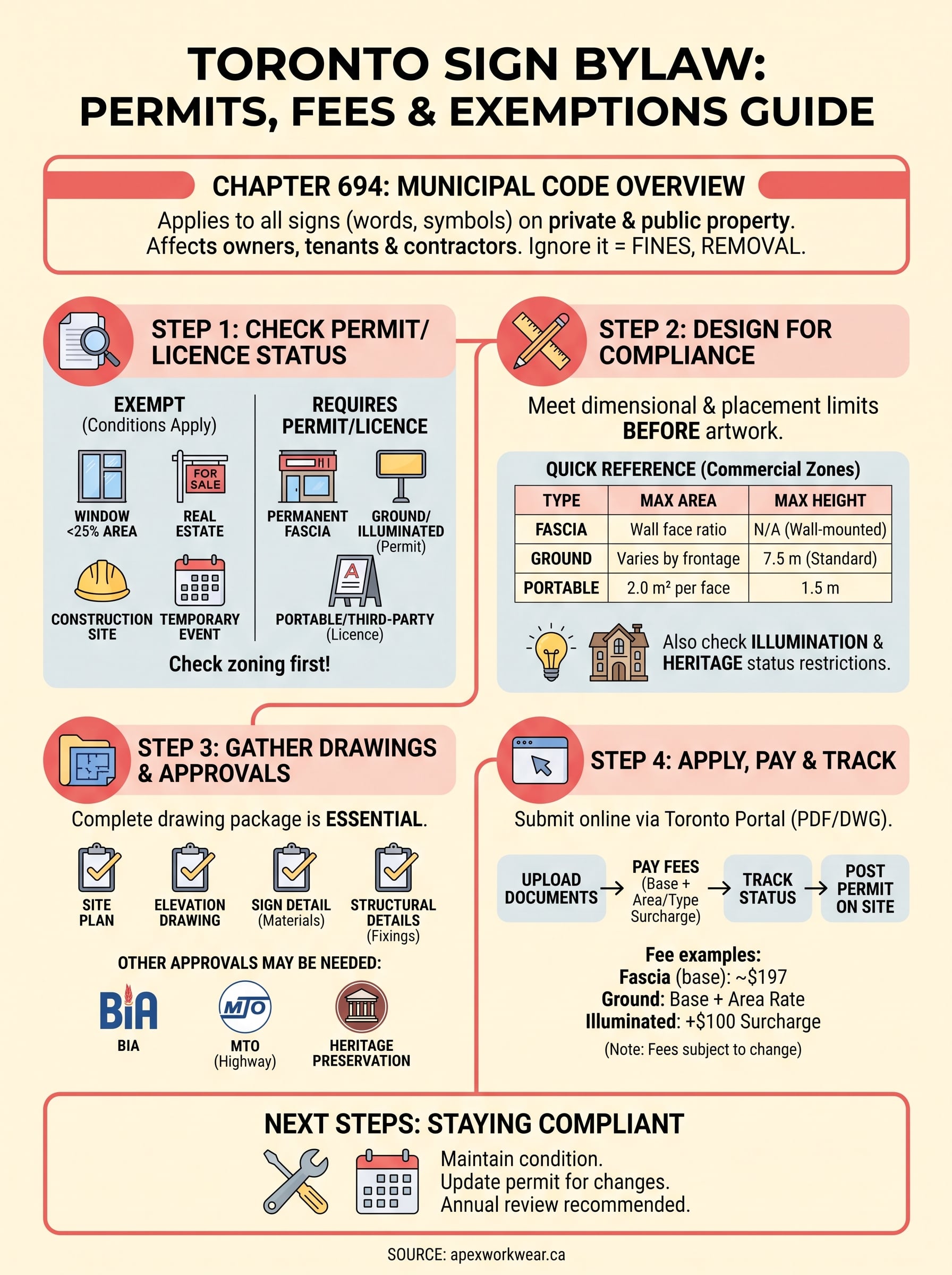
If you’re putting up a sign for your business in Toronto, there’s a good chance you need to deal with the city of Toronto sign bylaw first. Chapter 694 of the Municipal Code governs what you can display, where you can display it, and whether you need a permit to do so. Ignore it, and you’re looking at fines, removal orders, or both.
The rules aren’t always straightforward. Permanent signs, temporary signs, banners, and even window graphics each fall under different requirements, and some are exempt from permits entirely. Knowing the difference before you order your signage saves you time, money, and headaches.
At Apex Workwear, we produce custom banners, aluminum signs, coroplast signs, and large format prints for businesses across the GTA every day. We’ve seen customers run into bylaw issues that could have been avoided with a bit of upfront research, which is exactly why we put this guide together.
Below, you’ll find a clear breakdown of Toronto’s sign permit requirements, the associated fees, common exemptions, and the step-by-step application process, everything you need to get your signage up legally and without surprises.
What Chapter 694 covers and who it affects
Chapter 694 of the Toronto Municipal Code is the governing document behind the city of toronto sign bylaw. It applies to virtually every sign placed on private and public property within city limits, including storefronts, fences, rooftops, vehicles used as stationary displays, and digital screens. The bylaw sets rules for size, height, placement, illumination, and structural safety, all with the goal of keeping Toronto’s streetscape legible and safe.
What counts as a "sign" under Chapter 694
The bylaw defines a sign broadly. If it displays words, symbols, logos, or graphics intended to attract attention or communicate a message, it likely qualifies under the regulation. That means window decals, A-frame boards, wall murals with brand content, projecting fascia signs, and temporary promotional banners all fall within this framework. Even a small board with painted text propped in a window can trigger bylaw requirements depending on its size and placement.
If your display communicates a business message, the city treats it as a sign, regardless of the material it’s printed on.
Chapter 694 groups signs into categories based on type and mounting method: fascia signs (flush to a wall), projecting signs (extending outward from a building face), ground signs (freestanding), roof signs, portable signs, and third-party advertising signs. Each category carries its own dimensional limits and permit requirements, so identifying which type applies to your situation is the most practical first step before you spend anything on production.
Who the bylaw applies to
Business owners, property managers, landlords, and sign contractors are all named parties under Chapter 694. If you’re a tenant, that still applies to you: you’re responsible for ensuring any sign you install complies with the bylaw, even when your landlord has given verbal approval. The city holds the property owner ultimately accountable, which means both parties carry risk if a sign goes up without proper approvals.
Contractors who fabricate and install signs in Toronto must also follow the bylaw’s structural and clearance standards. If you’re ordering a large format print and arranging your own installation, confirm that whoever is mounting the sign understands the setback, clearance, and fastening requirements before work begins.
Step 1. Check if you need a permit or a licence
Before you order anything, confirm whether your sign requires a permit, a licence, or neither under the city of toronto sign bylaw. Getting this wrong early is the most common and costly mistake business owners make, so treat it as your first task before any production spend.
Signs that are exempt from permits
Not every sign in Toronto needs a permit. The bylaw exempts certain sign types provided they meet specific size and placement conditions. Common exemptions include:
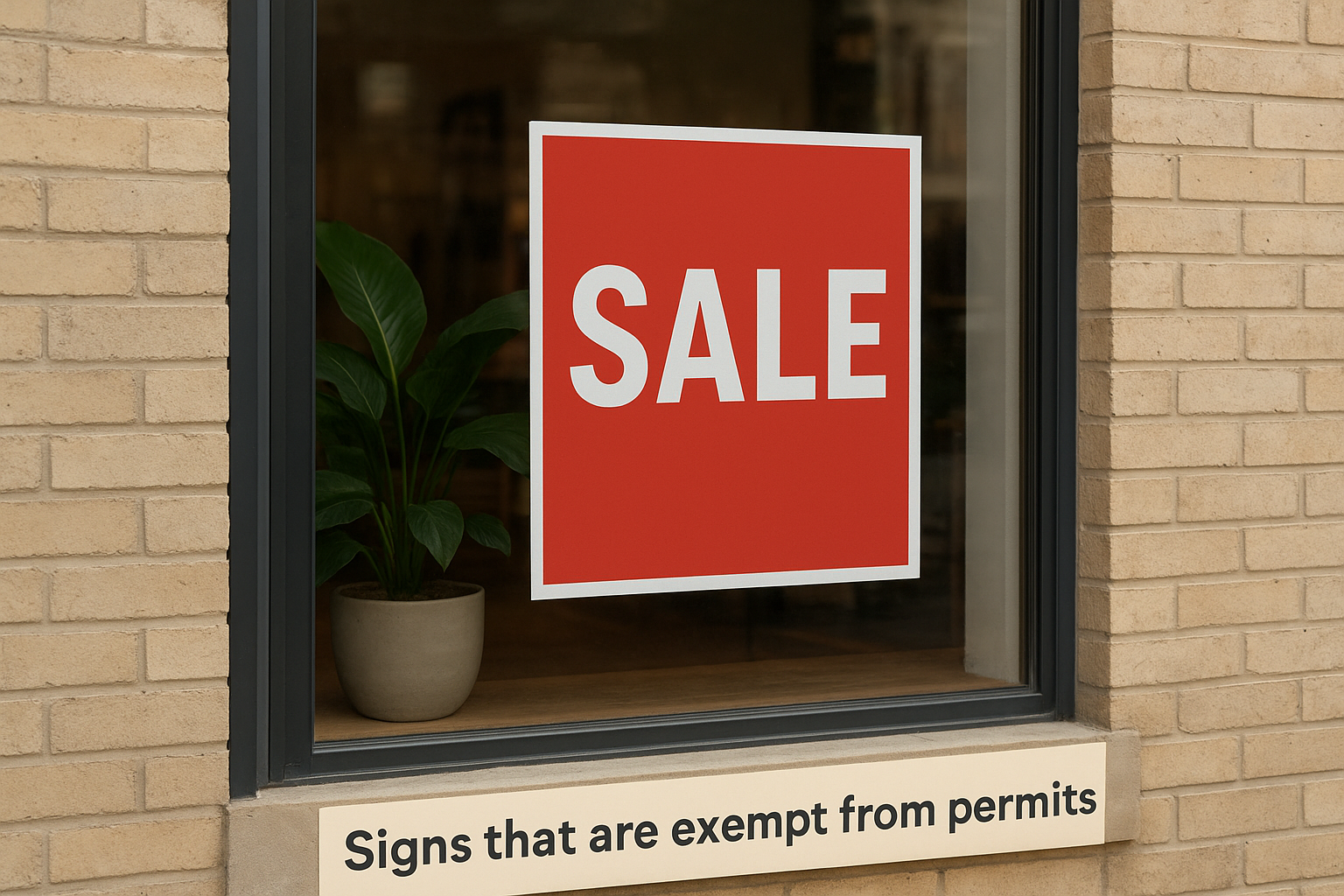
- Window signs covering no more than 25% of the total window area
- Real estate signs on properties actively listed for sale or lease
- Construction site signs within the defined area limits for the project
- Temporary event signs displayed for a short period tied to a specific occasion
Even exempt signs must still comply with all other bylaw provisions, including structural safety, clearance from overhead utilities, and content restrictions. Exempt does not mean unregulated.
Signs that require a permit or a licence
Most permanent signs attached to a building, freestanding ground signs, and illuminated displays require a sign permit before installation. You apply through the city’s Building Division and pay a fee based on the sign’s area and type.
If your sign is a portable sign or a third-party advertising display, you need a sign licence, not a permit. These go through a separate process and carry different conditions.
Check the City of Toronto zoning information to confirm what your property’s zoning designation permits, since certain sign types are restricted in residential or heritage districts regardless of permit status.
Step 2. Design a compliant sign from the start
Once you’ve confirmed whether your sign needs a permit, design it to meet the dimensional and placement requirements of the city of toronto sign bylaw before you finalise any artwork. Starting with compliant dimensions prevents costly reprints and avoids delays during the approval process.
Understand size and placement limits
The bylaw sets maximum sign area based on your property’s zoning and the sign’s mounting method. For fascia signs, the permitted area is typically calculated as a percentage of the building face width where the sign is installed. Ground signs have their own height and setback rules tied to the distance from the property line.
Designing your sign slightly under the maximum allowed dimensions gives you a clear compliance buffer without sacrificing visual impact.
Here is a quick reference for common sign types in commercial zones:
| Sign Type | Max Area | Max Height |
|---|---|---|
| Fascia sign | Based on wall face ratio | N/A (wall-mounted) |
| Ground sign | Varies by street frontage | 7.5 m (standard) |
| Portable sign | 2.0 m² per face | 1.5 m |
Account for illumination and heritage restrictions
Illuminated signs require additional review regardless of size, and heritage-designated properties carry stricter rules on materials, colours, and letter styles. Check your property’s heritage status through the City of Toronto Property Information Map before commissioning any artwork. Submitting a design that conflicts with heritage guidelines means restarting the approval process from the beginning, which adds weeks to your timeline.
Step 3. Gather drawings and supporting approvals
Before you submit your application, the city requires a complete drawing package that shows exactly what you’re installing and where. Submitting an incomplete package is the single biggest reason permit applications stall, so assemble every document before you log into the portal.
What your drawing package must include
Your drawings must give the reviewer enough detail to verify that your sign meets the dimensional and structural requirements of the city of toronto sign bylaw. Prepare all drawings to scale, and label them clearly with measurements in metric units.
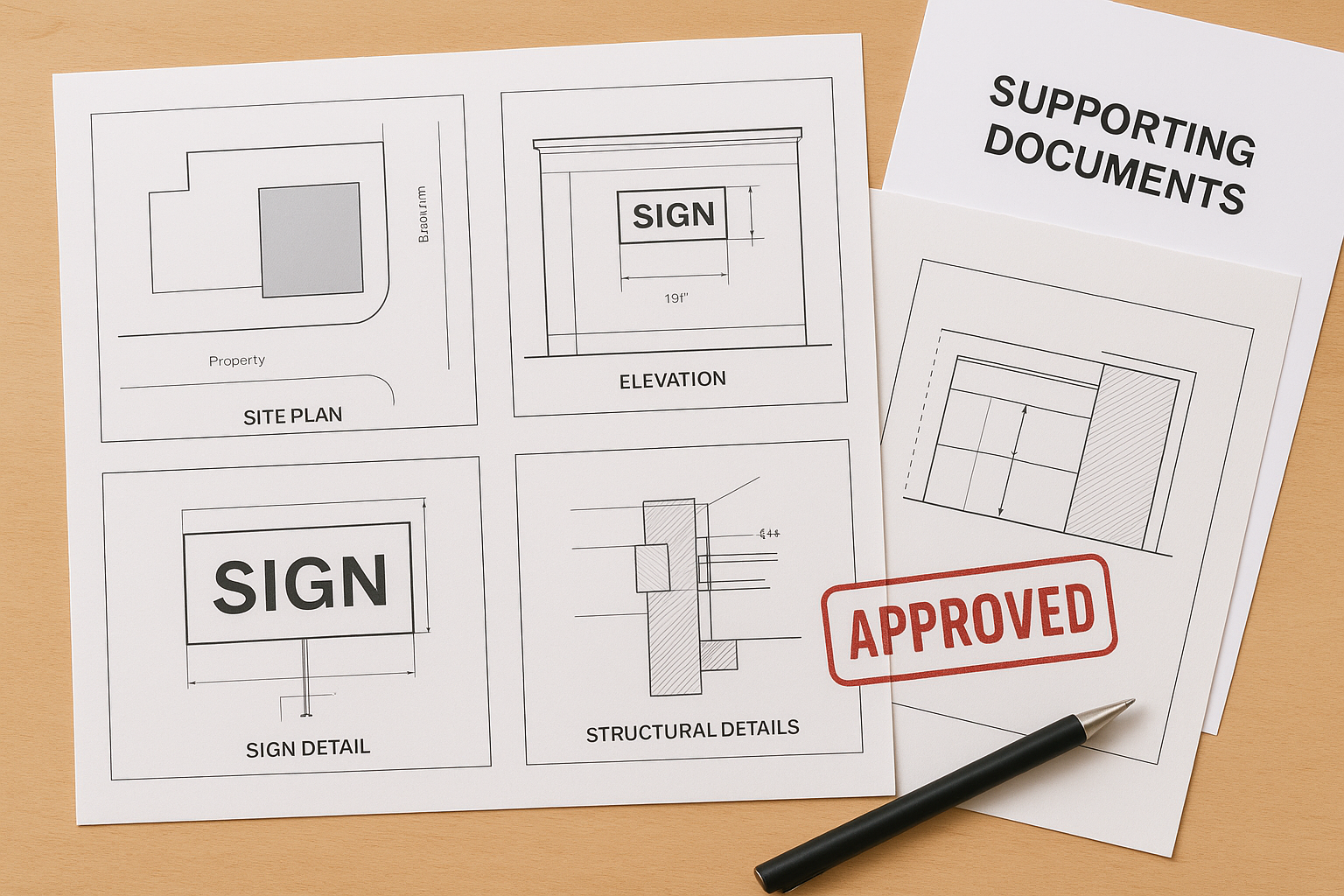
A drawing package missing even one required element will be flagged as incomplete, which resets your review timeline.
Include the following in your submission:
- Site plan showing the sign’s location relative to property lines, the building face, and the road
- Elevation drawing of the building face with the sign’s position, height, and width clearly dimensioned
- Sign detail drawing showing materials, letter or graphic dimensions, and any lighting components
- Structural details including fastening methods, wall attachment points, and load specifications if the sign is ground-mounted or projecting
Supporting approvals you may need first
Some sign installations require third-party approvals before the city will process your permit. If your property sits within a Business Improvement Area, check whether the BIA has a design review process. Properties near a provincial highway may also need a separate Ministry of Transportation approval before the city proceeds.
Heritage-designated properties require heritage permit approval from the city’s Heritage Preservation Services team. Confirm this early, as heritage reviews run on their own separate timeline and can add several weeks to your overall schedule.
Step 4. Apply, pay fees, and track your permit
With your drawings ready, you submit your sign permit application through Toronto’s online portal at toronto.ca. The city processes most sign permits through its Development Applications system, where you upload your documents, pay the applicable fee, and track the status of your review from a single dashboard.
Submit your application online
Log into the City of Toronto’s online permit portal and select the sign permit application type that matches your project. Upload each drawing file individually, label them clearly to match the required document list, and confirm that all files are in PDF or DWG format before submission. Once you submit, you receive a reference number you’ll use to follow up on your application.
Keep a copy of every document you upload, including the submission confirmation, in case the city requests revisions or additional information mid-review.
Understand the fee structure
Fees under the city of toronto sign bylaw are calculated based on sign type and total area. Below are the standard rates for common sign categories:
| Sign Type | Base Fee |
|---|---|
| Fascia sign | $197.00 (up to 10 m²) |
| Ground sign | $197.00 + area-based rate |
| Illuminated sign | Additional $100.00 surcharge |
These figures are subject to change, so confirm current rates on the City of Toronto fee schedule before you submit. Once the city approves your permit, post the approval document on site until the installation is complete and the required inspection is signed off.
Next steps to stay compliant
Once your permit is approved and your sign is installed, your compliance work isn’t finished. The city of toronto sign bylaw requires that you maintain your sign in good structural condition and update your permit if you make any material changes to the sign’s size, position, or illumination. Keep a digital copy of your permit approval in an accessible location, since city inspectors can request it at any time.
Review your signage at least once a year to confirm it still meets current bylaw requirements, particularly if your business has moved, expanded, or rebranded. Permit conditions can change when the city updates its regulations, and you’re responsible for staying current regardless of when your original permit was issued.
When you’re ready to order compliant signage, Apex Workwear produces custom banners, aluminum signs, and coroplast signs for businesses across the GTA with fast turnaround and no minimum order requirements.