You have seen "DTF" listed as a printing option and wondered what you are actually paying for. DTF printing meaning confuses a lot of buyers because it sounds technical, but the concept is straightforward once someone walks you through it. If you are trying to choose between apparel printing methods for your business, you need the plain answer, not marketing jargon.
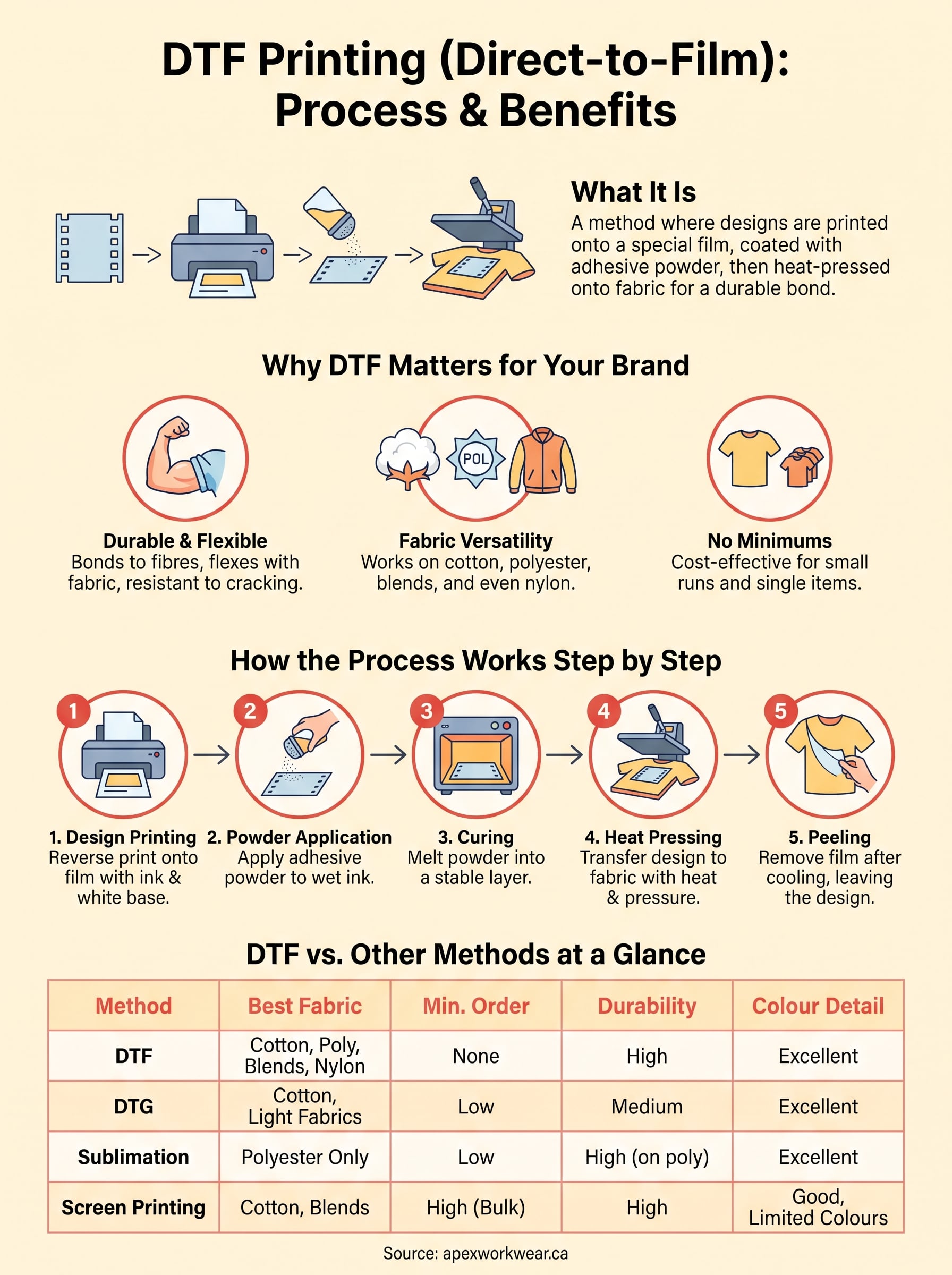
DTF stands for direct-to-film, a process where a design is printed onto a special film, coated with adhesive powder, then heat-pressed onto fabric. It works on cotton, polyester, blends, and even tricky materials like nylon, which is why it has become popular for custom apparel orders that need durability and colour accuracy without the setup costs of screen printing.
In this article, we break down exactly how the DTF process works step by step, and compare it against sublimation, DTG, and screen printing so you can see the real differences in cost, durability, and finish. By the end, you will know whether DTF is the right call for your next batch of branded T-shirts, hoodies, or team gear.
Why DTF printing matters for your brand
If you run a small business or manage a team, the printing method you choose affects your bottom line more than most people realise. DTF printing gives you full-colour, photo-quality designs without the setup fees that screen printing demands for every colour separation. That matters when you need 15 hoodies for a staff outing, not 500 for a warehouse sale. You get the same print quality whether you order five shirts or five hundred, which is exactly why so many Canadian small businesses have shifted towards it for team apparel and promotional gear.
Durability is where DTF earns its reputation. The transfer bonds to the fabric fibres rather than sitting as a thick layer of ink on top, so it flexes with the garment instead of cracking after a few washes. Contractors ordering branded hi-vis shirts or hoodies that see daily wear and frequent laundering need that resilience. A logo that peels after ten washes does nothing for your brand image on a job site.
DTF prints move with the fabric, not against it, which is why the design still looks sharp after months of washing and wear.
Flexibility across fabric types is another reason DTF matters commercially. Screen printing struggles with polyester blends and performance fabrics because of dye migration, and DTG often needs pretreatment on darker cotton garments. DTF sidesteps both problems. It works on cotton, poly-blends, and even nylon jackets, which means you are not stuck choosing between the fabric you want and the print quality you need.
Ordering practicality also plays a role for businesses that value simplicity. No minimum order requirements mean a startup testing a new logo or an event coordinator ordering a handful of custom hats does not need to commit to bulk quantities just to get professional results. That accessibility, paired with fast turnaround times, is what makes DTF a practical default for brands that need to look sharp without overcommitting budget or storage space on inventory they may not reorder.
Ultimately, the method you choose signals how seriously you take your brand presentation. Cutting corners on print quality shows up in customer perception fast, and DTF gives smaller operations a way to compete visually with larger companies without the larger company’s print budget.
How the DTF printing process works step by step
Understanding the mechanics behind DTF printing helps you spot quality work when you see it, and it explains why the process costs what it does. Each step builds directly on the last, and skipping or rushing any of them shows up in the final garment as cracking, fading, or a design that peels within a few washes.
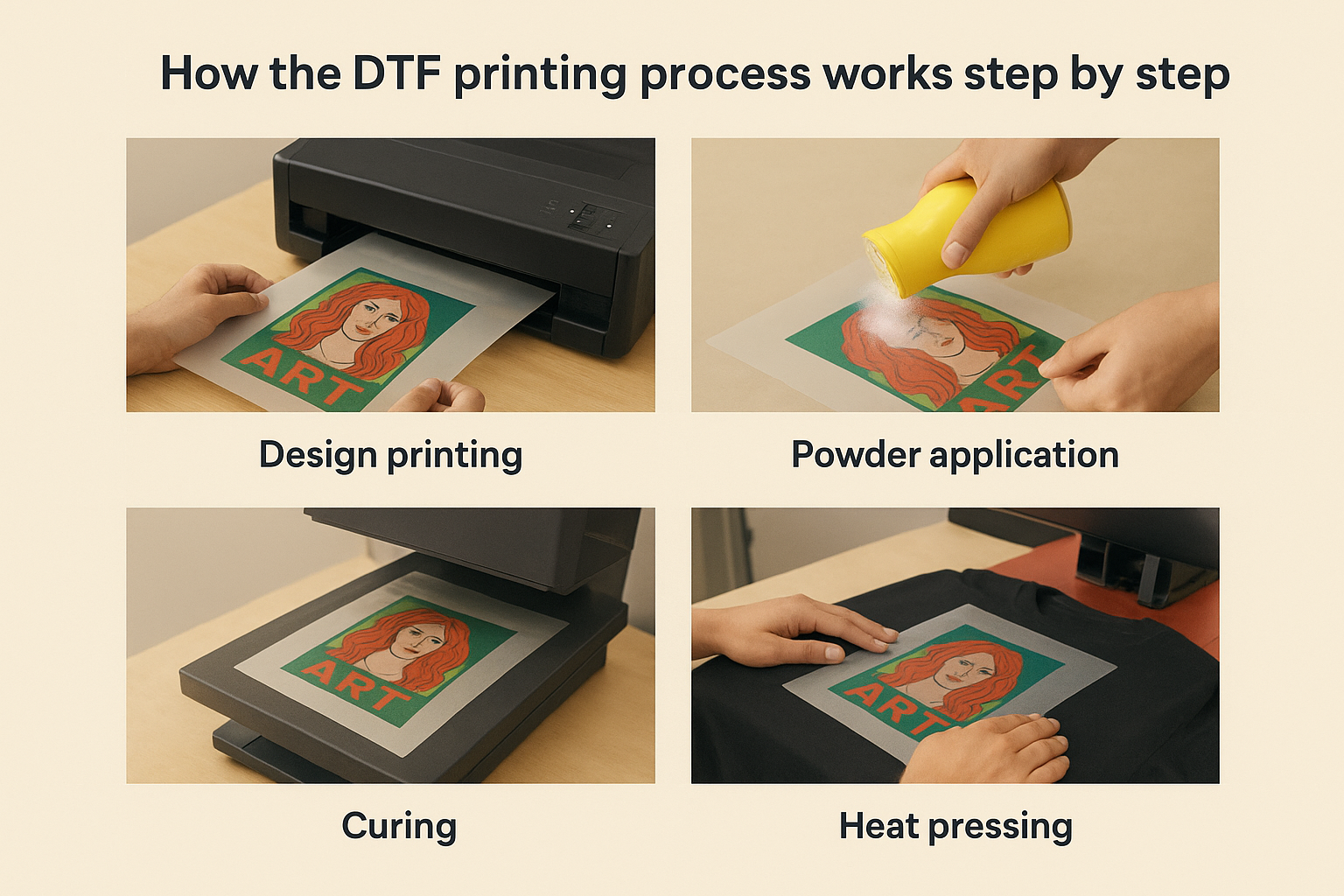
Every step in the DTF process exists to make one thing happen: a print that bonds to fabric instead of sitting on top of it.
Here is how a design goes from a digital file to a finished, wearable print:
- Design printing: The artwork prints in reverse onto a clear PET film using specialised DTF inks, including a white ink base layer for vibrancy on dark fabrics.
- Powder application: A thermoplastic adhesive powder is applied evenly across the wet ink while it is still tacky, then the excess is shaken off.
- Curing: The film passes through a heat unit or oven, melting the powder into a stable adhesive layer bonded to the ink.
- Heat pressing: The cured film is placed on the garment and pressed at high temperature and pressure, transferring the design permanently onto the fabric.
- Peeling: Once the transfer cools slightly, the film is peeled away, leaving the design fused into the fibres.
That adhesive powder step is what separates DTF from a basic heat transfer sticker. It creates a flexible bond that survives repeated washing far better than iron-on vinyl, which is why businesses ordering team apparel or uniforms lean on it for daily-wear gear.
DTF vs DTG, sublimation and screen printing
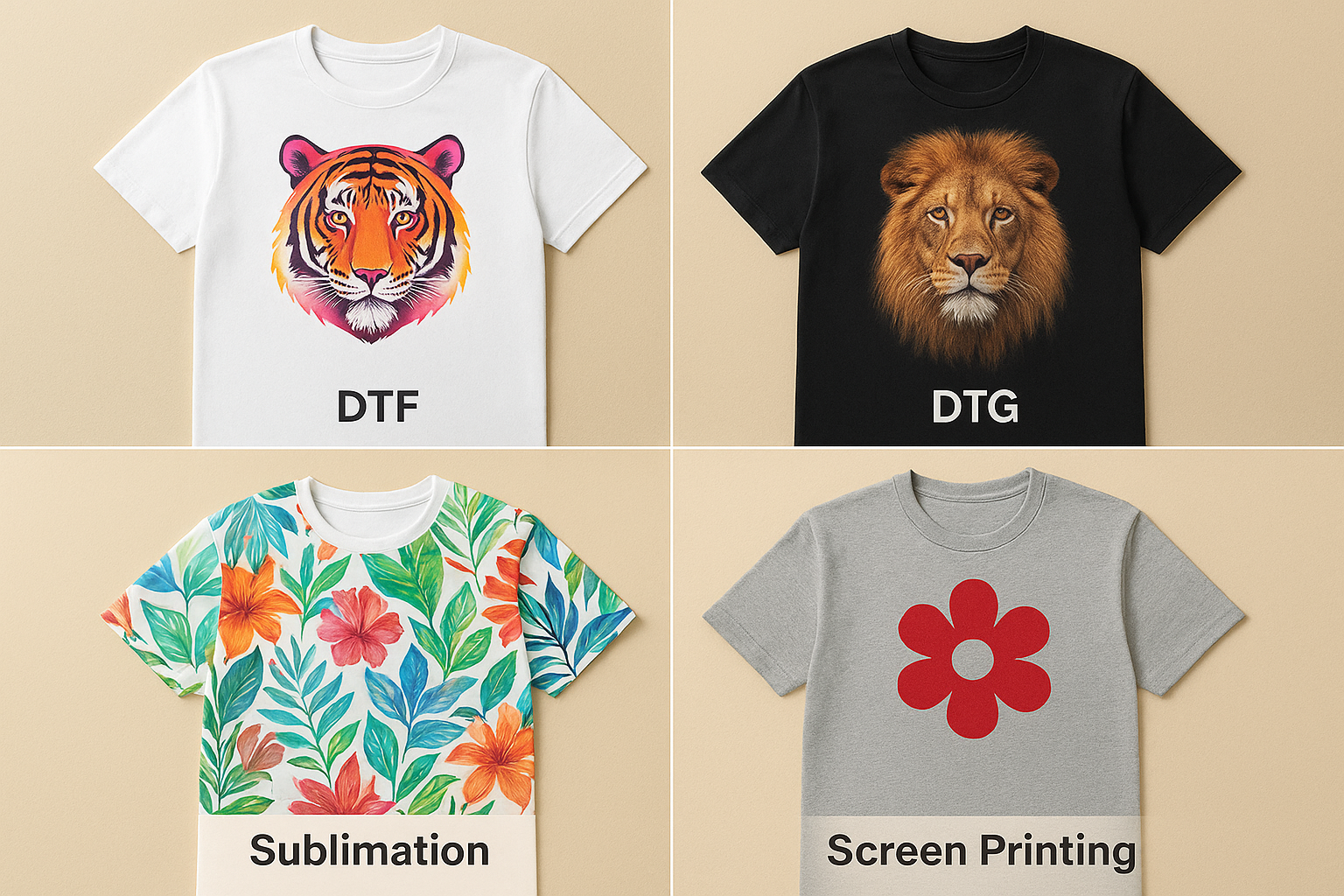
Comparing DTF printing against its main rivals shows why so many businesses now treat it as the default choice for mixed-fabric orders. Screen printing still wins on massive runs because ink costs drop sharply per unit once you pass a few hundred pieces, but it loses that advantage fast on small batches. Sublimation produces vivid, permanent colour, but only on polyester or poly-coated items, ruling it out for cotton tees. DTG lays ink directly onto fabric for photo-realistic detail, though it struggles on dark garments without heavy pretreatment and washes down faster on blended fabrics.
Comparing the four methods at a glance
| Method | Best fabric | Minimum order | Durability | Colour detail |
|---|---|---|---|---|
| DTF | Cotton, poly, blends, nylon | None | High | Excellent |
| DTG | Cotton, light fabrics | Low | Medium | Excellent |
| Sublimation | Polyester only | Low | High (on poly) | Excellent |
| Screen printing | Cotton, blends | High (bulk) | High | Good, limited colours |
Which method wins for your use case
Small orders on mixed fabrics almost always favour DTF transfers, since you get the fabric flexibility of screen printing without the setup fees. Bulk orders of a single design on cotton still make sense for screen printing, where the per-unit cost drops once you cross a few hundred pieces. Polyester sportswear with all-over graphics belongs with sublimation, and single-colour detailed art on light cotton shirts can work well with DTG.
No single method wins every job, but DTF wins the most jobs a small business actually places.
Understanding these trade-offs before you order saves you from paying for a technique that was never built for your fabric or your quantity.
What to consider before choosing DTF printing
Before you lock in an order, it helps to revisit the DTF printing meaning in practical terms: a film-based transfer bonded to fabric with heat and adhesive powder. That definition matters because it shapes what the process can and cannot do well, and knowing those limits upfront saves you from a disappointing batch of shirts.
Garment colour plays a bigger role than most buyers expect. Dark fabrics need that white ink base layer to make colours pop, which adds a fraction more cost per print but keeps the design from looking washed out. Skip it on a black hoodie and the logo turns dull fast.
Know your fabric and your quantity first, and the right printing method picks itself.
Design complexity also factors into your decision. Fine text under 6pt or hairline details can blur slightly during the powder and heat-press stages, so simplify small type before sending final art.
Quick checklist before you order
- Fabric type: cotton, poly, blend, or nylon all work, but confirm with your supplier
- Order size: DTF suits runs from one piece to a few hundred
- Design detail: bold graphics transfer cleaner than tiny fine print
- Turnaround needed: ask about rush options if you are on a deadline
Finally, pricing structure deserves a second look. Ask whether bulk pricing kicks in at your expected quantity, since some suppliers offer no minimums but still reward larger orders with better per-unit rates.
Choosing the right print for your next order
Now that you know the DTF printing meaning and how the process actually works, you are in a far better position to pick the right method for your next batch of shirts, hoodies, or team gear. DTF earns its place because it handles small runs, mixed fabrics, and dark garments better than screen printing, sublimation, or DTG can manage on their own. That flexibility is exactly why so many small businesses and contractors across Canada default to it for branded apparel.
The method only pays off when it is done right, though, with proper white ink layers, clean artwork, and a supplier who understands the fabric you are pressing onto. If you want a Canadian-based team that gets this right the first time, get a free quote from Apex Workwear and see what your design looks like on real fabric before you commit to a full order.