You’ve seen DTF prints that look sharp straight out of the box, vibrant colours, crisp details, solid coverage. But the real question is: is DTF printing durable enough to hold up after dozens of washes and regular wear? It’s a fair concern, especially when you’re putting your brand name or logo on custom apparel for your team or business.
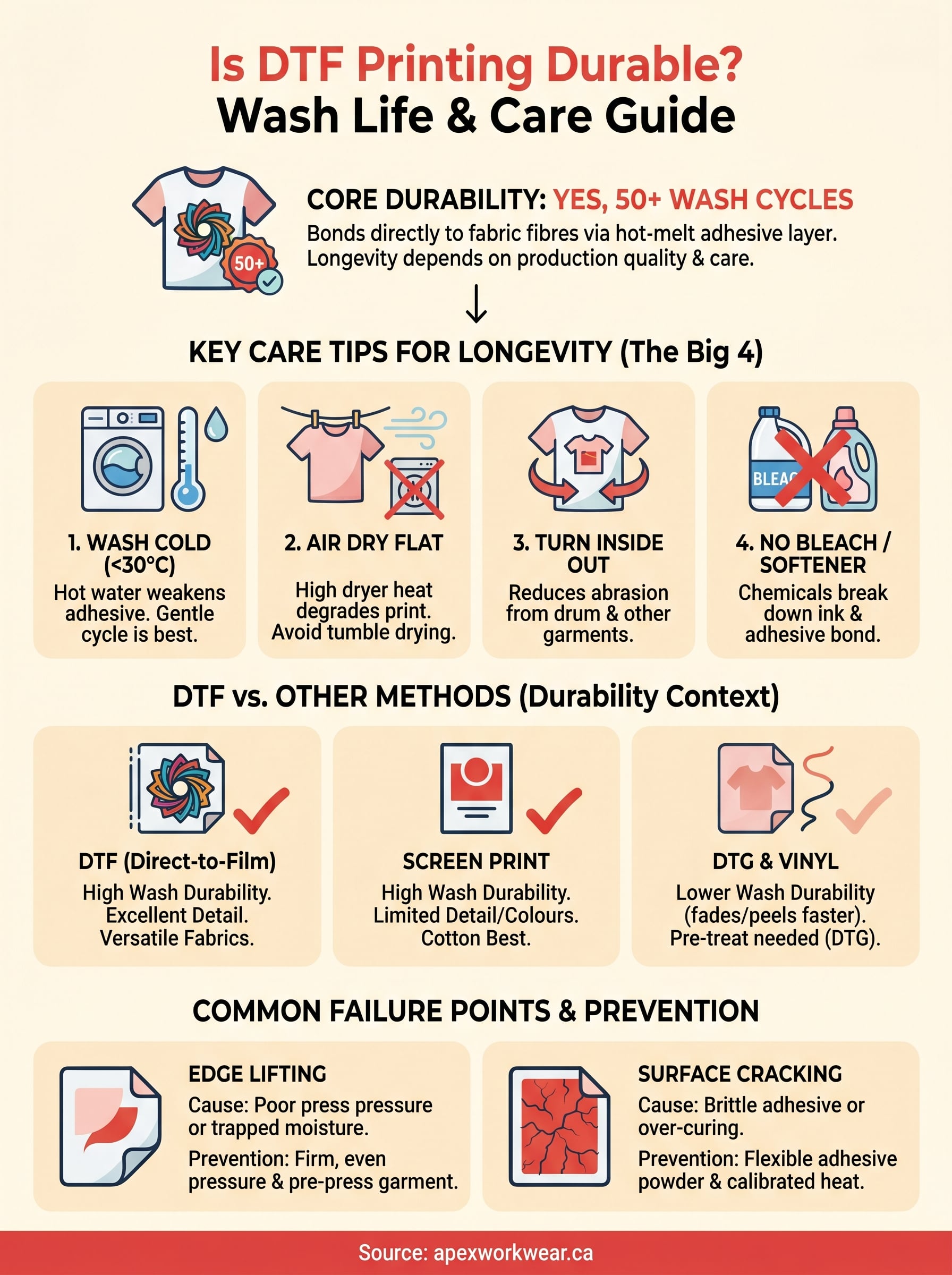
The short answer is yes, DTF (Direct-to-Film) printing is one of the more durable decoration methods available today. A well-produced DTF print can withstand 50 or more wash cycles without significant cracking, peeling, or fading. But durability isn’t just about the method itself. It depends on print quality, curing, fabric choice, and how you care for the garment after it leaves the press. Skip any one of those steps, and even the best transfer won’t last.
At Apex Workwear, we use DTF printing across a wide range of custom apparel, from staff uniforms and team hoodies to branded tees for events. Our production is done right here in Canada, and we see firsthand how these prints perform in real working conditions. This article breaks down exactly what affects DTF print longevity, how it stacks up against screen printing and other methods, and the care tips that actually make a difference. No guesswork, just practical information you can use before placing your next order.
Why DTF durability matters for custom apparel
When you’re ordering custom apparel for a business, durability isn’t just a preference, it’s a baseline requirement. A print that cracks after ten washes isn’t a minor inconvenience. It reflects directly on how your brand appears in front of customers, clients, and the general public. Whether you’re outfitting a crew of contractors or ordering branded hoodies for a company event, the longevity of the decoration method matters from the moment the garment leaves the production floor. Getting this wrong costs you more than money.
The real cost of prints that don’t hold up
Replacing custom apparel is expensive and time-consuming. If you order 30 shirts for your staff and the prints start peeling after a few months, you’re not just looking at a reprint cost. You’re also dealing with inconsistent team presentation, the logistics of reordering, and potential delays if your supplier is backed up. For small businesses and contractors working in the field, worn-out prints signal a lack of attention to detail, and that impression sticks with anyone who sees it.
The true cost of a print failure isn’t just the replacement order. It’s what your customers see in the meantime.
The question of is dtf printing durable enough for professional use comes down to understanding what you’re actually buying. A DTF print with a low per-unit price that fades in eight washes costs far more in the long run than a well-produced print that lasts through 50 or 60 cycles. Factoring in total cost of ownership, not just the unit price, is how experienced buyers evaluate their printing options, and it’s the smarter way to budget for branded apparel.
What durability looks like across different uses
Not every garment takes the same level of abuse. A branded event t-shirt worn once or twice has completely different durability requirements than a work uniform that goes through the wash three times a week. Understanding where your custom apparel sits on that spectrum helps you make smarter decisions about the printing method, fabric choice, and care instructions you pass on to your team.
For high-frequency-use garments like contractor uniforms, kitchen staff shirts, or tradespeople’s workwear, durability becomes a direct operational concern. These garments need to look presentable after dozens of washes, resist the wear of physical work, and hold their colour without fading under regular laundering. DTF printing handles these conditions well when the transfer is properly cured and applied to the right fabric weight. Cutting corners on either of those factors is where most durability problems start.
The brand perception angle
Your apparel functions as a moving advertisement. Every time a staff member wears your branded shirt in public, your logo and colour accuracy are on display. A faded, cracked, or peeling print sends a message you don’t want to send. It suggests that either the quality of what you offer is low, or you don’t invest in your own presentation, neither of which builds confidence in your brand.
Businesses that take brand consistency seriously understand that the durability of their custom apparel directly supports that goal. It’s not about being precious over a t-shirt. It’s about making sure every touchpoint, including what your team wears on-site or at an event, reflects the same standard you hold yourself to in the rest of your operations. Durable prints make that possible in a practical, repeatable way.
What makes DTF printing durable in the first place
Understanding why DTF prints hold up starts with understanding how the process actually works. DTF stands for Direct-to-Film. Ink is printed onto a special film sheet, coated with a hot-melt adhesive powder, and then heat-pressed onto the fabric. That adhesive layer is the foundation of the whole system, and it’s what separates a lasting print from one that peels within weeks.
The adhesive layer is doing most of the work
The hot-melt adhesive powder bonds both to the ink layer above it and to the fabric fibres below it during the heat press stage. When done correctly, the print doesn’t just sit on top of the garment, it fuses into it at a structural level. This mechanical bond is what makes DTF competitive with screen printing on durability. The adhesive fills the gaps between fabric fibres, which gives the transfer something to grip rather than just coating the surface.
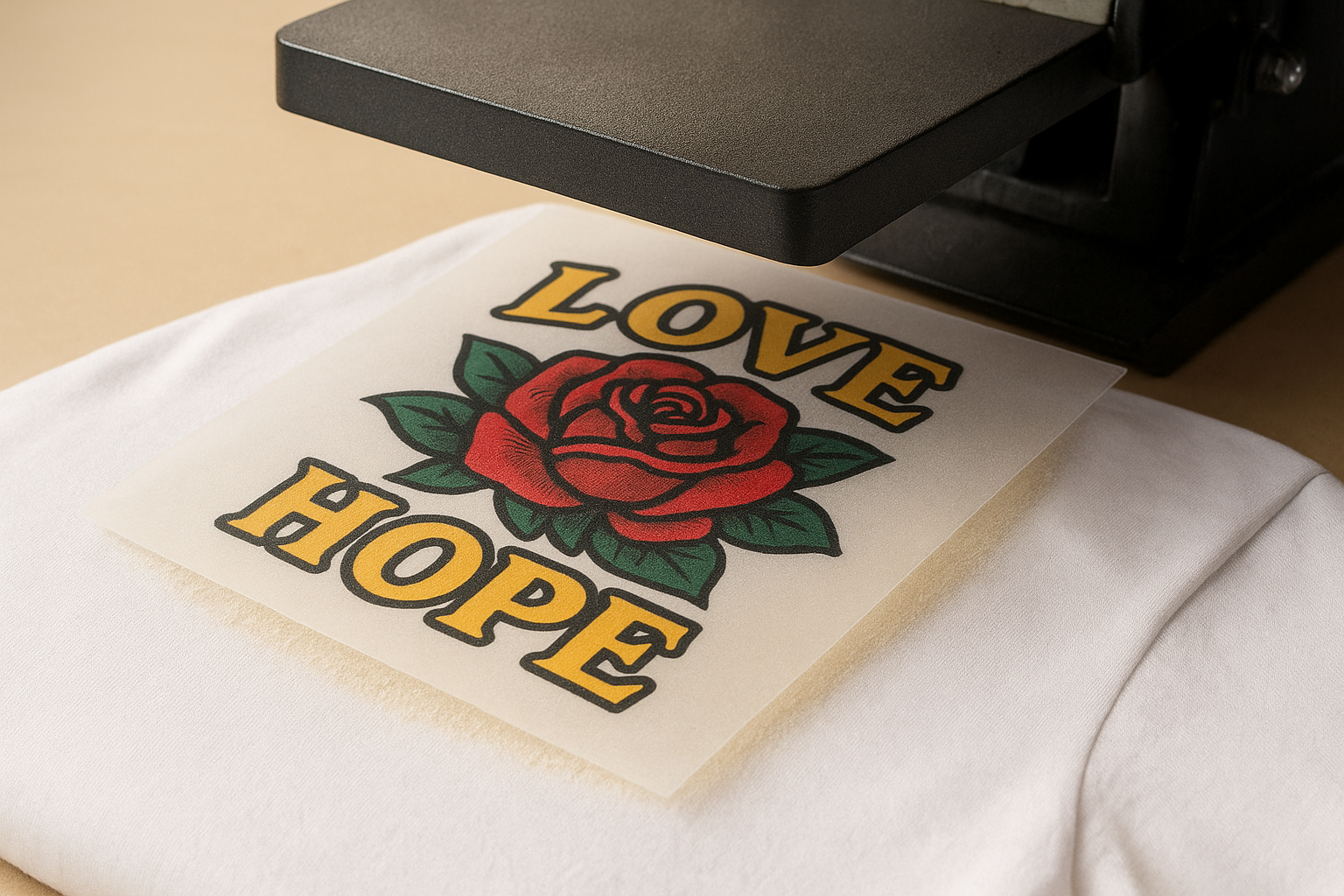
A DTF print that’s been properly cured doesn’t peel from the outside in. It holds because the adhesive has bonded directly into the fabric structure.
The quality of the adhesive powder itself also plays a role. Lower-grade powders can produce a brittle bond that cracks under flexing or repeated washing. Reputable production facilities use fine-grain, high-tack powders that remain flexible after curing, which is what allows the print to move with the fabric rather than resist it.
Heat, pressure, and curing time
The heat press stage is where a DTF print either succeeds or fails long-term. Temperature, pressure, and dwell time all need to hit specific values for the adhesive to cure fully. Under-curing leaves a weak bond that separates in the wash. Over-curing can scorch certain fabrics or cause the adhesive to become brittle.
For most DTF transfers, the press needs to reach between 150°C and 165°C with firm, even pressure for 10 to 15 seconds. Any deviation from those parameters introduces risk. This is why consistent, professional production equipment matters. A well-calibrated heat press with trained operators produces a fundamentally more durable result than a setup where those variables aren’t controlled closely.
How long DTF prints last in real-world washing
The standard benchmark you’ll see quoted for DTF prints is 50 wash cycles, and in practice that figure holds up when the print is produced correctly and cared for properly. Some well-applied transfers on quality fabric have made it past 80 cycles with no meaningful cracking or peeling. That said, wash count alone doesn’t tell the whole story. How you wash, what temperature you use, and how often the garment goes through a tumble dryer all influence how quickly the print degrades over time.
What 50 washes actually means in practice
If someone on your team wears a uniform three times a week and washes it after each wear, 50 cycles takes roughly four months. For a seasonal event shirt worn a handful of times, that same print could last years. Understanding your actual use frequency helps you set realistic expectations and decide whether DTF is the right fit for your specific situation.
A print rated for 50 washes on a once-a-week shirt outlasts most people’s interest in wearing it. On a daily-use uniform, you’re replacing it within a season.
The wear pattern also matters. High-friction areas like underarms, collar edges, and chest panels where a seatbelt or bag strap crosses the print see more stress per wash than flat back prints. Those zones tend to show wear first, which is worth considering when you’re placing your artwork and deciding on garment type.
What causes DTF prints to degrade faster
Hot wash cycles above 40°C break down the adhesive bond faster than anything else. Paired with a high-heat tumble dry setting, you can cut a print’s lifespan in half within the first 20 washes. If you’re asking is dtf printing durable for workwear that goes through industrial laundering, the answer shifts depending on whether your team follows the correct care instructions.
Fabric composition is another factor. Polyester blends tend to hold DTF prints longer than 100% cotton because the fibres flex less during washing and retain their structure better over time. Cotton is still a perfectly valid base, but it benefits more from cold-wash, low-heat drying than synthetic fabrics do. Passing your team a simple care card with their uniforms takes two minutes and can add months to the life of the print.
DTF vs screen printing, DTG, vinyl and sublimation
When you’re deciding on a decoration method for custom apparel, durability is one of the most practical filters you can apply. DTF holds up well in direct comparisons with the four most common alternatives, but each method has strengths and trade-offs worth understanding before you commit to an order.
How DTF compares to screen printing
Screen printing is the long-standing benchmark for durability in the custom apparel industry. Plastisol inks bond deeply into cotton fibres and can survive well over 50 wash cycles with minimal fading. DTF matches that lifespan when produced correctly, and it pulls ahead in one key area: detail. Screen printing struggles with fine lines, gradients, and multicolour artwork because each colour requires a separate screen. DTF handles all of that in a single transfer, which makes it the more flexible option for complex logos without sacrificing wash life.
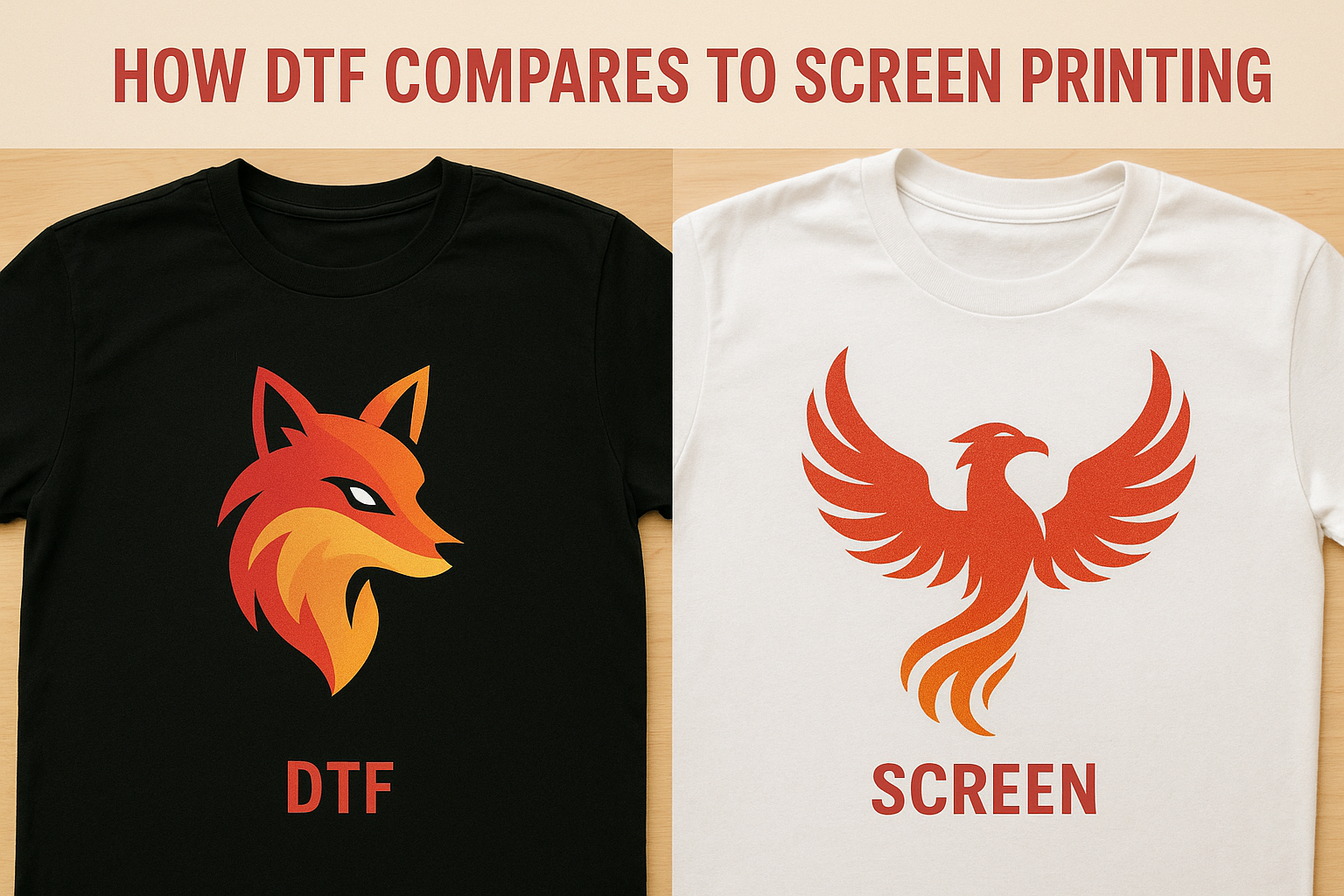
If your artwork has more than four colours or fine gradients, DTF gives you better results than screen printing at a comparable durability level.
How DTF compares to DTG and vinyl
Direct-to-garment (DTG) printing applies ink directly to the fabric using an inkjet-style process. It produces soft, detailed prints but requires pre-treatment for dark fabrics, and the prints tend to fade faster than DTF, particularly on polyester blends. For wash durability, DTF consistently outperforms DTG, especially on darker garments where DTG ink adhesion is already under more stress.
Vinyl heat transfers are a different category entirely. Cut vinyl is durable for simple, single-colour designs but cracks and peels faster than DTF on complex or full-colour artwork. The physical cutting process also limits design complexity in ways that DTF doesn’t face. If you’re asking is dtf printing durable compared to vinyl, the answer is yes, particularly for multi-colour and detailed designs that exceed what cut vinyl can handle cleanly.
How DTF compares to sublimation
Sublimation dyes the fabric itself rather than sitting on top of it, which means it cannot crack or peel. On paper, that sounds like a clear durability win. The catch is that sublimation only works on light-coloured polyester fabrics, which limits its practical use significantly. DTF works across fabric types and colours, making it the more versatile option for most businesses ordering mixed garment types.
How to make DTF prints last longer
The single biggest variable you control after the garment leaves production is how you wash it. A properly cured DTF print already has a strong bond going into your hands, but repeated exposure to hot water, high dryer heat, and harsh chemicals will degrade that bond faster than normal wear ever would. Following a few consistent care habits adds real wash cycles to the life of your prints and reduces how often you need to reorder.
Wash cold and air dry when possible
Cold water, ideally at or below 30°C, is the most effective single step you can take to extend the life of a DTF print. Hot water causes the adhesive layer to soften slightly with each cycle, which gradually weakens its grip on the fabric over time. If your team wears work uniforms multiple times a week, switching to cold washing alone can meaningfully extend how long the prints hold before you see any cracking or edge lifting.
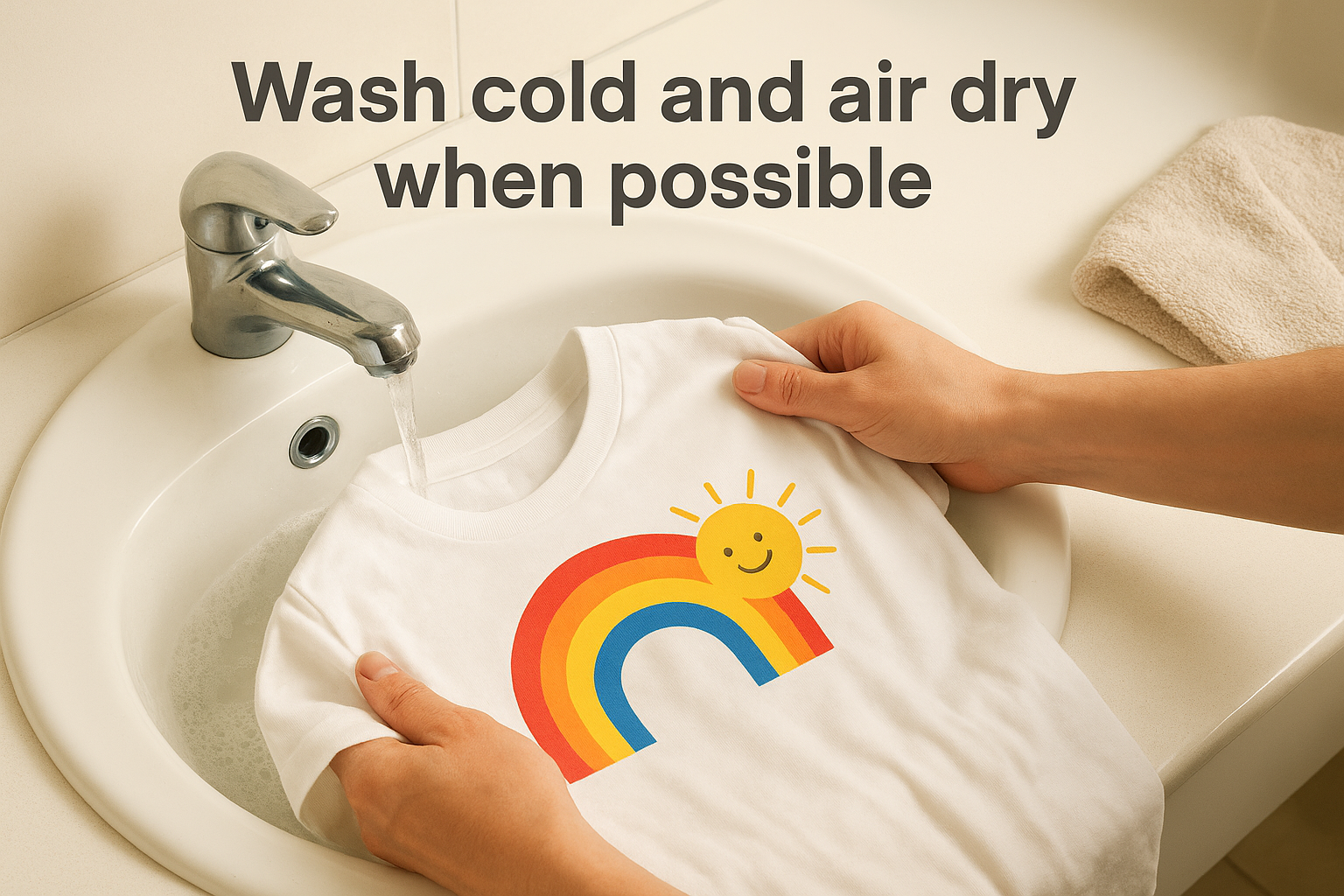
The dryer is harder on DTF prints than the washing machine. If you can air dry, do it.
Tumble drying on high heat accelerates print wear faster than almost any other factor outside of bleach. Air drying flat or using a low-heat setting is the better option wherever it’s practical. For businesses issuing branded uniforms, including a printed care instruction card with each garment costs almost nothing and pays off directly in fewer reprints down the line.
Turn garments inside out before washing
Turning garments inside out before each wash reduces direct abrasion on the print surface during the cycle. The drum, other garments, and the general agitation of the water all create friction, and flipping the garment means that friction lands on the fabric’s interior rather than the print face. This is a small habit with a measurable impact, particularly for items that go through the wash several times a week.
Avoid fabric softener and bleach
Fabric softener coats fibres with a conditioning layer that interferes with the adhesive bond gradually over multiple washes. Bleach is more direct in its damage: it breaks down both the ink and the adhesive at the same time. If you are asking is dtf printing durable under regular laundering, the answer is yes when you skip these two products entirely and use a standard, mild detergent without added brighteners or softening agents.
Common durability problems and how to avoid them
Even a well-produced DTF transfer can fail early if specific conditions aren’t met during production or care. Knowing the most common failure points in advance lets you catch problems before they show up on a finished garment. Most issues with DTF print longevity trace back to one of three causes: poor application, incorrect washing, or a mismatch between the transfer and the fabric type.
Edge lifting and peeling
Edge lifting is the most visible sign that a DTF transfer didn’t bond properly. It usually starts at the corners or outer edges of the design and works inward with each wash cycle. The most common cause is incomplete heat press contact, either from uneven pressure across the platen or a dwell time that was too short. You can avoid this entirely by ensuring the transfer receives firm, even pressure across its full surface during the application stage.
If your prints are lifting at the edges after fewer than ten washes, the issue is almost always in the press stage, not the transfer itself.
A secondary cause is applying a DTF transfer to a fabric with too much surface moisture. Moisture trapped in the garment during pressing prevents full adhesive bonding. Pre-pressing the garment for a few seconds before applying the transfer removes that moisture and gives the adhesive a clean, dry surface to bond to properly.
Cracking across the print surface
Cracking across the body of a design points to a different root cause than edge lifting: either low-quality adhesive powder or over-curing during production. Over-cured adhesive becomes brittle and loses its flexibility, which means the print resists movement rather than flexing with the fabric. On garments that stretch or flex regularly, like performance wear or fitted shirts, that brittleness shows up as surface cracks within the first 20 washes.
Selecting a supplier who uses fine-grain, flexible adhesive powder and operates calibrated heat press equipment reduces this risk significantly. If you’re asking is dtf printing durable for stretch fabrics specifically, the answer depends almost entirely on whether the adhesive layer retained its flexibility through the curing process. Requesting a sample transfer on your specific fabric before committing to a full production run is the most reliable way to confirm that before you invest in a larger order.
Key takeaways
So, is dtf printing durable? Yes, when it’s produced correctly and cared for properly. A well-applied DTF transfer bonds directly into the fabric structure and holds up through 50 or more wash cycles without peeling, cracking, or significant fading. The method competes directly with screen printing on longevity, outperforms DTG and vinyl on complex artwork, and works across a far wider range of fabrics than sublimation.
Your biggest levers are cold washing, air drying, and turning garments inside out before each cycle. Avoid bleach, fabric softener, and high dryer heat, and you extend the life of every print meaningfully. On the production side, quality adhesive powder and a properly calibrated heat press are what separate a print that lasts from one that fails early.
If you’re ready to order custom apparel that holds up in the real world, get a free quote from Apex Workwear and we’ll help you get it right.