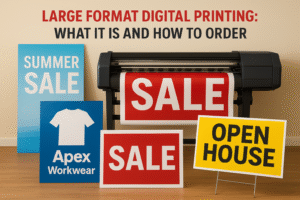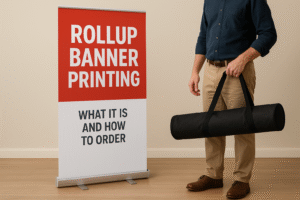
You need a banner for a trade show, a yard sign for a job site, or a storefront sign that actually holds up through a Canadian winter, and you’re not sure where to start. Sign and banner printing covers a lot of ground, from custom printed vinyl banners and coroplast yard signs to aluminum signs and foam board displays, and picking the wrong material or size wastes money and time you don’t have.
At its core, signs and banner printing means turning your artwork into a durable, weather-ready product sized and finished for exactly where it’s going up, indoors or out. The right process depends on your surface, your timeline, and how long the sign needs to last outside. Getting a clear answer up front, rather than guessing at specs, is what separates a sign that looks sharp for months from one that fades in a season.
This article walks through what banner and sign printing actually involves, the common materials and formats you’ll choose between, and how to order a printed banner from design proof to delivery. We produce everything in Canada, so you’ll also see what to expect for turnaround and how to get a quote without the guesswork.
Why sign and banner printing matters for your business
Every storefront, job site, and trade show booth is competing for a few seconds of someone’s attention. A well-placed sign or banner is often the cheapest, most effective piece of marketing you’ll ever buy, because it works around the clock without a monthly ad spend. A contractor’s yard sign printed on corrugated plastic at a renovation site tells every passerby who did the work and how to reach you. A banner at a farmers’ market stall does the selling before a customer even reaches your table. That’s the practical value behind sign and banner printing: it turns a physical location into a 24-hour advertisement.
A sign that’s easy to read from the street is worth more than a full-page ad nobody sees.
Signage drives foot traffic and sales
Consider how often you’ve chosen a business because a sign caught your eye while driving or walking past. Studies from industry groups like the Small Business Administration consistently point to on-premise signage as one of the highest-return marketing investments for local businesses, largely because it reaches people already close enough to walk in. A clear, well-lit sign with strong contrast and a simple message converts curiosity into customers far more reliably than a social media post buried in someone’s feed.
A one-time cost with a long payoff
Compare the economics against recurring ad spend and the case gets stronger. A vinyl banner or aluminum sign is a single upfront cost that keeps working for months or years, unlike pay-per-click campaigns that stop the moment you stop paying. Here’s how the numbers typically stack up for a small business:
| Marketing method | Typical cost | Lifespan | Ongoing cost |
|---|---|---|---|
| Vinyl banner | $60 to $150 | 1 to 3 years outdoors | None |
| Aluminum sign | $80 to $250 | 5+ years | None |
| Coroplast yard sign | $15 to $40 | 6 to 12 months outdoors | None |
| Social media ads | Varies | Ongoing | Monthly spend required |
That kind of durability is why signs and banner printing shows up in almost every small business budget, whether it’s a construction company marking job sites or a café hanging a sandwich board.
Built to survive Canadian weather
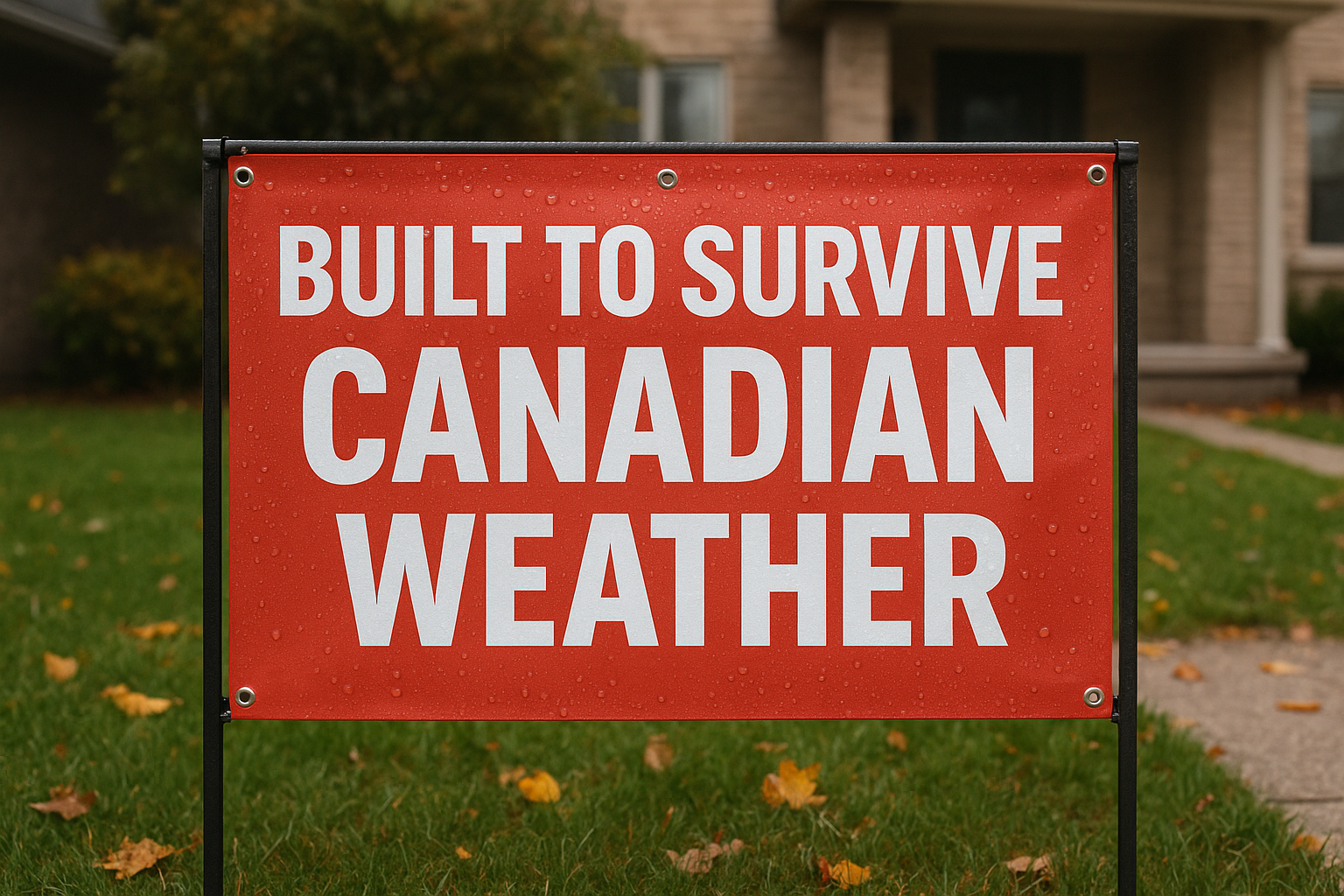
Weather is where cheap signage falls apart, literally. A banner printed on thin, low-grade vinyl will crack after one Ontario winter, and a sign without UV-stable inks fades to a washed-out version of your brand colours by mid-summer. Materials matter more here than almost anywhere else in print, because a sign that only looks good for a season isn’t saving you money, it’s costing you a reprint. Choosing weather-rated materials from the start, whether that’s heavy-duty coroplast or aluminum with a protective laminate, is what keeps a sign looking sharp through freeze-thaw cycles, road salt, and direct sun.
Consistent branding across every touchpoint
Finally, signage ties your whole brand together. A banner that matches the logo on your team’s custom apparel and the business cards in your wallet builds recognition faster than any single piece on its own. Customers trust businesses that look put together, and mismatched fonts or colours between your sign and your uniform quietly undercut that trust. Getting your banner and sign printing sorted alongside your other branded materials means everything a customer sees, from the truck door to the trade show booth, reinforces the same message.
How to order sign and banner printing
Ordering sign and banner printing doesn’t need to be complicated, but skipping a step almost always adds a day or two to your turnaround. Most printers, including Apex Workwear, follow the same basic sequence: you submit your idea or artwork, get a quote, approve a proof, and then wait for production and delivery. Knowing what happens at each stage helps you avoid the back-and-forth that slows down rush orders.
Getting a quote and submitting your artwork
Start by sending your rough idea, even if it’s just a photo of a napkin sketch or a logo file, along with the size and location you have in mind. A request a quote request typically gets a response within 24 hours, seven days a week, so you’re not stuck waiting until Monday to plan a weekend event. If you already have print-ready artwork, great, but plenty of customers don’t, and that’s fine too.
The fastest orders are the ones where the customer tells us exactly where the sign is going and how long it needs to last.
Design review and proofing
Once you’ve got a quote you’re happy with, an actual person reviews your design for print issues like low resolution, missing bleed, or colours that won’t translate well to vinyl or aluminum. Basic edits and layout adjustments are included at no extra cost, so a slightly off logo file or a sizing mismatch won’t kill the order or add a surprise fee. You’ll see a digital proof before anything goes to press, which is your last chance to catch a typo or swap a colour.
Production and delivery
After you approve the proof, production starts. Here’s what the timeline usually looks like:
- Standard turnaround: most orders ship within 5 to 7 business days
- Rush orders: banners printed in a single day are available when you’re working against an event date or deadline
- Local delivery: free shipping on eligible orders across the GTA and surrounding areas
- Production location: everything is made in Canada, so there’s no cross-border shipping delay
That combination of fast review, real proofing, and Canadian production is what makes signs and banner printing manageable even when you’re ordering a week before a trade show.
Choosing the right materials, finishes and sizes
Once you know what you’re advertising, the next decision is what to print it on, and that choice depends entirely on where the sign lives. A banner hanging inside a trade show booth has completely different needs than a yard sign staked into wet ground for a month. Getting this wrong is the single biggest reason people end up reordering signage within a year.
Matching material to environment
Every material has a sweet spot, and picking outside that range shortens the life of your sign fast. Vinyl banners handle wind and rain well but aren’t meant for years of direct exposure. Coroplast is cheap and disposable, ideal for short campaigns, and it comes in standard yard sign sizes like 18×24 and 24×36. Aluminum and dibond hold up the longest but cost more upfront.
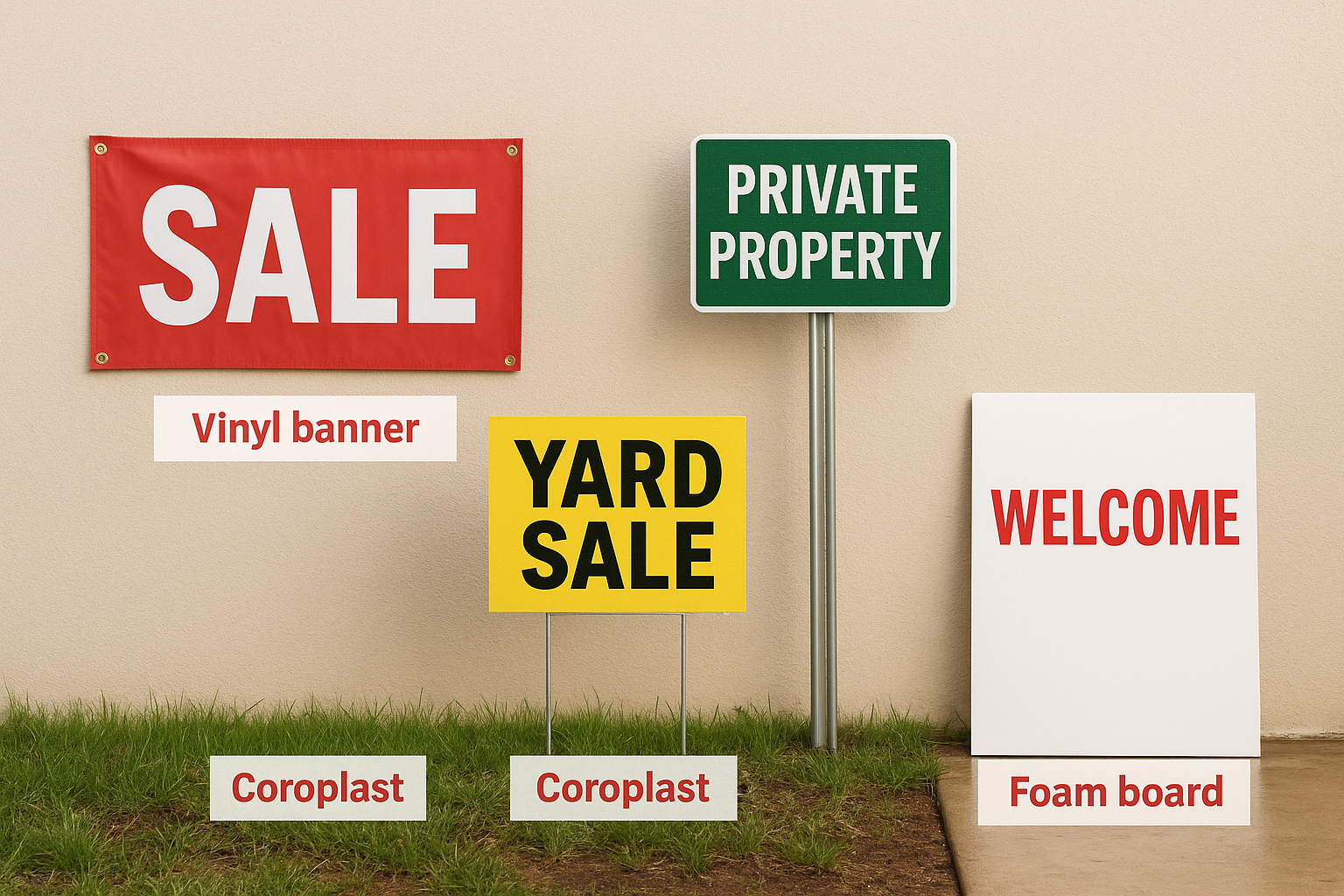
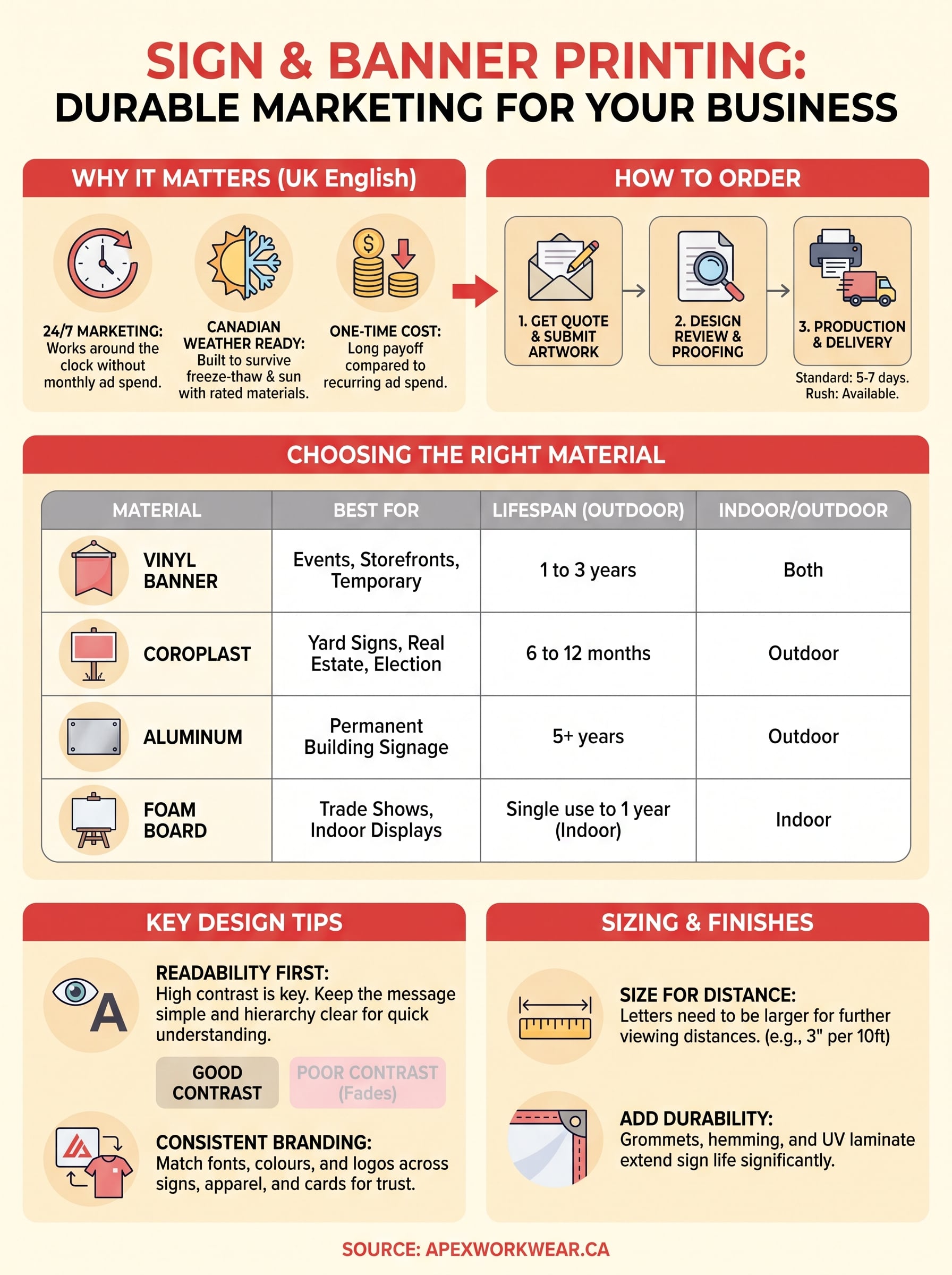
| Material | Best for | Typical lifespan | Indoor/outdoor |
|---|---|---|---|
| Vinyl banner | Events, storefronts, temporary displays | 1 to 3 years | Both |
| Coroplast | Yard signs, real estate, election signs | 6 to 12 months | Outdoor |
| Aluminum | Permanent building or property signage | 5+ years | Outdoor |
| Foam board | Trade show displays, presentations | Single use to 1 year | Indoor |
Match the material to the weather it’ll actually face, not the weather you hope it’ll face.
Finishes that add durability
Beyond the base material, finishing details decide how well a sign survives handling and weather. Grommets let a banner get tied down in wind instead of ripping at the corners. Hemming reinforces the edges of larger vinyl pieces. UV laminate on aluminum or coroplast keeps colours from bleaching out under summer sun. None of these add much to the cost, but skipping them is how a sign fails weeks early.
Getting the size right
Size decisions come down to viewing distance, not personal preference. A banner read from a car needs letters at least three inches tall for every ten feet of distance, while a sign meant to be read on foot can run smaller. Standard banner sizes like 2×4, 3×6, and 4×8 feet cover most events, but custom dimensions are common for storefronts and job sites with odd spacing. Talking through your exact placement with a printer before you order, and understanding how large format printing works, saves you from a sign that’s technically correct but practically unreadable from the street.
Common uses and design tips for signs and banners
Signs and banners show up everywhere once you start looking, from a real estate yard sign on a quiet street to a full storefront banner announcing a grand opening. Contractors use coroplast signs to mark active job sites and generate leads from neighbours. Event coordinators lean on vinyl banners and portable trade show displays for everything from farmers’ markets to conference booths. Understanding the common applications helps you figure out which format fits your situation before you even get to material choices.
Where signage gets used most
Here’s where sign and banner printing earns its keep for the businesses we work with:
- Storefronts and windows: seasonal promotions, hours of operation, grand openings
- Job sites: contractor yard signs, safety notices, property boundary markers
- Trade shows and markets: pop-up banners, table runners, foam board displays
- Real estate: for-sale signs and open house directionals, covered in our guide to real estate sign printing in the GTA
- Vehicles and job trailers: magnetic signs and decals that turn a truck into a moving ad
Designing for readability first
Good signage design starts with a hierarchy of information, not a crowded layout, the same principle behind designing yard signs that stay readable from the road. Put your business name or the single most important word largest, then your phone number or website second, and skip anything a driver can’t read in three seconds. High contrast beats clever colour pairings every time. Dark text on a light background, or the reverse, reads clearly at distance, while pastel-on-pastel combinations disappear entirely under bright sun.
If a sign takes more than three seconds to understand, it’s already lost most of its audience.
Keeping design consistent with your brand
Jumping between fonts and colours across your signage, apparel, and print materials makes a business look scattered. Logos, colour codes, and fonts should carry over from your custom apparel straight through to your banners and yard signs, so a customer recognises you the same way whether they’re looking at a truck, a booth, or a business card. Location matters too, a sign meant for a busy roadway needs simpler wording and bigger type than one hanging inside a quiet showroom. Working through these details before artwork goes to print is what separates signage that actually pulls in business from signage that just fills space.
Getting your signage right from the start
Good signage isn’t complicated once you know the basics: pick a material rated for where it’s actually going, size the text for the viewing distance, and keep the design simple enough to read in three seconds. Sign and banner printing only becomes a headache when those decisions get made too late, after the artwork’s already gone to print and the sign is fading in a parking lot somewhere.
Whether you need a single yard sign for a job site or a full set of banners for a trade show season, the process works best when you start with a clear picture of the material, size and finish you actually need, then let a printer fill in the technical details. That’s exactly the kind of guidance you get with a straightforward quote request.
Ready to get your signage sorted properly? Browse our banner and sign printing products and request a free quote from Apex Workwear, with expert-reviewed artwork ready within 24 hours.