If you’ve been searching for EDDM Canada options, you’ve likely discovered that the United States Postal Service’s Every Door Direct Mail programme doesn’t exist here. That’s because Canada Post operates its own unaddressed mail service, and it works differently than what you might have seen south of the border. The good news? Canada has a direct equivalent that lets you reach every household in specific neighbourhoods without needing a mailing list.
Canada Post calls this service "Neighbourhood Mail," and it’s designed specifically for businesses wanting to blanket target areas with promotional materials. Whether you’re launching a new service, promoting a seasonal sale, or simply building brand awareness in your community, Neighbourhood Mail gets your printed pieces, flyers, postcards, menus, coupons, into the hands of potential customers. For small businesses and contractors across the GTA and beyond, it’s one of the most cost-effective ways to generate local leads.
At Apex Workwear, we print the marketing materials that make these campaigns work: flyers, postcards, door hangers, and more. We see firsthand how effective a well-designed direct mail piece can be when it lands in the right neighbourhood. This guide breaks down everything you need to know about Canada Post’s Neighbourhood Mail service, how it compares to EDDM, what it costs, how to set up a campaign, and how to get your materials printed and ready to mail.
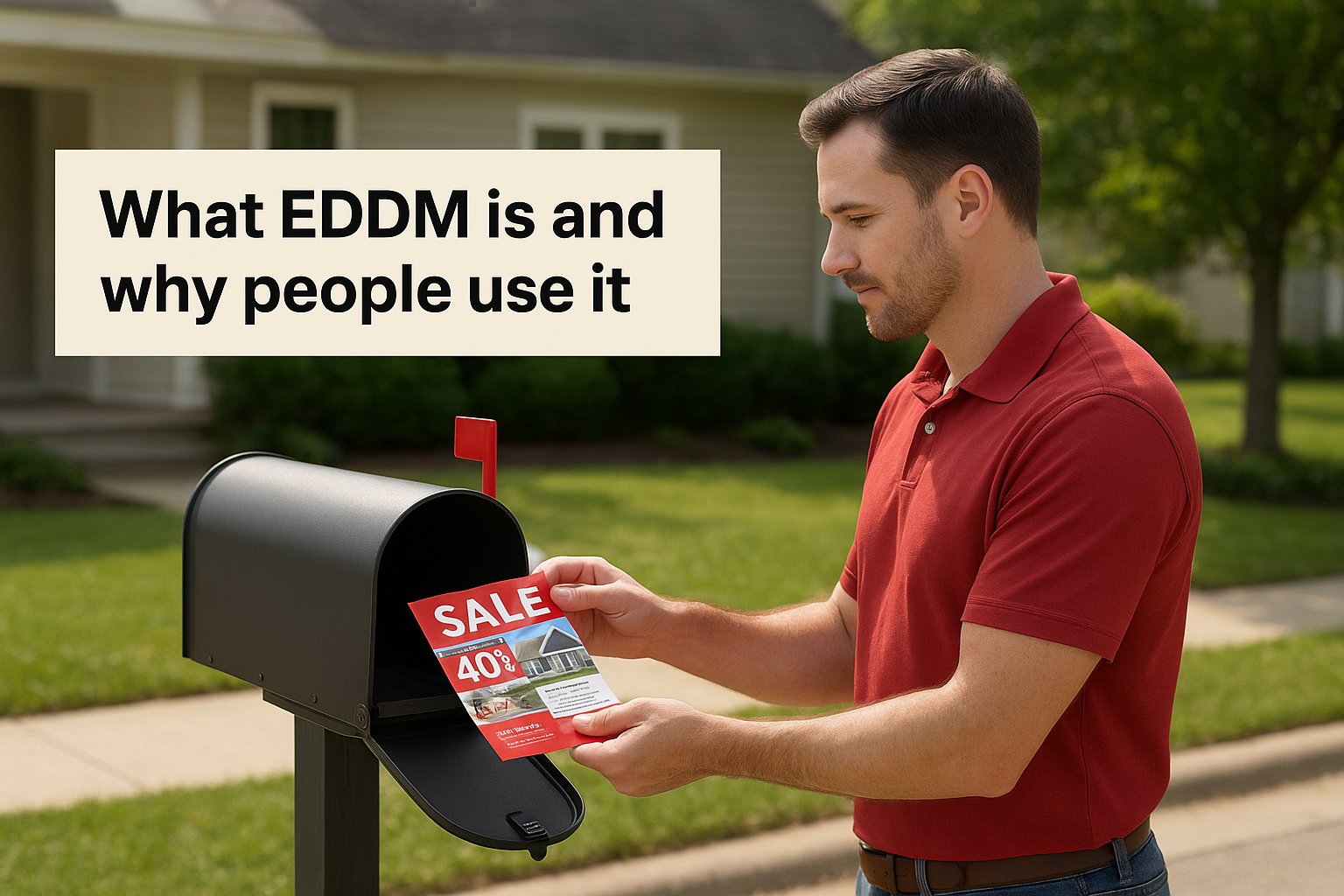
What EDDM is and why people use it
EDDM stands for Every Door Direct Mail, a service created by the United States Postal Service that lets businesses send marketing materials to every address in a specific postal route without needing individual names or a mailing list. You simply choose your target neighbourhoods using a postal route map, prepare your printed pieces according to size and format requirements, and the USPS delivers them to every residential or business mailbox along those routes. The entire appeal rests on its simplicity: no database purchases, no address labels, and no complicated targeting software required.
What EDDM actually means
The programme eliminates the traditional barriers to direct mail marketing by letting you sidestep the cost and hassle of buying or maintaining customer lists. Instead of paying for names and addresses or spending hours scrubbing data, you select carrier routes based on geography, household income, age demographics, or household size. Every address on that route receives your mailer, whether it’s a postcard, flyer, or menu. This saturation approach works particularly well when your service or product appeals to a broad local audience rather than a narrow niche.
USPS designed EDDM specifically for small businesses, restaurants, and local service providers who wanted an affordable entry point into direct mail advertising. Before this service existed, direct mail campaigns required significant upfront investment in list rental or purchase, along with the printing costs for individualized mailings. EDDM changed that dynamic by offering bulk rates and simplified preparation requirements, making it accessible to businesses that previously couldn’t justify the expense.
Why businesses choose unaddressed mail
Unaddressed mail campaigns deliver exceptional cost efficiency when you need to reach an entire neighbourhood rather than specific households. You avoid paying for list acquisition, address verification services, or personalization printing. The postage rates typically cost less than standard mail because the postal service doesn’t need to sort individual addresses. Your printed materials simply need to meet size and format specifications, then they get bundled by carrier route and delivered.
Businesses save 30 to 50 percent on postage costs compared to traditional direct mail when they use unaddressed bulk services.
Geography matters more than demographics for many local businesses. If you operate a landscaping company, pizza restaurant, or home renovation service, you care more about proximity than purchasing history. Getting your message into every household within a five-kilometre radius of your location often produces better results than targeting a carefully segmented list scattered across a wider area. Unaddressed mail ensures complete coverage of your service territory without gaps or missing addresses.
Who benefits most from EDDM campaigns
Restaurants use EDDM-style campaigns to distribute menus, coupons, and grand opening announcements throughout their delivery zones. Real estate agents send market updates and property listings to entire neighbourhoods. Home service contractors, from plumbers to painters, reach homeowners in specific postal codes where their work trucks already travel. Fitness centres, dental practices, and retail shops all benefit from the complete market penetration that unaddressed mail provides.
Seasonal businesses see particularly strong returns because they can time their mailings to coincide with peak demand periods. Lawn care companies mail before spring growth starts. Snow removal services reach homeowners before winter arrives. HVAC contractors promote furnace tune-ups in autumn and air conditioning service in late spring. The ability to blanket a target area with time-sensitive offers without the lag time of building a mailing list makes unaddressed mail ideal for these cyclical campaigns.
Those searching for eddm canada (direct mail) options typically want these same benefits: affordable postage, no mailing list requirements, complete neighbourhood coverage, and straightforward preparation. The question becomes whether Canada offers a comparable service, and if so, how it differs from the American model.
Is EDDM available in Canada
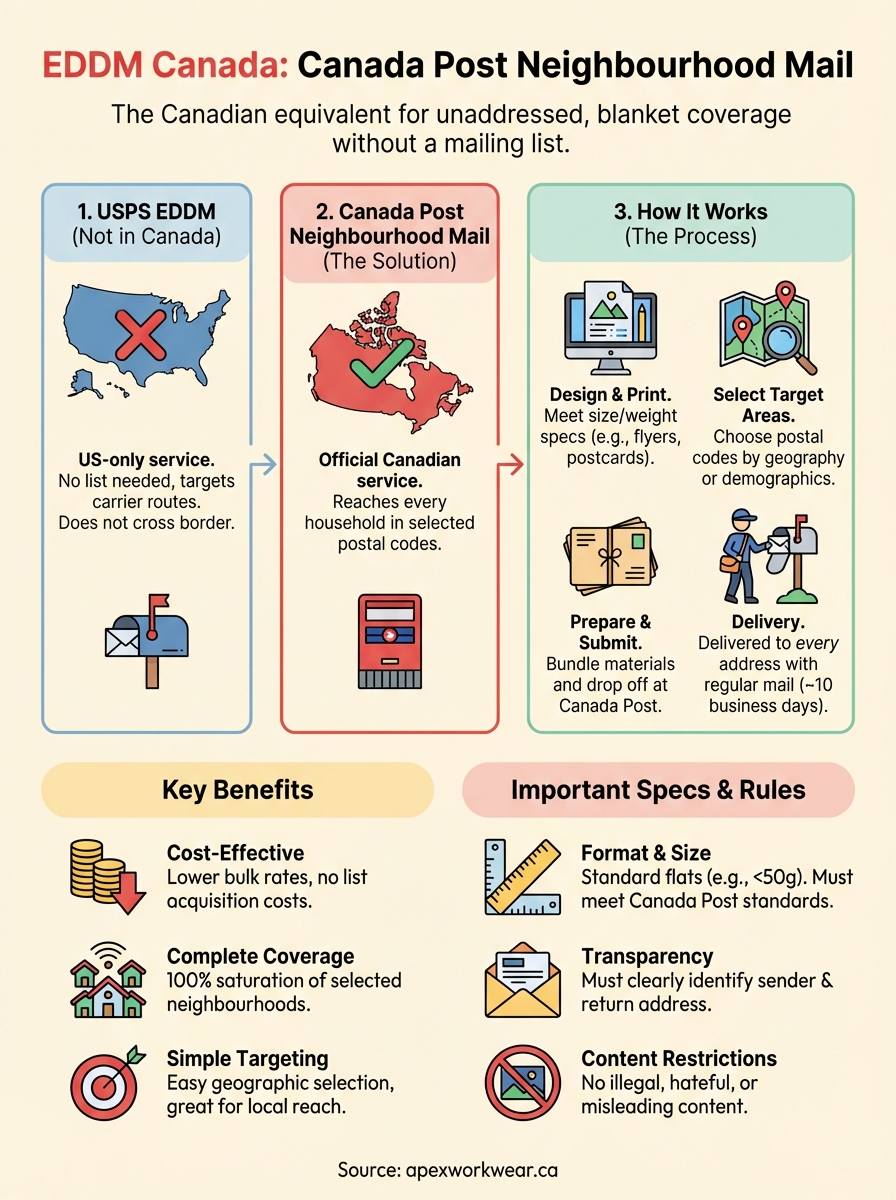
EDDM remains exclusively a United States Postal Service programme and does not operate in Canada. If you search for eddm canada (direct mail) services, you won’t find the official USPS version available through Canada Post or any other Canadian carrier. The programme was designed specifically for American postal routes, uses American postal codes, and integrates with USPS delivery infrastructure that doesn’t extend beyond US borders. You cannot purchase EDDM services from Canada Post, nor can you use USPS EDDM to mail into Canadian addresses from the United States.
Why EDDM doesn’t cross the border
The USPS created EDDM as a proprietary service tied to its internal systems, carrier routes, and operational procedures. Each country’s postal service operates independently with its own regulations, pricing structures, and delivery networks. Canada Post cannot process EDDM mailings because the routing data, sorting requirements, and delivery protocols differ fundamentally between the two national systems. Your local postal carriers follow different routes, serve different territories, and work under separate organizational mandates.
National postal services develop their own bulk mail programmes based on domestic infrastructure and customer needs rather than adopting foreign systems.
This separation affects how you prepare and submit your mailings. USPS requires specific bundling methods, sorting procedures, and documentation that align with American postal operations. Canada Post developed its own standards for unaddressed mail that reflect Canadian delivery practices, postal code structures, and regulatory requirements. You need to learn a different system if you want to run direct mail campaigns north of the border.
What Canada offers instead
Canada Post provides Neighbourhood Mail as its answer to unaddressed direct mail marketing. This service delivers the same core benefits that American businesses get from EDDM: you reach every household in selected areas without needing individual names or addresses. The mechanics differ in the details, from how you select your target areas to what size and format your printed pieces must follow, but the fundamental concept remains identical. You print your marketing materials, prepare them according to Canada Post specifications, and they get delivered to every residential or business address in your chosen postal codes.
The transition from searching for EDDM to using Neighbourhood Mail requires understanding these Canadian-specific requirements, which we cover in the following sections.
Canada Post Neighbourhood Mail explained
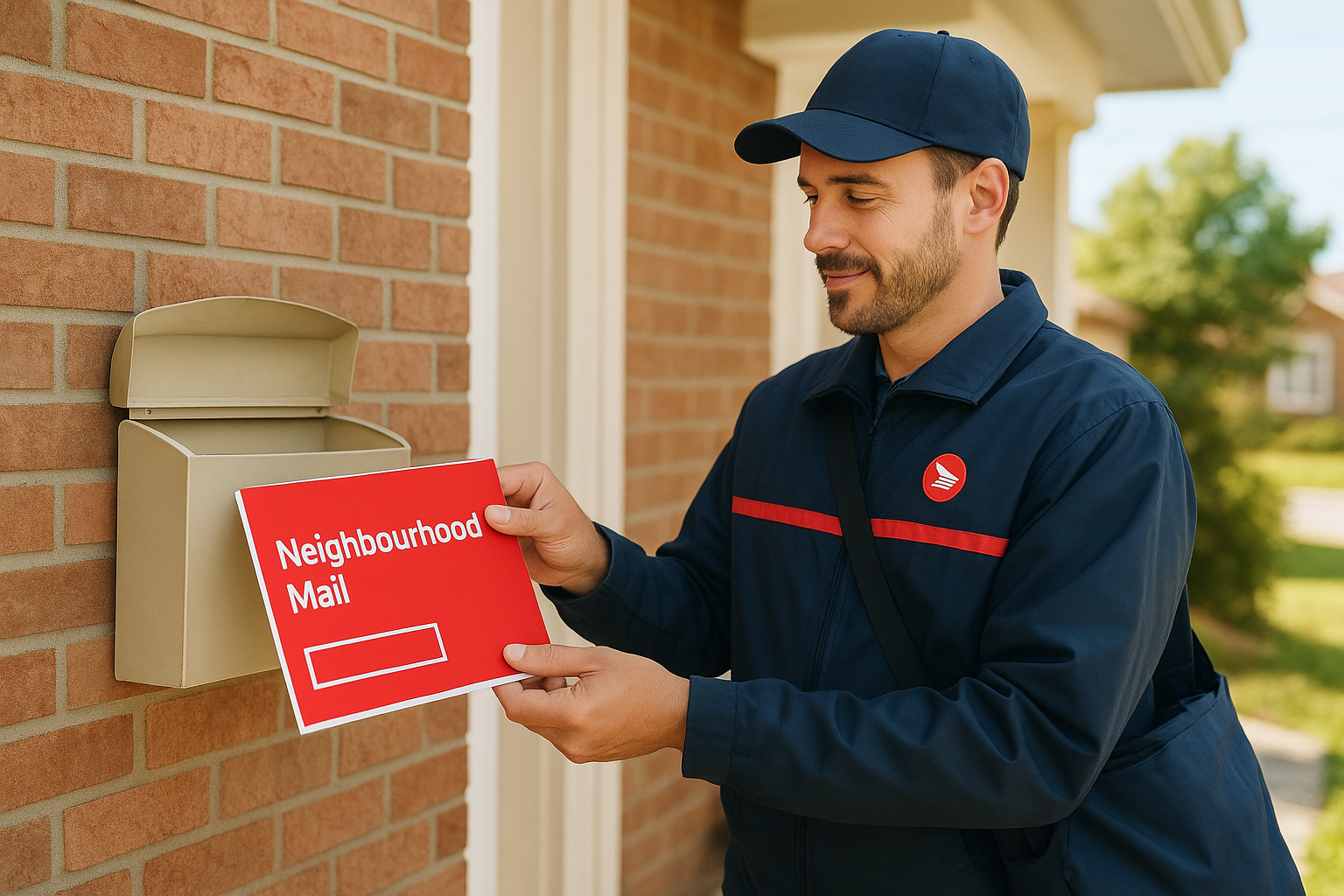
Canada Post’s Neighbourhood Mail service gives you the Canadian equivalent of what Americans know as EDDM. You design your printed marketing piece, choose your target postal codes, and Canada Post delivers it to every address in those areas without requiring individual names or a mailing list. The service handles residential and business addresses equally, ensuring complete coverage of your selected neighbourhoods. Think of it as blanket coverage for local marketing: your flyer, postcard, or menu reaches every household and business within the geographic boundaries you specify.
What the service includes
Neighbourhood Mail operates as an unaddressed admail programme under Canada Post’s commercial mail services. You prepare your printed materials according to specific size and weight requirements, bundle them properly, and drop them off at designated Canada Post facilities. The postal service then distributes your pieces to every delivery point within your selected postal code areas during regular mail delivery. Your materials arrive mixed with addressed mail rather than as separate deliveries, which means recipients encounter them alongside their bills, letters, and parcels.
Canada Post delivers approximately 15 million addresses across the country, making Neighbourhood Mail one of the most comprehensive local marketing channels available.
The programme accepts various printed formats including flyers, postcards, brochures, menus, and catalogues. You can mail as few as 5,000 pieces per campaign, though many businesses start with 10,000 to 25,000 units to cover their core service territories effectively. Canada Post requires you to print your materials before submitting them, unlike some services that offer integrated printing and mailing. This separation means you control your print quality and design by working with your chosen printer, then handle the mailing logistics separately.
How it differs from standard mail
Standard addressed mail requires you to purchase or build mailing lists, print individual addresses on each piece, and pay higher postage rates based on letter mail pricing. Neighbourhood Mail eliminates these requirements entirely. You skip the list acquisition costs, avoid personalization printing expenses, and benefit from bulk unaddressed mail rates that typically cost 30 to 50 percent less than standard postage. The trade-off is that you cannot personalize messages or exclude specific households from receiving your materials.
Canada Post delivers Neighbourhood Mail pieces within 10 business days of your drop-off date, though timing varies by season and volume. You receive less precise delivery tracking compared to addressed mail because the service focuses on geographic saturation rather than individual delivery confirmation. This approach works perfectly when searching for eddm canada (direct mail) solutions because you care more about reaching every potential customer in an area than tracking who specifically received your piece.
Who can use it
Any business, organization, or individual can use Neighbourhood Mail as long as you meet the minimum quantity requirements and follow content regulations. Restaurants distribute menus and coupons, contractors promote seasonal services, retailers announce sales, and real estate agents share market updates. Non-profit organizations use the service for fundraising appeals and event announcements. Political campaigns, community groups, and educational institutions all qualify as eligible mailers under Canada Post regulations.
You do not need a business account to get started, though establishing one streamlines the preparation and payment process for ongoing campaigns. Small businesses benefit from the same postal rates as larger companies because pricing depends on quantity and format rather than your organization’s size or shipping volume.
How targeting works with Neighbourhood Mail
Canada Post bases Neighbourhood Mail targeting on postal code geography rather than individual carrier routes. You select the postal codes where you want your materials delivered, and Canada Post drops your piece at every address within those codes. This system differs from how Americans search delivery routes when looking for eddm canada (direct mail) equivalents, but it provides equally precise geographic control. You can target as narrowly as a single postal code covering a few blocks or expand to dozens of codes spanning entire municipalities.
Selecting postal codes and delivery areas
You start by identifying which postal codes match your target market. Canada Post provides a postal code lookup tool that shows you the boundaries of each code and tells you how many delivery points it contains. Most Canadian postal codes cover 10 to 20 blocks in urban areas, though rural codes span much larger territories. You build your campaign by adding codes one at a time until you reach your desired coverage area and piece count.
Each postal code contains a specific number of addresses, and Canada Post charges you based on total pieces delivered. You cannot exclude individual households within a selected postal code. If you choose postal code M5V 3A8 in downtown Toronto, your mailer reaches every single address in that zone. This all-or-nothing approach mirrors how EDDM works south of the border, ensuring complete neighbourhood saturation without gaps.
Demographic filters and geographic tools
Canada Post offers demographic overlay data that helps you choose which postal codes to target based on household characteristics. You can filter areas by average household income, age ranges, dwelling types, household size, and language preferences. These filters appear through Canada Post’s online planning tools or through commercial mailing services that integrate this data into their route planning software.
Demographic targeting lets you focus your budget on postal codes where residents match your ideal customer profile rather than mailing randomly across entire cities.
Geographic selection works differently than demographic filtering. You might choose postal codes based on proximity to your business location, following major roads or transit lines, or creating concentric rings around your storefront. Contractors often target neighbourhoods where they already completed projects, leveraging social proof and local familiarity. The flexibility to combine geographic and demographic criteria gives you precise control over who receives your marketing materials without requiring individual names or addresses.
Mailer formats, sizes, and print requirements
Canada Post accepts specific printed formats for Neighbourhood Mail campaigns, and you need to prepare your materials correctly before submitting them. Your printed pieces must meet size, weight, and quality standards that ensure they move smoothly through sorting equipment and deliver properly to mailboxes. These requirements differ from standard letter mail specifications, so you cannot simply print regular flyers and expect them to qualify. Understanding these technical details before you design and print saves you from costly reprints and rejected submissions.
Acceptable sizes and specifications
Canada Post permits several standard formats for Neighbourhood Mail pieces, with the most common being flat unaddressed admail. Your materials must measure between 140 mm by 90 mm (roughly postcard size) and 380 mm by 305 mm (approximately tabloid size). Thickness cannot exceed 5 mm, and weight must stay under 50 grams per piece. These dimensions accommodate flyers, postcards, menus, brochures, and folded materials while excluding bulky items that might jam sorting equipment or damage mailboxes.
Staying within Canada Post’s size specifications ensures your materials process smoothly through automated sorting systems and reach every targeted address without delays.
Your printed pieces require adequate paper weight to survive postal handling. Canada Post recommends 80 lb text (120 gsm) minimum for single-sheet flyers, though 100 lb text (150 gsm) provides better durability and a more professional feel. Postcards typically use 14 pt cardstock (around 280 gsm) to prevent bending during transit. Folded pieces like brochures need proper scoring and folding to maintain their shape through the delivery process.
Paper stock and printing standards
Canada Post requires high-quality printing that resists smudging, fading, or transferring during handling. Digital printing works perfectly for runs under 10,000 pieces, while offset printing becomes more cost-effective for larger quantities. Your ink must dry completely before you bundle and submit your materials. Wet or tacky ink causes pieces to stick together, which creates sorting problems and potential rejection of your entire batch.
Design elements affect how your eddm canada (direct mail) materials perform in the postal system. You must leave clear space for Canada Post’s required indicia marking, which typically goes in the upper right corner where a stamp would normally appear. Avoid printing critical information near the edges because postal equipment sometimes crops or damages perimeter areas during processing. Your contact details and call-to-action should appear centrally where they remain visible regardless of minor handling wear.
Pricing, timelines, and delivery expectations
Canada Post prices Neighbourhood Mail campaigns based on quantity and piece size, with rates decreasing as your volume increases. You pay per delivered piece rather than per postal code, which means a campaign targeting 10,000 addresses costs the same whether you spread those pieces across two postal codes or twenty. Typical rates range from $0.12 to $0.18 per piece for standard-sized flyers, though exact pricing depends on your format, weight, and distribution volume. These costs remain significantly lower than addressed mail while delivering complete coverage of your target neighbourhoods.

What you pay per piece
Your per-piece rate drops as your total campaign volume increases. Campaigns distributing 5,000 to 10,000 pieces typically pay the highest rates, while those mailing 25,000 or more pieces qualify for better pricing tiers. Canada Post adjusts rates annually, so you should request current pricing before finalizing your budget. Format affects your costs as well: oversized pieces or heavier materials carry premium rates compared to standard postcard or flyer dimensions.
Bulk pricing rewards larger campaigns, making it cost-effective to expand your target area rather than limiting coverage to save money.
You pay separately for printing and postal services. Canada Post does not include printing costs in their Neighbourhood Mail rates. You need to budget for design, printing, and bundling before calculating postage expenses. When comparing eddm canada (direct mail) options, remember that your total campaign cost combines these elements rather than postage alone.
Delivery timelines and scheduling
Canada Post requires 10 business days to complete delivery after you submit your materials. This timeline covers sorting, routing, and distribution across all addresses in your selected postal codes. You cannot guarantee specific delivery dates, though Canada Post aims to deliver all pieces within the stated window. Seasonal volume affects timing, with holiday periods potentially adding extra days to the standard delivery schedule.
What to expect after submission
Your materials arrive mixed with regular mail at each address, appearing in mailboxes alongside bills, letters, and parcels. Canada Post delivers during normal postal rounds rather than making special trips for unaddressed mail. Residents receive your piece whenever their regular mail arrives, which varies by route and time of day. You should plan your campaign timing around when you want customers to see your message rather than when you submit materials to Canada Post.
Rules, privacy, and mailbox do’s and don’ts
Canada Post regulates what you can send through Neighbourhood Mail to protect recipients and maintain delivery standards. You must follow specific content rules and delivery protocols that differ from standard advertising regulations. Understanding these requirements prevents your campaign from getting rejected and ensures you stay compliant with postal regulations. These rules cover everything from what materials you can include to how your pieces interact with residential mailboxes.
Content restrictions and prohibited materials
Canada Post prohibits certain content types from Neighbourhood Mail campaigns regardless of your business or message. You cannot mail sexually explicit materials, hate speech, or content promoting illegal activities. Your materials must comply with Canadian advertising standards, which means avoiding false claims, misleading statements, or unsubstantiated promises about products or services. Tobacco advertising faces strict limitations, and cannabis promotions require special approval and targeting restrictions.
Your printed pieces must clearly identify the sender’s name and return address. This transparency requirement prevents anonymous mailings and gives recipients a way to contact you or request removal from future campaigns. You cannot disguise promotional materials as government correspondence, urgent notices, or official documents. Canada Post reviews submissions for compliance and rejects materials that violate these content standards before distribution begins.
Identifying your business clearly on every mailing piece builds trust with recipients and meets Canada Post’s transparency requirements.
Privacy and data handling requirements
Neighbourhood Mail campaigns do not collect or process personal information because you mail to geographic areas rather than named individuals. This approach sidesteps most privacy regulations that apply to addressed mail campaigns. You cannot track which specific households received or opened your materials, which means you operate without creating customer data profiles. Recipients who contact you through your campaign create new data relationships, but those interactions fall under standard privacy laws rather than postal regulations.
Canada Post requires you to include an opt-out mechanism if you plan to run ongoing campaigns. You must honour requests from households that do not want to receive your future mailings, though implementing this system for eddm canada (direct mail) campaigns requires maintaining your own suppression list since Canada Post cannot filter individual addresses from selected postal codes.
Mailbox access and delivery rules
Canada Post carriers place your materials directly inside residential mailboxes alongside regular mail. You cannot attach items to mailboxes, hang materials on doors, or leave pieces in unsecured locations. Only Canada Post employees access mailboxes during delivery, which means you cannot distribute materials yourself to save postage costs. Attempting to use mailboxes without proper postage constitutes a federal offence under postal regulations.
Properties displaying "No Flyers" or "No Junk Mail" signs still receive Neighbourhood Mail because Canada Post classifies it as legitimate postal delivery rather than unsolicited flyers. However, respecting these preferences builds community goodwill even when regulations permit delivery. You control how your campaign appears by investing in quality design and relevant messaging that recipients value rather than discard immediately.
Where to go from here
You now understand how Canada Post’s Neighbourhood Mail serves as the direct Canadian equivalent when searching for eddm canada (direct mail) solutions. The service delivers complete neighbourhood coverage without requiring mailing lists, offering affordable bulk rates and straightforward preparation requirements. You select your target postal codes, prepare your printed materials according to size and weight specifications, and Canada Post handles delivery to every address in those areas within 10 business days.
Your next step involves getting your marketing materials printed and ready to mail. You need flyers, postcards, or door hangers that meet Canada Post’s technical requirements while grabbing attention in crowded mailboxes. Quality printing makes the difference between pieces that generate responses and materials that get discarded immediately.
Apex Workwear prints the flyers and marketing materials that power successful Neighbourhood Mail campaigns across the GTA and beyond. We handle everything from design assistance to finished printed pieces, ensuring your materials meet Canada Post specifications while delivering professional results that reflect well on your business.