
Every invoice, work order, or receipt your business hands out needs to be trackable. That’s exactly what sequential numbering on NCR forms does, it assigns a unique, consecutive number to each copy in a set, so nothing gets lost, duplicated, or disputed. It sounds simple because it is. But skipping this step is one of the fastest ways to create accounting headaches and customer disputes down the road.
Whether you’re a contractor writing up job estimates, a small business owner processing sales orders, or a startup trying to keep your paperwork tight, numbered NCR forms bring structure to your day-to-day operations. They give you a reliable paper trail without relying on software or apps. And when tax season rolls around or a client questions a charge, that sequential number is your proof that the transaction happened exactly as recorded.
At Apex Workwear, we print custom NCR forms right here in Canada, with sequential numbering included. This article breaks down what sequential numbering actually is, how it works in practice, and why it matters for your business. We’ll also walk you through design considerations and ordering options so you can get forms that fit your workflow perfectly.
Why sequential numbering matters for NCR forms
When you hand a customer or job site a form, that document needs to be traceable back to a specific transaction. Sequential numbering on NCR forms gives every form set a unique identifier, so both you and the other party can reference the same record without confusion. Skipping this step seems harmless until you’re trying to track down a missing order or resolve a billing dispute weeks after the fact.
It creates accountability on both sides
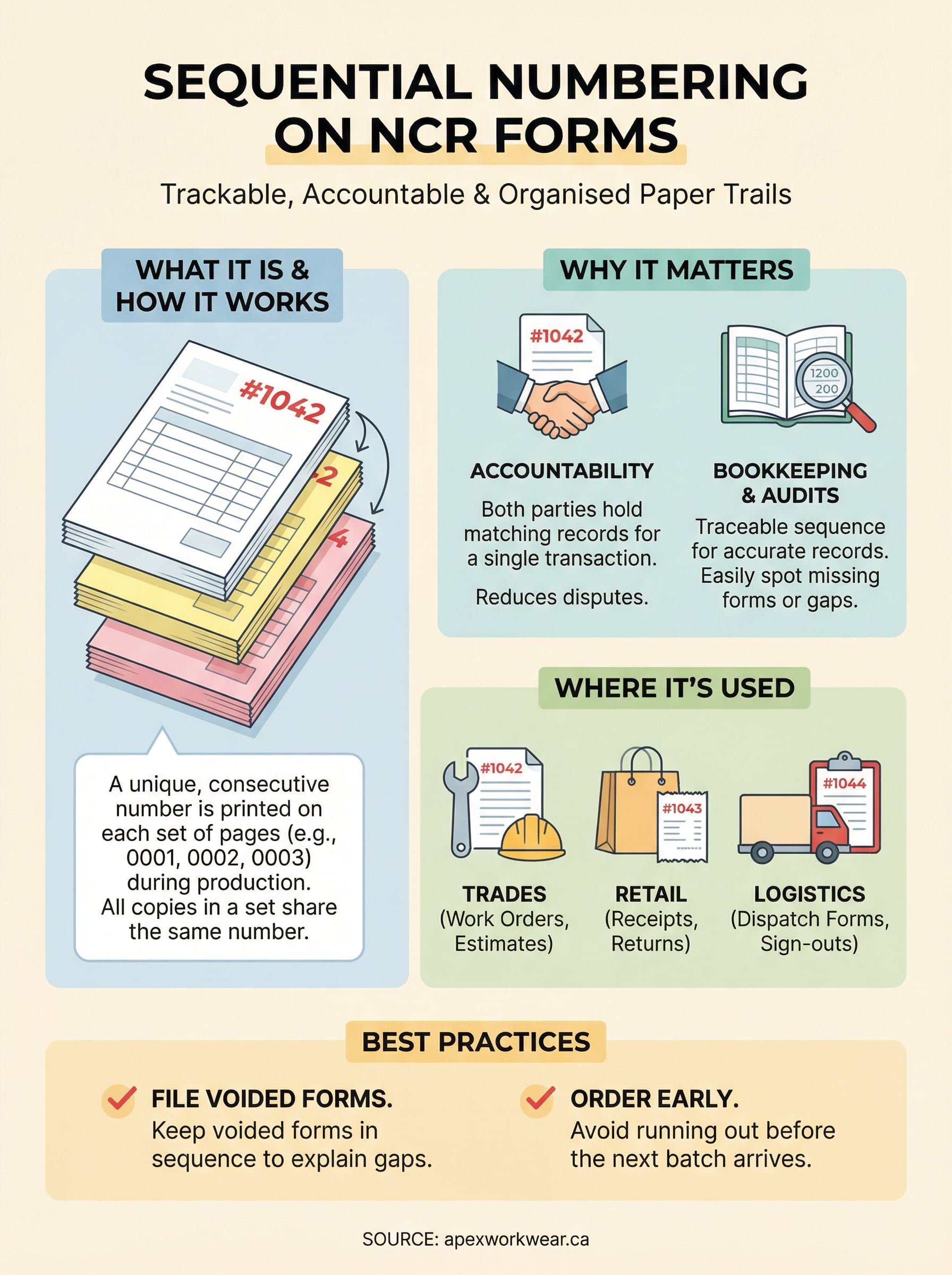
A numbered form is harder to dispute. When your customer signs off on a work order carrying form number 1042, and your copy shows the same number, there’s no room for a "we never agreed to that" conversation. Both parties hold matching records tied to a single transaction, which protects you legally and professionally.
Numbered forms shift disputes from "your word against mine" to a documented, numbered record that both parties hold.
Each form in the sequence also acts as a checkpoint. If you’re processing 30 jobs a week and form 1017 is missing from your records, you know immediately that something needs chasing down. That kind of gap detection is simply impossible with generic, unnumbered forms.
It supports accurate bookkeeping and auditing
Your accountant, bookkeeper, or the Canada Revenue Agency may ask you to produce records for a specific period. Sequential numbering makes that process straightforward. You can pull every form in a numbered range and confirm that no transactions are unaccounted for. Gaps in your sequence flag missing paperwork before it becomes a compliance problem.
Numbered NCR forms also integrate naturally with most accounting workflows. Many businesses assign form numbers directly to invoice or purchase order references, creating a clean link between the physical copy and any digital records. This cross-referencing saves time during reconciliation and reduces the chance of double-billing or missed charges on your end.
Where businesses use sequentially numbered NCR forms
Sequential numbering on NCR forms shows up across almost every service-based and product-based business that handles recurring transactions. If you issue the same type of document repeatedly, a numbered multi-copy form keeps your records clean and consistent without any extra admin work.
Trades and service-based businesses
Contractors, electricians, plumbers, and landscapers rely on numbered work orders and job estimates more than almost any other sector. When you’re running multiple crews across multiple sites, a unique form number tells you exactly which job a document belongs to and whether it’s been signed off. Missing or duplicate records in trades work can lead to unpaid invoices or liability issues, and sequential numbering closes that gap fast.
A numbered work order gives every job a paper identity, which matters when clients question scope or pricing weeks after the work is done.
Retail, events, and logistics
Retail businesses use numbered NCR forms for sales receipts and return authorisations, giving both staff and customers a shared reference point for every transaction. Event coordinators use them for vendor agreements and equipment sign-outs, where tracking who received what is critical to a smooth operation. Logistics and delivery companies rely on numbered dispatch forms to confirm that goods left the warehouse and arrived at the destination in the right condition.
Across all of these industries, the common thread is the same: numbered forms create a verifiable chain of documentation that protects your business and keeps your operations running without gaps.
How sequential numbering works on NCR forms
Sequential numbering on NCR forms is printed directly onto the form pad before it reaches you. A unique number is applied to each set of pages, typically in the top or bottom corner, so every copy in that set, whether it’s a duplicate or triplicate, carries the same identifying number. The numbering runs consecutively across the full print run, meaning your forms might start at 0001 and run to 0500 depending on the quantity you order.
Where the number sits on the form
You choose the placement and starting number when you place your order. Most businesses put the number in the upper right corner for quick reference, but lower corners work just as well depending on your layout. The number is usually printed in a contrasting colour or bold font so it stands out from the rest of the content and is easy to locate under pressure.
Placing the number in a consistent location across all your forms makes referencing and filing significantly faster for your team.
How all copies share the same number
Each multi-part NCR set is collated and numbered as a single unit, so the top white sheet and every coloured copy beneath it share one identical number. When you write on the top sheet, your details transfer through to the copies below via the pressure-sensitive coating on the paper. This means every party receives a copy with the same reference number, which is the foundation of a clean, traceable paper trail.

How to design and order numbered NCR forms
Before you submit your artwork, you need to make a few key decisions that directly affect how your forms function in the field. Sequential numbering on NCR forms starts with getting the details right at the design stage, because changes after printing mean restarting the entire run, which costs both time and money.
What to sort out before you submit your artwork
Your design needs to account for where the number sits, what number you start from, and how many parts each set requires. Most businesses work with two-part (duplicate) or three-part (triplicate) sets, depending on how many copies each transaction needs. Think about your workflow: if a client, a site supervisor, and your office all need a copy, three-part forms are the right choice.

Before finalising your artwork, confirm these details:
- Starting number (for example, 0001 or 1001)
- Number placement on the form (upper right is most common)
- Number of parts per set (2-part or 3-part)
- Quantity of sets in the full print run
Placing your order with Apex Workwear
Once your design is ready, you submit it along with your specifications. The team at Apex Workwear reviews your artwork and flags any issues before going to print, so you won’t waste a full batch on an error you could have caught early.
Getting a digital proof approved before printing saves you from discovering layout or numbering errors after the full run is complete.
Rush options are available if your timeline is tight, and most orders ship within five to seven business days from a production facility right here in Canada.
Troubleshooting and best practices
Even with sequential numbering on NCR forms in place, a few common issues can undermine your record-keeping if you don’t catch them early. Most problems come down to inconsistent handling or ordering mistakes rather than print errors, and nearly all of them are preventable with a bit of planning upfront.
What to do when numbers go missing
A gap in your sequence usually means a form was voided, lost, or left out of the filing process. Never discard a voided form, even if it was filled out incorrectly. Mark it clearly as void, retain all copies, and file it in sequence with the rest of your records. That way, if an auditor or client questions the gap, you have a clear explanation ready.
Retaining voided forms in sequence prevents a missing number from looking like a missing transaction during an audit.
Keep a simple log of your current form range, which pad you’re using, and when you started it. This takes less than a minute to set up and saves considerable time if you ever need to trace a specific form back to a date or project.
Best practices for ordering and storage
Always order your next batch before you finish your current one so there’s no gap between runs. Store unused pads flat in a dry location to prevent the pressure-sensitive coating from degrading, which can cause faint or incomplete transfers on the lower copies.
Next steps
Sequential numbering on NCR forms is one of the simplest, most practical changes you can make to how your business handles paperwork. A unique number on every form set gives you accountability, cleaner records, and a reliable reference point for every transaction you process. Whether you’re running work orders across multiple job sites or issuing receipts at a retail counter, the numbering does the hard work of keeping your documentation traceable without adding any extra steps to your day.
Your next move is straightforward. Decide on your starting number, your form layout, and how many parts each set needs. Then get a quote so you know exactly what you’re working with before committing to a print run. Apex Workwear prints NCR forms right here in Canada, reviews your artwork before production, and ships most orders within five to seven business days. Order your custom NCR forms with Apex Workwear and get your paperwork sorted properly.