Choosing the right packaging printing process affects everything from how your product looks on the shelf to how much you spend per unit. Whether you’re a small business launching a new product line or a startup ordering your first batch of branded boxes, the printing method you pick determines colour accuracy, durability, and cost-effectiveness at every scale.
The problem is, most guides dump a list of techniques without explaining when each one actually makes sense. Flexography, digital, offset, gravure, screen, they all have a place, but the right choice depends on your order volume, material type, and budget. At Apex Workwear, we work with Canadian businesses every day on custom print projects, from labels and stickers to large-format signage, so we understand how critical it is to match the method to the job.
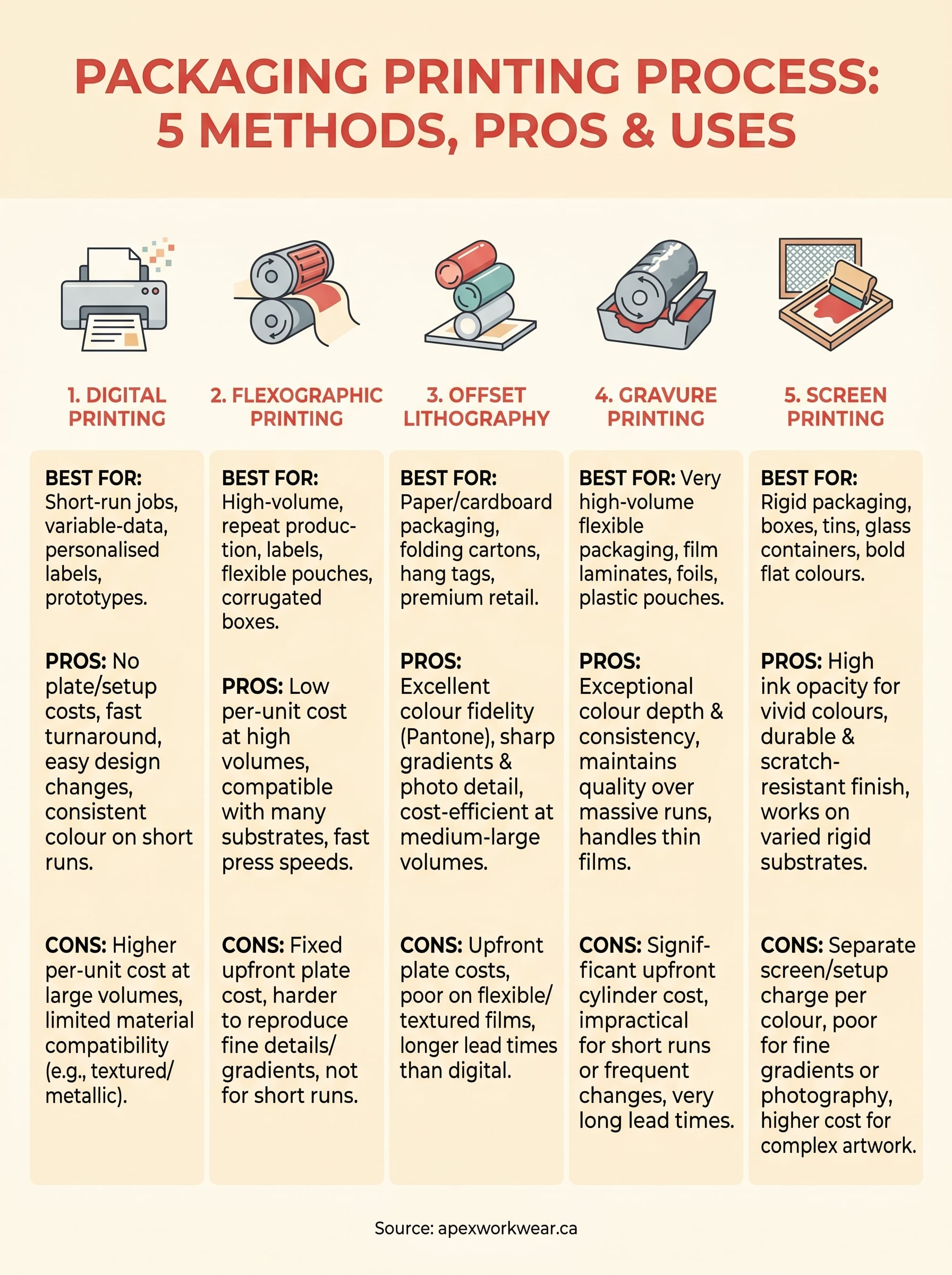
This article breaks down five major packaging printing methods, covering how each one works, where it performs best, and the trade-offs you should weigh before committing. By the end, you’ll have a clear picture of which process fits your project and your bottom line.
1. Digital printing
Digital printing uses inkjet or laser technology to transfer your design directly onto the packaging material without physical plates. It is one of the most accessible options in the packaging printing process today, and it gives smaller businesses the ability to produce professional-quality packaging without committing to large-volume runs.
How it works
A digital press reads your design file directly and applies ink or toner to the substrate, whether that is paper, cardboard, film, or label stock. Modern digital equipment uses CMYK or expanded colour gamuts to reproduce detailed graphics, gradients, and fine text with high precision, and each copy can differ from the last without stopping the press.
Where it fits best
Digital printing suits short-run jobs and variable-data applications best. If you need personalised labels, limited-edition packaging, or product prototypes, digital gives you the flexibility to order exactly the quantity you need without waste or excess stock.
If you are testing a new product or running a seasonal promotion, digital printing lets you move quickly and adjust your design between batches without penalty.
Pros for brands and procurement
The biggest advantage is no plate or setup tooling costs, which keeps your upfront spend low. You also benefit from fast turnaround times, sometimes as quick as 24 to 48 hours, and you can iterate on your design without scrapping expensive equipment.
- No minimum order on many print runs
- Quick design changes between jobs at no extra cost
- Consistent colour reproduction across short runs
Cons and watch-outs
Digital printing carries higher per-unit costs at large volumes compared to flexography or offset. Some substrates, like heavily textured surfaces or metallic films, may not accept digital ink as reliably, so confirm material compatibility with your printer before locking in your artwork.
Costs, lead times, and minimums
Expect setup costs to be low or zero, with per-unit pricing that falls as quantity increases. Most digital print jobs ship within five to seven business days, and many suppliers carry no minimum order threshold on labels and stickers.
Artwork and prepress tips
Submit your files at 300 DPI or higher and work in CMYK colour mode throughout. Convert all fonts to outlines and include a 3 mm bleed around your design to prevent white edges after trimming.
2. Flexographic printing
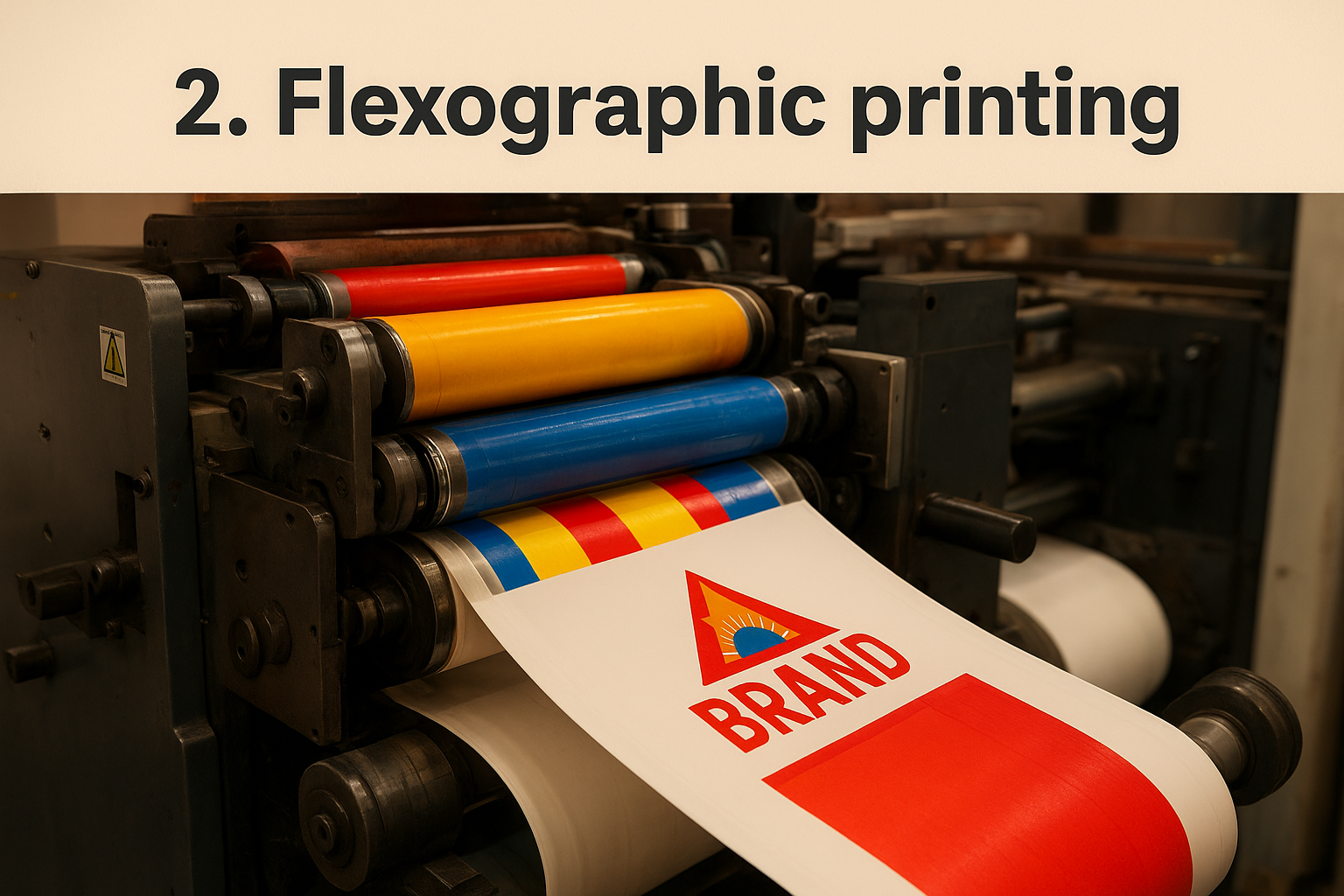
Flexographic printing uses flexible relief plates on rotating cylinders to stamp ink onto packaging at high speed. It is one of the most established methods in the packaging printing process and dominates large-scale production for food, beverage, and consumer goods brands.
How it works
A flexo press mounts your design on raised photopolymer plates, with each colour requiring its own plate and ink station. The substrate, whether film, paper, or corrugated board, feeds through continuously as the inked plates apply each colour in sequence at speed.
Where it fits best
Flexo suits high-volume, repeat production runs on labels, flexible pouches, and corrugated boxes. If you order in the thousands on a regular cycle, it gives you consistent output at a low per-unit cost.
Flexo becomes significantly more cost-effective as volume rises, so it rarely makes sense for short or one-off runs.
Pros for brands and procurement
- Low per-unit cost at high volumes
- Compatible with films, foils, paper, and corrugated substrates
- Fast press speeds keep turnaround tight on large orders
Cons and watch-outs
Plate creation adds a fixed upfront cost that pushes small-run pricing high. Fine gradients and photographic detail are also harder to reproduce cleanly, so keep your artwork bold and simple wherever possible.
Costs, lead times, and minimums
Plate fees can run several hundred to a few thousand dollars depending on colour count. Expect lead times of two to four weeks and minimum quantities in the thousands from most suppliers.
Artwork and prepress tips
Submit files in vector format with solid, high-contrast colours. Always check your printer’s dot gain specifications before finalising any fine details or thin lines in your design.
3. Offset lithography
Offset lithography transfers ink from a metal plate to a rubber blanket, then onto the substrate surface. It plays a central role in the packaging printing process for folding cartons, labels, and paper-based packaging where colour accuracy and fine detail cannot be compromised.
How it works
Ink adheres to image areas on an aluminium plate and repels from non-image areas using water. The plate rolls against a rubber blanket, which presses your design onto the substrate, delivering sharp, consistent results at scale.
Where it fits best
This method suits paper-based and cardboard packaging like folding cartons and hang tags best. It excels on flat, rigid substrates and is a strong option when your artwork includes photographic images or precise Pantone spot colours.
Pros for brands and procurement
- Excellent colour fidelity, including accurate Pantone matching
- Reproduces fine gradients and photographic detail cleanly
- Cost-efficient at medium to large volumes
Offset lithography delivers the sharpest colour accuracy of any mechanical printing method, making it a dependable choice for premium retail packaging.
Cons and watch-outs
Plate creation adds upfront tooling costs that make small runs expensive per unit. Offset also performs poorly on flexible films or highly textured materials, so confirm substrate compatibility before committing.
Costs, lead times, and minimums
Expect plate setup fees alongside minimums that typically start in the hundreds of units. Most jobs carry lead times of two to three weeks, accounting for prepress and plate production.
Artwork and prepress tips
Submit press-ready PDF files at 300 DPI with colours defined in CMYK or Pantone. Confirm trapping and overprint settings with your supplier before sending your final artwork to avoid misregistration on press.
4. Gravure printing
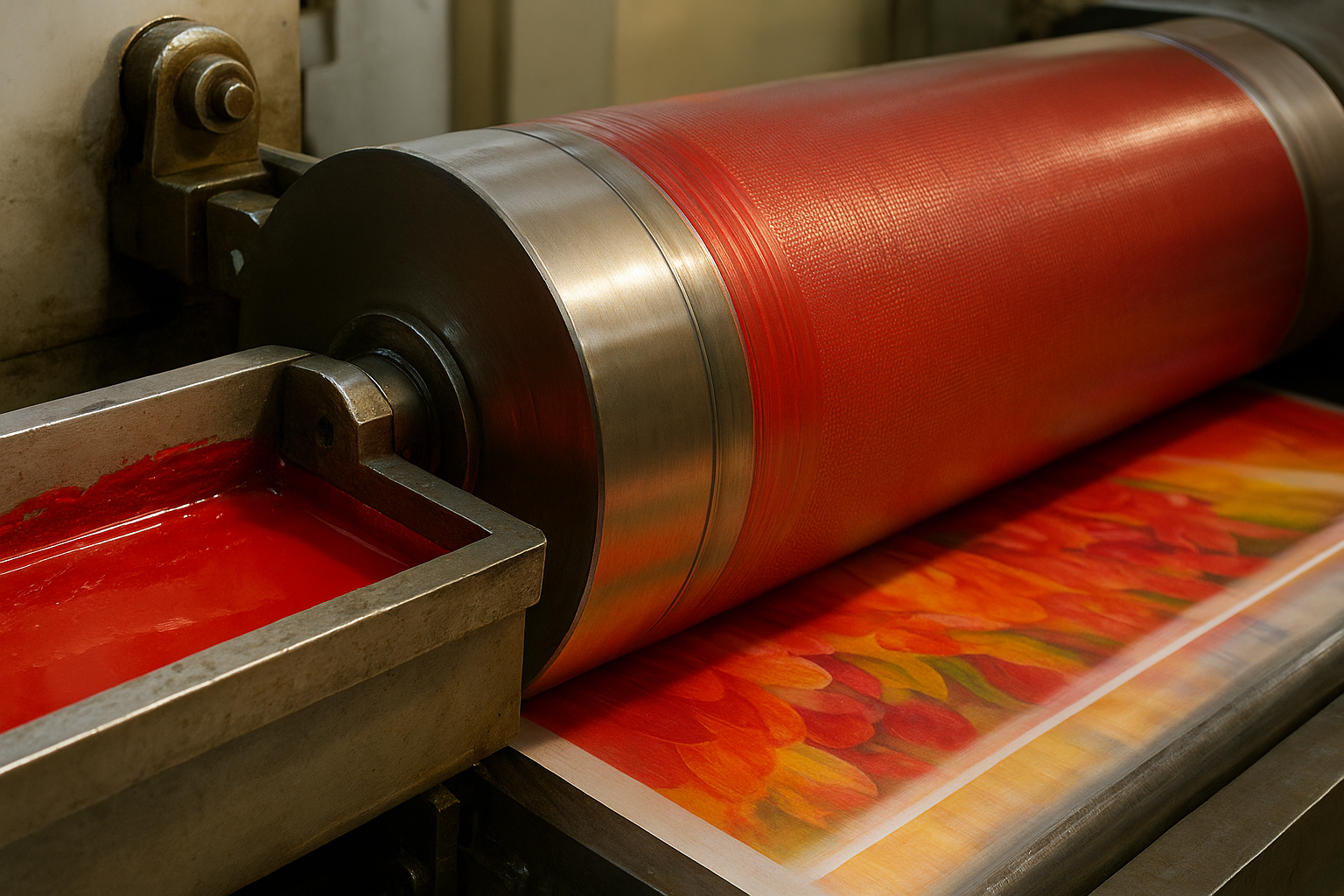
Gravure printing uses a cylinder engraved with tiny cells to carry ink directly onto the substrate, giving you some of the richest colour reproduction available in the packaging printing process.
How it works
A rotogravure cylinder picks up ink from a trough, and a doctor blade wipes away excess before the substrate contacts the cylinder. This delivers precise, consistent ink transfer across extremely long production runs.
Where it fits best
Gravure suits very high-volume flexible packaging such as film laminates, foils, and plastic pouches. It provides outstanding consistency over millions of impressions, making it standard practice for large consumer goods manufacturers.
Pros for brands and procurement
- Exceptional colour depth and tonal range on flexible substrates
- Maintains consistent quality across enormous production volumes
- Handles thin films that other methods struggle with reliably
Cons and watch-outs
Cylinder engraving carries a significant upfront cost, often the highest of any printing method. Changing your design means replacing the entire cylinder, so gravure is impractical for short runs or frequent design updates.
Costs, lead times, and minimums
Cylinder fees can reach tens of thousands of dollars per colour, with minimums running into the hundreds of thousands of units. Lead times commonly stretch to four weeks or longer.
Gravure only pays off when your volumes are consistently high and your design stays stable across multiple production cycles.
Artwork and prepress tips
Submit files with fine tonal gradients preserved, as gravure reproduces smooth colour transitions exceptionally well. Confirm your printer’s cell depth specifications before finalising artwork to ensure clean reproduction on the engraved cylinder.
5. Screen printing
Screen printing forces ink through a mesh stencil onto your packaging material, producing bold, saturated colour that stands out on rigid surfaces. It remains a straightforward option in the packaging printing process for brands that prioritise colour intensity over photographic detail.
How it works
A squeegee pushes ink through open areas of a tensioned mesh screen, transferring your design directly to the substrate. Each colour needs its own screen, and the press layers them in sequence to build the finished image.
Where it fits best
Screen printing works best on rigid packaging such as boxes, tins, and glass containers. Your designs produce the strongest results when they use a small number of bold, flat colours rather than gradients or photography.
Pros for brands and procurement
- High ink opacity delivers vivid colour on dark or uncoated surfaces
- Durable finish resists scratching and UV fading over time
- Works on a wider variety of rigid substrates than most other methods
Screen printing consistently delivers the highest colour intensity per method, making it a strong fit for premium or shelf-impact packaging.
Cons and watch-outs
Each colour adds a separate screen and setup charge, so complex artwork raises costs quickly. Reproducing fine gradients or photographic imagery is outside what this method handles well.
Costs, lead times, and minimums
Expect per-screen setup fees with minimums typically starting at 50 units. Most jobs complete within one to two weeks from artwork approval.
Artwork and prepress tips
Prepare all files in vector format with each colour on its own layer. Keep line weights above 1 mm to ensure clean ink transfer through the mesh.
What to do next
Now that you understand each method in the packaging printing process, the next step is matching the right technique to your specific project. Start with your order volume and substrate type, since those two factors alone will rule out most options and point you toward the right shortlist.
If you run a small business, digital or screen printing will likely fit your needs best. If you produce at scale, flexo or gravure will deliver the lowest per-unit cost over time. Either way, getting a quote before finalising your artwork saves you from expensive design revisions later.
At Apex Workwear, we help Canadian businesses produce high-quality custom print products, from labels and stickers to large-format signage, with no minimums on many items and fast turnaround times. Get in touch with the team at Apex Workwear to discuss your project and receive a free quote within 24 hours.