If you have ever seen a jacket or cushion with raised, textured stitching that looks almost sculpted onto the fabric, you have probably seen crewel embroidery. It is one of the oldest surviving embroidery styles, and it still confuses people who mix it up with cross-stitch or standard machine embroidery. Understanding the technique matters if you are choosing decoration methods for custom apparel or promotional pieces.
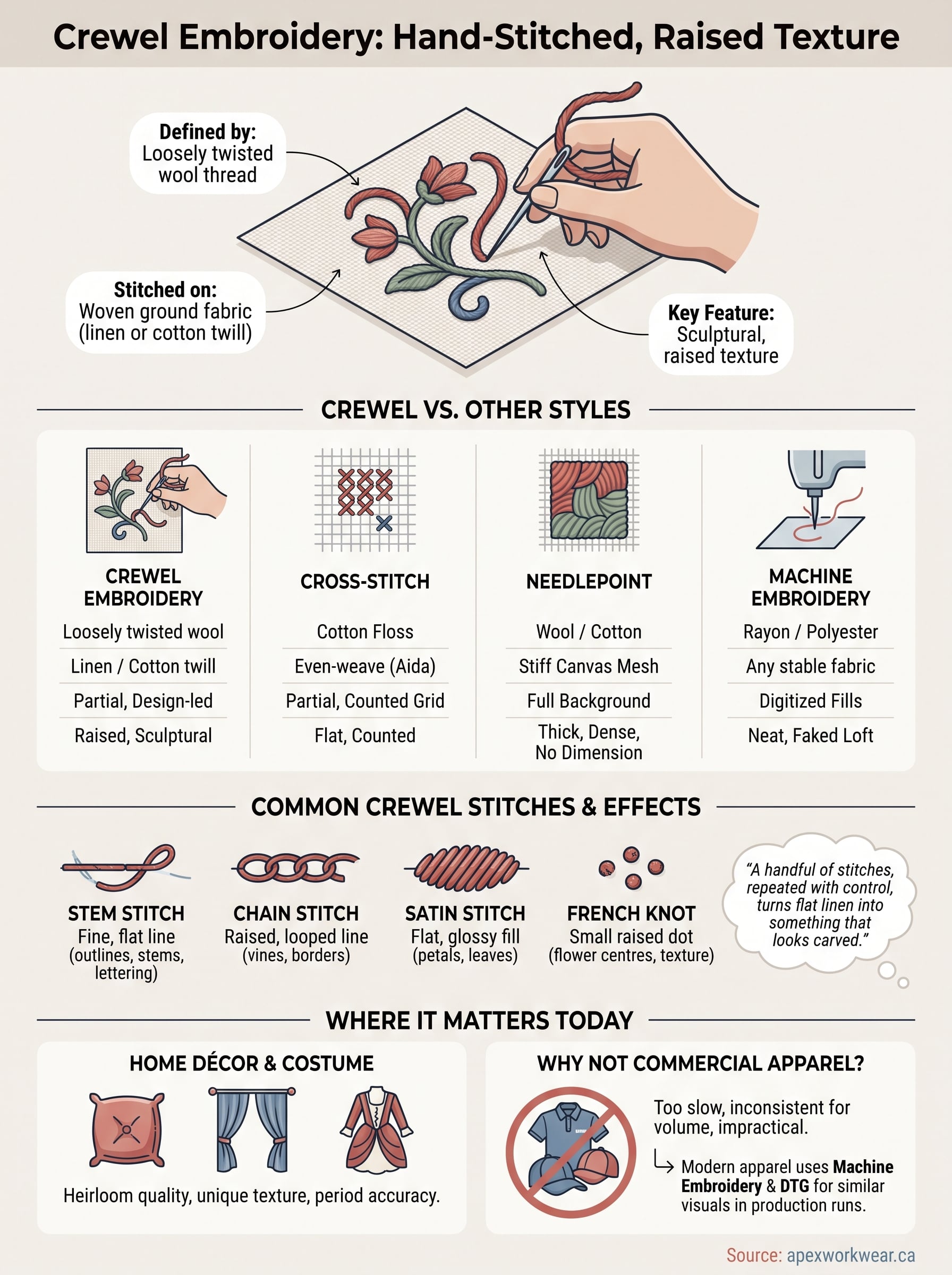
Crewel embroidery is defined by one thing: loosely twisted wool thread, stitched by hand onto a woven ground fabric, usually linen or cotton twill. The wool sits proud of the surface, giving depth that flat cotton or silk threads cannot match. Its roots trace back centuries, most famously to the Bayeux Tapestry, and the technique has stayed largely unchanged since.
In this guide, we break down exactly what separates crewel from cross-stitch, needlepoint, and standard embroidery, walk through the stitches that define the style, and explain where it still shows up in apparel and home goods today. If you are weighing decoration options for your own branded gear, we will also touch on why most modern shops, ourselves included, favour embroidery and DTG printing over hand crewel work for production runs.
Why crewel embroidery still matters today
Crewel embroidery survives because it does something machines still struggle to replicate cheaply: sculptural texture. Long after cross-stitch samplers and machine-run logos became household staples, crewel work stayed a niche craft precisely because it takes patience and skilled hands. Museums preserve Jacobean crewel hangings from the 1600s not as curiosities but as working proof that wool thread on linen can outlast centuries of handling.
A living craft tradition
Heritage groups, textile conservators, and hobbyists keep the technique alive through workshops and restoration projects. The Royal School of Needlework in the UK, for instance, still teaches crewel as part of its formal curriculum, treating it with the same seriousness as goldwork or blackwork. That kind of institutional backing tells you this is not a forgotten stitch style. It is a documented, taught, and actively practiced craft with its own body of technique passed down through apprenticeship rather than shortcuts.
Why designers still reach for it
Interior designers and costume makers return to crewel because nothing else gives fabric that raised, almost carved look without adding weight or stiffness the way beading or sequins do. A crewel-worked cushion or curtain panel reads as handmade and durable, two qualities that machine embroidery can approximate but rarely match in feel. Textile artists also value the wool thread’s forgiveness: it blends colours softly, unlike the harder sheen of cotton floss, which makes shading and naturalistic motifs like vines and birds easier to render convincingly.
Crewel embroidery endures because raised wool texture on cloth still can’t be faked by a machine.
What it means for branded apparel today
For businesses, crewel’s relevance is mostly historical and aesthetic rather than practical. It informs the visual vocabulary that modern embroidery digitizing still borrows from, thick fills, raised satin stitches, dimensional lettering. But hand crewel work is slow. A single motif can take hours, which makes it unworkable for uniforms, team apparel, or promotional runs where you need consistent results across dozens or hundreds of pieces.
Here is how crewel’s continued relevance breaks down by context:
| Setting | Why crewel still matters |
|---|---|
| Museums and archives | Preserves textile history and technique documentation |
| Fine art and costume | Delivers texture no printed or flat-stitched design can match |
| Home décor | Adds handmade, heirloom-quality detail to cushions and hangings |
| Commercial apparel | Inspires design style, but rarely used directly due to production time |
So while you will not find crewel embroidery on a batch of company polos, its influence shows up every time a modern embroidery machine is programmed to mimic raised, textured stitching. Knowing where it came from helps you appreciate what your decorator is actually recreating.
How crewel embroidery differs from other embroidery styles
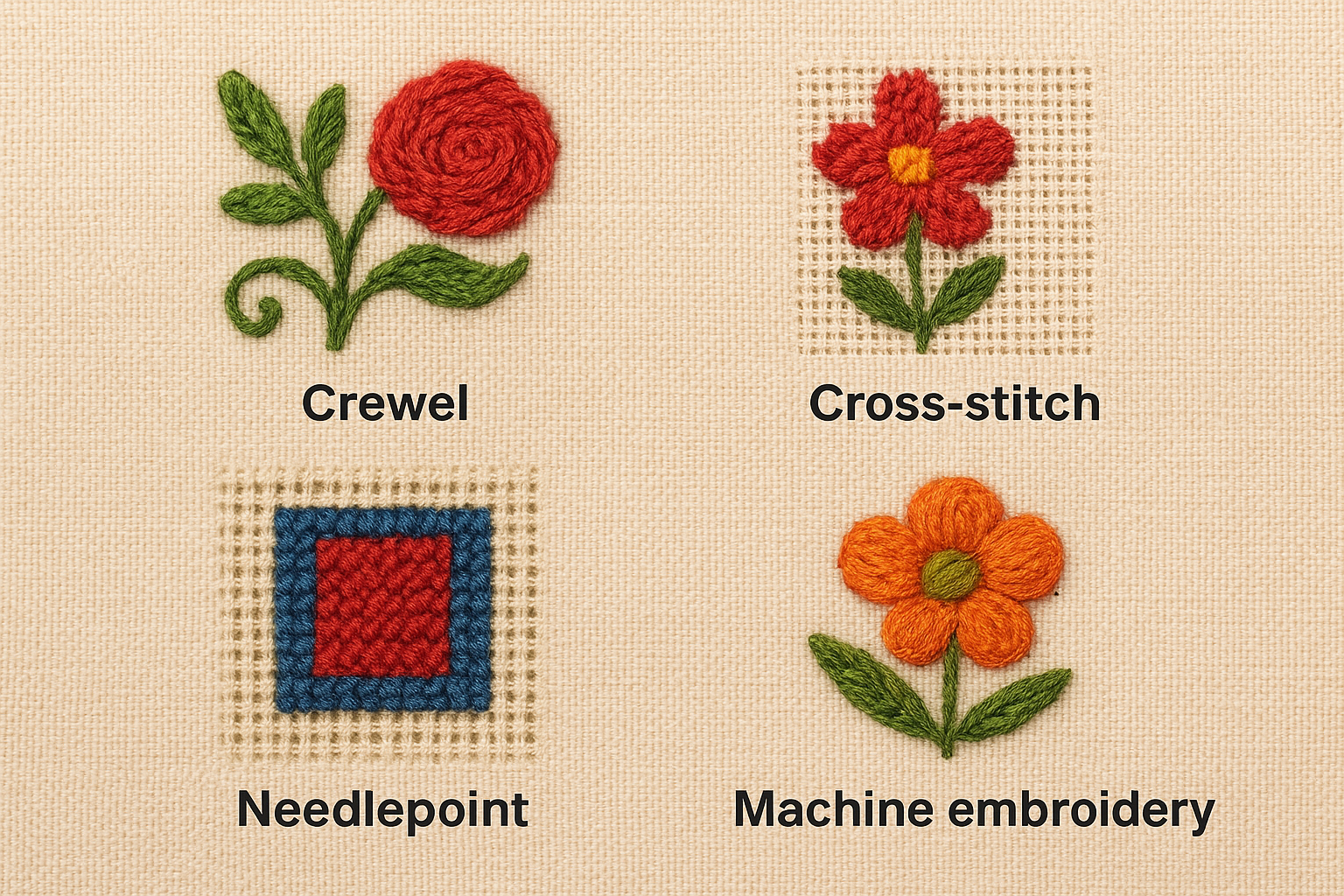
Confusion between crewel, cross-stitch, needlepoint, and machine embroidery is common, but the techniques differ in almost every way that matters: thread type, fabric base, and stitch method. Cross-stitch relies on counted X-shaped stitches worked over even-weave fabric with a grid you can count square by square. Needlepoint uses a stiff canvas mesh and covers it completely with wool or cotton, leaving no visible background. Crewel does neither. It uses loosely twisted wool thread worked freehand across a plain woven ground like linen or twill, following a printed or transferred design rather than a counted grid.
Comparing the core techniques
Here is how the four styles stack up on the details that actually change the finished look:
| Technique | Thread | Fabric | Coverage |
|---|---|---|---|
| Crewel | Loosely twisted wool | Linen or cotton twill | Partial, design-led |
| Cross-stitch | Cotton floss | Even-weave (Aida) | Partial, counted grid |
| Needlepoint | Wool or cotton | Stiff canvas mesh | Full background coverage |
| Machine embroidery | Rayon or polyester | Any stable fabric | Digitized, programmed fills |
Why texture sets crewel apart
Nothing else on that list produces the same raised, sculptural surface. Cross-stitch stays flat by design. Needlepoint builds thickness but through dense coverage rather than dimensional stitch types. Machine embroidery can fake loft with heavy fill stitches, but it uses fine synthetic thread, not thick wool, so the effect reads as neat rather than handmade.
Crewel is the only technique built specifically around wool’s thickness and drape, which is exactly why nothing else replicates its texture.
Recognizing these differences matters if you are briefing a decorator: ask for "crewel-style" texture and you will get raised satin fills, not an actual hand-worked wool piece.
How to get started with crewel embroidery
Starting crewel embroidery does not require expensive kit. You need a few specific materials, and skipping the right ones is the fastest way to get frustrated. Ground fabric matters most: pick a medium-weight linen or cotton twill that can hold tension without puckering under the weight of wool thread. Cheap quilting cotton will pucker and warp within the first few stitches.
Materials worth buying properly
Quality tools save you hours of unpicking bad stitches later. Here is a basic starter list:
- Crewel wool (also called Persian or tapestry wool), sold in small skeins by colour
- A crewel needle, sizes 3 to 9, with a sharp point and a larger eye than regular sewing needles
- An embroidery hoop or slate frame to keep fabric taut
- Transfer paper or a water-soluble pen to trace your design onto the fabric
- Small, sharp embroidery scissors
Learning the basics before tackling a full design
Beginners should practice stitches on a scrap piece before starting a real project. Stem stitch, satin stitch, and French knots cover most of what you will need for a first attempt, and mastering them on scrap linen means your actual project will not become the place you learn tension control. Once those feel natural, move to a simple printed design, a single leaf or small flower works well, rather than jumping straight into a full Jacobean-style panel with dozens of motifs.
Practice your stitches on scrap fabric first; your real project should not double as your learning curve.
Patience matters more than skill here. Wool thread behaves differently from cotton floss, it splits less but also shows every inconsistency in tension, so slow, even stitching beats speed every time. Working in good light also helps you catch mistakes before they get stitched over and buried under three more layers of thread.
Common crewel stitches and what they create
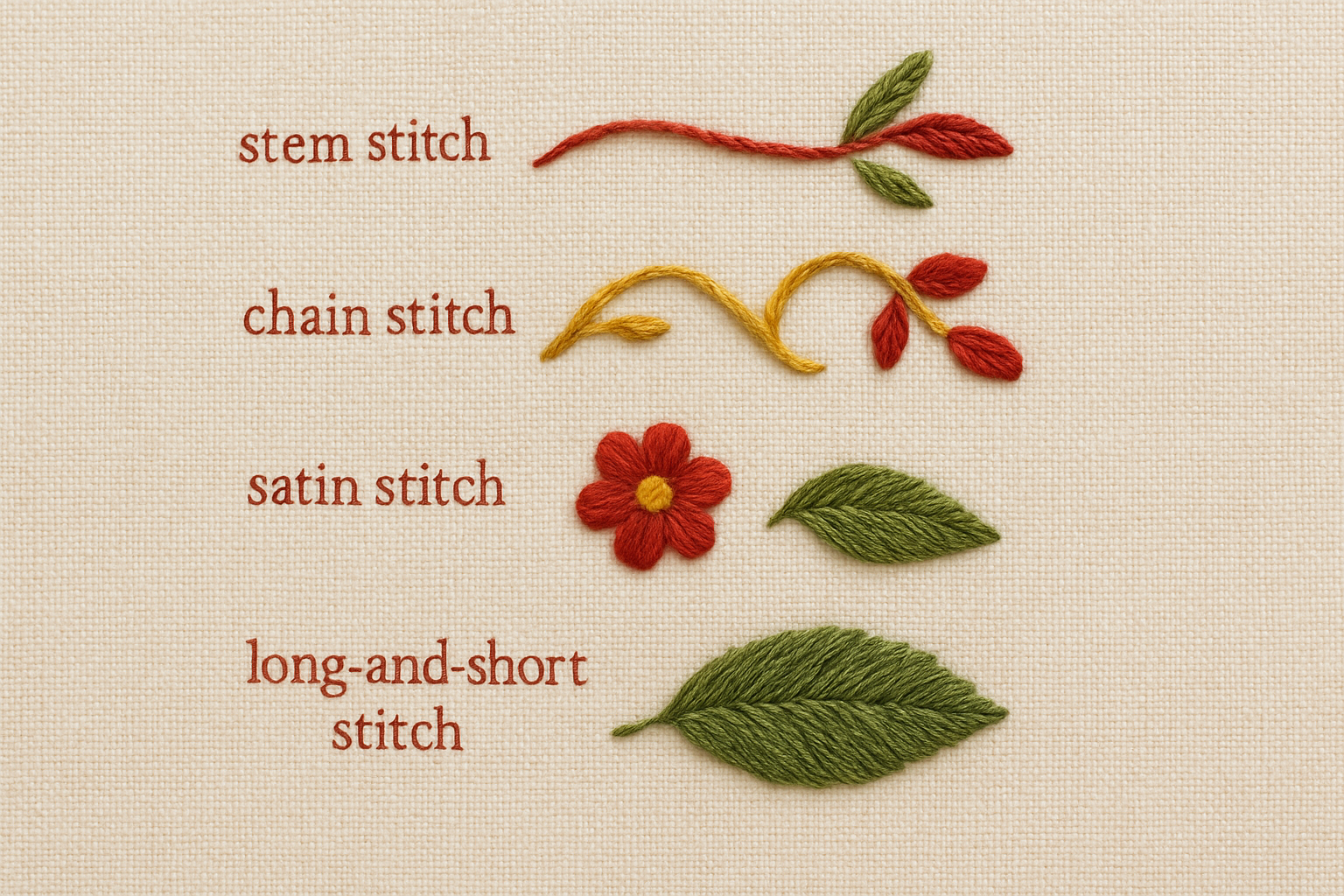
Every crewel design breaks down into a handful of core stitches, each doing a different job. Stem stitch creates fine, continuous lines and works best for stems, outlines, and lettering. It sits flat and neat, making it the workhorse stitch you will use more than any other. Chain stitch builds slightly raised, looped lines and fills wider spaces than stem stitch can, which is why old crewel hangings often use it for vines and borders.
Stitches that build texture
Satin stitch and long-and-short stitch handle the areas where you want solid colour with real dimension. Satin stitch fills small, defined shapes like petals or leaves with flat, glossy coverage, though wool’s thickness gives it more loft than the same stitch in cotton. Long-and-short stitch blends shades gradually, which is exactly how crewel artists render shaded leaves, feathers, and animal forms without hard colour breaks.
Here is a quick reference for what each stitch actually produces:
| Stitch | Effect | Common use |
|---|---|---|
| Stem stitch | Fine, flat line | Outlines, stems, lettering |
| Chain stitch | Raised, looped line | Vines, borders, thick outlines |
| Satin stitch | Flat, glossy fill | Petals, leaves, small motifs |
| Long-and-short stitch | Blended, shaded fill | Naturalistic shading |
| French knot | Small raised dot | Flower centres, texture accents |
Small stitches, big impact
French knots deserve their own mention because they do more work than their size suggests. French knots create small, raised dots that suggest flower centres, berries, or scattered texture across a background, and a cluster of them can fill a shape faster than solid satin stitch would.
A handful of stitches, repeated with control, is all it takes to turn flat linen into something that looks carved.
Most historical crewel pieces combine only four or five stitches, layered and repeated with control rather than variety. That repetition, not stitch complexity, is what gives finished crewel work its unmistakable, dimensional look.
Where crewel embroidery shows up beyond the hoop
Crewel embroidery rarely stays confined to a hoop on a craft table. Once a design is finished, it typically ends up as functional decor, something you sit on, drape over furniture, or wear. Historical crewel work covered curtains, bed hangings, and wall panels in wealthy homes, and that legacy still shapes where you find it now.
Home and interior pieces
Cushions, upholstered chair backs, and framed wall panels remain the most common places crewel work turns up today. Interior designers commission custom crewel pieces for clients who want heirloom-quality texture that a printed fabric can’t replicate. A single crewel-worked cushion cover can take a skilled embroiderer twenty to thirty hours, which is part of why these pieces carry a premium price and get treated as investment decor rather than disposable accents.
Costume and performance wear
Theatre and film costume departments still hand-stitch crewel details onto period pieces because the raised wool reads correctly under stage lighting in a way flat printing never will. Historical reenactment groups do the same, often researching original stitch patterns from surviving Jacobean garments to keep their work accurate.
Crewel survives on stage and in period costume because raised wool catches light the way flat print never can.
Where it stops making sense
Beyond decor and costume, crewel embroidery mostly disappears from commercial production. It shows up in art installations and museum reproduction work, but you won’t find it on branded polos, hats, or team jackets. The hours involved make it impractical for anything produced in volume, which is exactly why modern apparel decorators rely on machine embroidery and DTG printing instead: same visual inspiration, far faster turnaround, and consistent results across a full order rather than one painstaking piece at a time.
Bringing crewel embroidery into your own projects
Crewel embroidery earns its place in textile history through wool thread worked by hand, not through any shortcut a machine can replicate. That raised, sculptural texture is the whole point, and it’s why the technique still shows up in museums, costume departments, and high-end home décor rather than on a rack of team polos. Knowing the difference between crewel, cross-stitch, and machine embroidery gives you a clearer sense of what you’re actually asking for when you brief a decorator on a project.
If you’re outfitting a team, promoting a business, or ordering apparel in any real quantity, hand crewel work simply isn’t the right tool. Machine embroidery and DTG printing borrow crewel’s visual language, raised fills, dimensional lettering, without the hours-long price tag. When you’re ready to turn that inspiration into apparel your whole team can wear, get a free quote from Apex Workwear and we’ll help you pick the finish that actually fits your order.