Choosing between saddle stitch vs perfect bound comes down to a few practical factors: how many pages you’re working with, what impression you want to make, and how much you’re looking to spend. Both binding methods have clear strengths, but picking the wrong one can mean a booklet that won’t lay flat, a spine that cracks, or a per-unit cost that eats into your budget for no good reason.
Whether you’re putting together product catalogues, training manuals, or branded lookbooks, the binding method shapes how your finished piece looks and holds up. At Apex Workwear, we help Canadian businesses produce print materials that match their brand, from brochures and booklets to large-format signage, so we walk clients through decisions like this regularly. It’s one of those details that seems minor until you’re holding the final product in your hands.
This guide breaks down the real differences between saddle stitch and perfect binding, including page count limits, cost considerations, durability, and when each method actually makes sense. By the end, you’ll know exactly which option fits your next project, and why.
Why binding choice matters for print projects
Binding is not a finishing detail you sort out after everything else is decided. It’s a structural choice that affects how your print piece is used, how long it lasts, and what it signals to the person holding it. When you’re comparing saddle stitch vs perfect bound options, you’re really deciding how your content is packaged, and that packaging either supports or undermines the message inside.
First impressions start with the cover
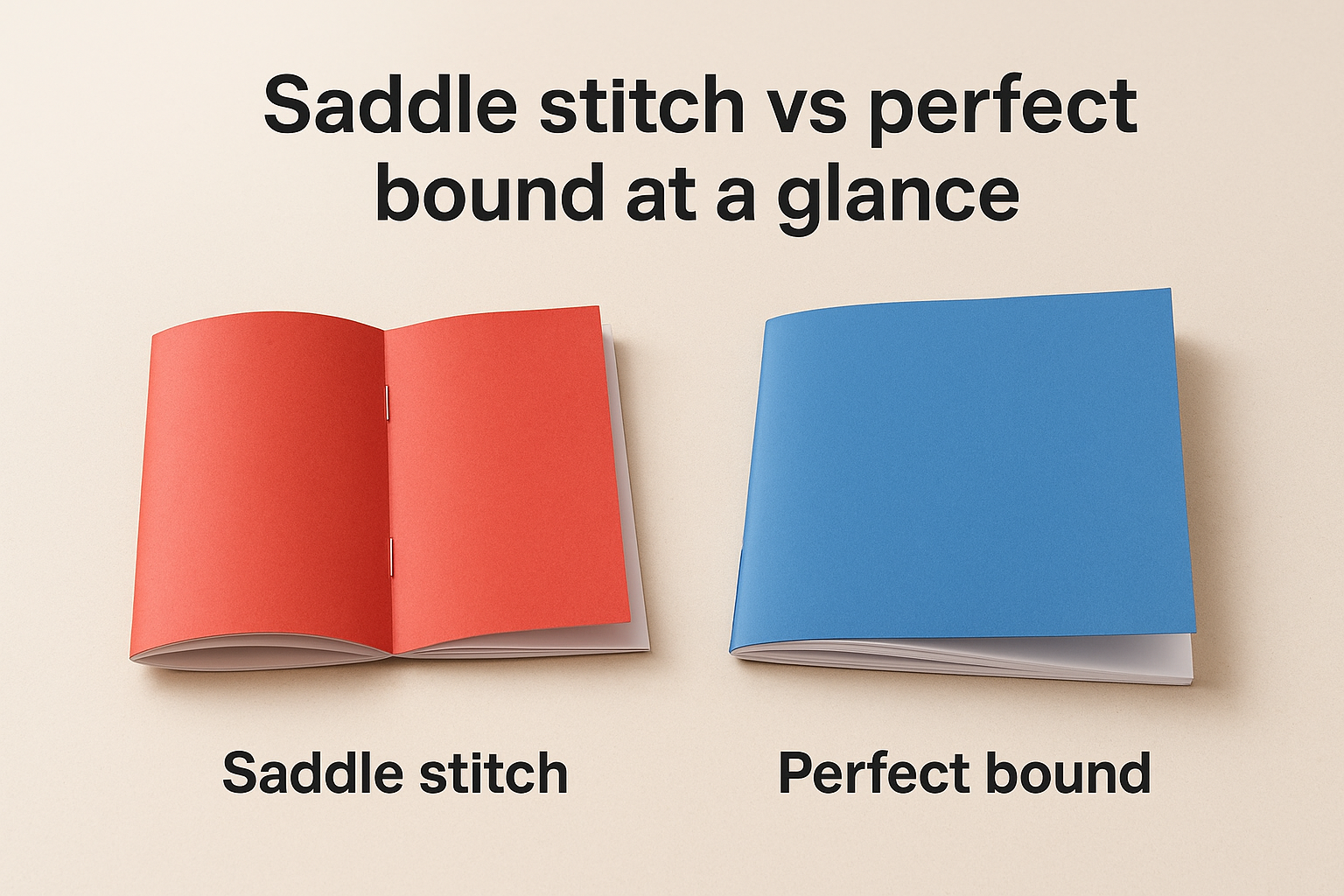
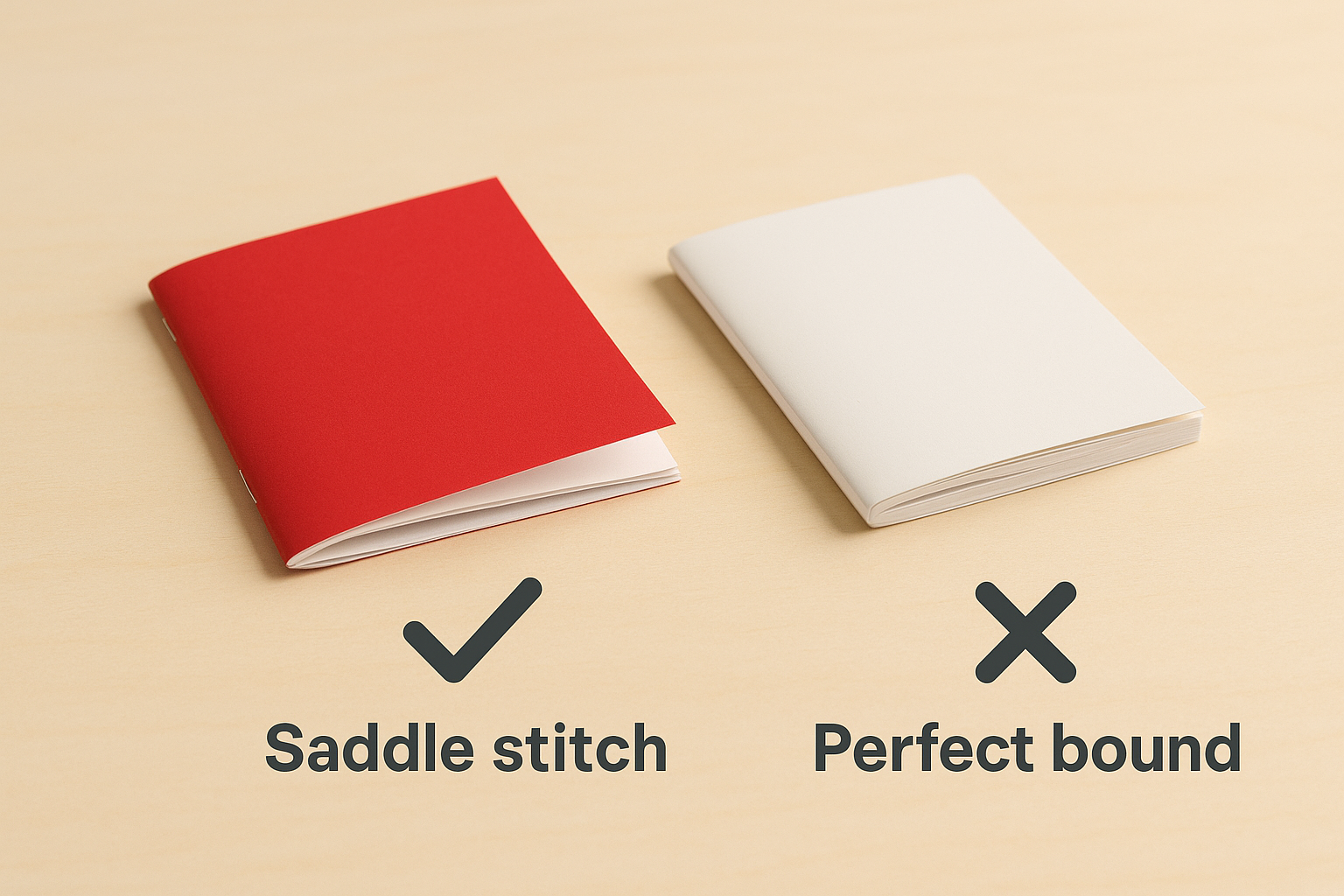
Your binding method is visible the moment someone picks up your booklet, catalogue, or manual. Saddle-stitched pieces have a folded, stapled edge with no spine, which gives them a lean, clean look that works well for shorter documents. Perfect bound pieces have a flat, glued spine you can print text on, which immediately reads as more substantial and polished.
The spine is often the first thing a person sees when a booklet sits on a desk or shelf, so your binding choice is also a branding decision.
That distinction matters most when your print materials represent your business in a professional setting. A trade show catalogue with a printed spine looks like it belongs on a shelf alongside published books. A saddle-stitched version of the same catalogue might look fine, but it won’t carry the same visual weight. Neither choice is wrong, but they send different signals.
Durability depends on how the piece gets used
Not all print projects face the same wear. A product lookbook handed to a client once needs to hold together for a single read-through. A training manual that employees flip through weekly needs to survive repeated use without the cover separating or the spine cracking. Binding directly affects how well your piece holds up under that kind of handling.
Perfect binding uses a strong adhesive along the spine, which creates a durable finished edge for thicker documents. That glue, however, can dry out and crack if the booklet is forced completely flat. Saddle-stitched pieces, by contrast, lay flat naturally because the pages are folded and stapled through the centre. That makes them easier to read without holding the booklet open, but the staples can work loose over time if the piece is handled frequently.
Budget and quantity factor in early
Binding also has a direct effect on your print costs, and the impact compounds at scale. Saddle stitching is typically faster and less expensive to produce, which makes it a practical choice for high-volume runs like event programmes or promotional booklets. Perfect binding involves more steps in production, which raises the per-unit cost, particularly on smaller quantities. If you’re printing 50 copies of a branded manual, that cost difference adds up quickly and should factor into your decision before you finalise specs.
Saddle stitch vs perfect bound at a glance
Before diving into specific use cases, it helps to understand what each method actually involves. Both saddle stitch and perfect bound options produce a finished booklet, but the construction techniques differ significantly, and those differences directly shape what each format can and cannot do for your project.
How saddle stitching works
Saddle stitching folds all pages of a document in half and drives two or three wire staples through the spine of that fold. Every page is part of a single folded sheet, which is why your total page count must always be a multiple of four. This method is fast to produce, cost-effective at volume, and the finished piece lays flat without any forcing. Common uses include event programmes, small product catalogues, and promotional booklets running up to around 64 pages.
Saddle stitching is often the right default for short-run and high-volume booklets where low cost and easy readability matter more than a visible spine.
How perfect binding works
Perfect binding gathers individual pages and a heavier cover and bonds them to a flat, square spine using a strong heat-activated adhesive. Pages are trimmed and stacked rather than folded, which means higher page counts are not a problem. This method typically starts at around 40 pages and scales well into the hundreds. The square spine is printable, so you can display your title, logo, or edition number, which is exactly why perfect binding is the standard for trade paperbacks, corporate reports, and thick product catalogues.
A quick comparison makes the core differences clear:
| Feature | Saddle Stitch | Perfect Bound |
|---|---|---|
| Binding method | Staples through fold | Glued square spine |
| Typical page range | 8 to 64 pages | 40+ pages |
| Lays flat | Yes | No |
| Printable spine | No | Yes |
| Relative cost | Lower | Higher |
Pros and cons that affect real projects
Understanding the tradeoffs in the saddle stitch vs perfect bound decision helps you avoid printing something that looks off or falls apart before it reaches the right hands. Both methods have genuine strengths, and both have real limitations that affect your budget and timeline, as well as how the finished piece performs once it’s in someone’s hands.
Where saddle stitching works in your favour
Saddle stitching is fast, cost-effective, and easy to produce at volume. If you need 100 event programmes or 500 promotional booklets, the lower per-unit cost gives you more room to invest in paper quality or full-colour cover printing. The flat lay is another genuine advantage: readers can open a saddle-stitched piece on a desk and see both pages clearly without holding it open, which matters for anything people need to write in or reference while working.
Once your content pushes past 64 pages, saddle stitching stops being a viable option and you need to shift your spec accordingly.
On the downside, saddle-stitched pieces have no spine to print on, and the wire staples can work loose or become visible with repeated handling. For anything representing your business in a corporate or senior professional context, the format can read as lightweight even when the content inside is not.
Where perfect binding earns its cost
Perfect binding gives your piece a substantial, finished appearance that reads as professional across almost any context. The printable spine means your catalogue or manual can sit on a shelf and remain identifiable at a glance, which is valuable when your materials need to be found and referenced repeatedly. The strong adhesive also holds up better over time for thicker, frequently handled documents.
The main downside is cost and minimum page count. Perfect binding on a 40-page document costs more to produce than a saddle-stitched equivalent, and the pages do not lay flat under the hand, which some readers find awkward for longer read-throughs.
Page counts, paper, and spine details
The technical specs behind saddle stitch vs perfect bound directly determine whether your chosen format is even viable for your project. Getting these numbers right before you submit files saves you from reprints and delays.
Page count rules for each method
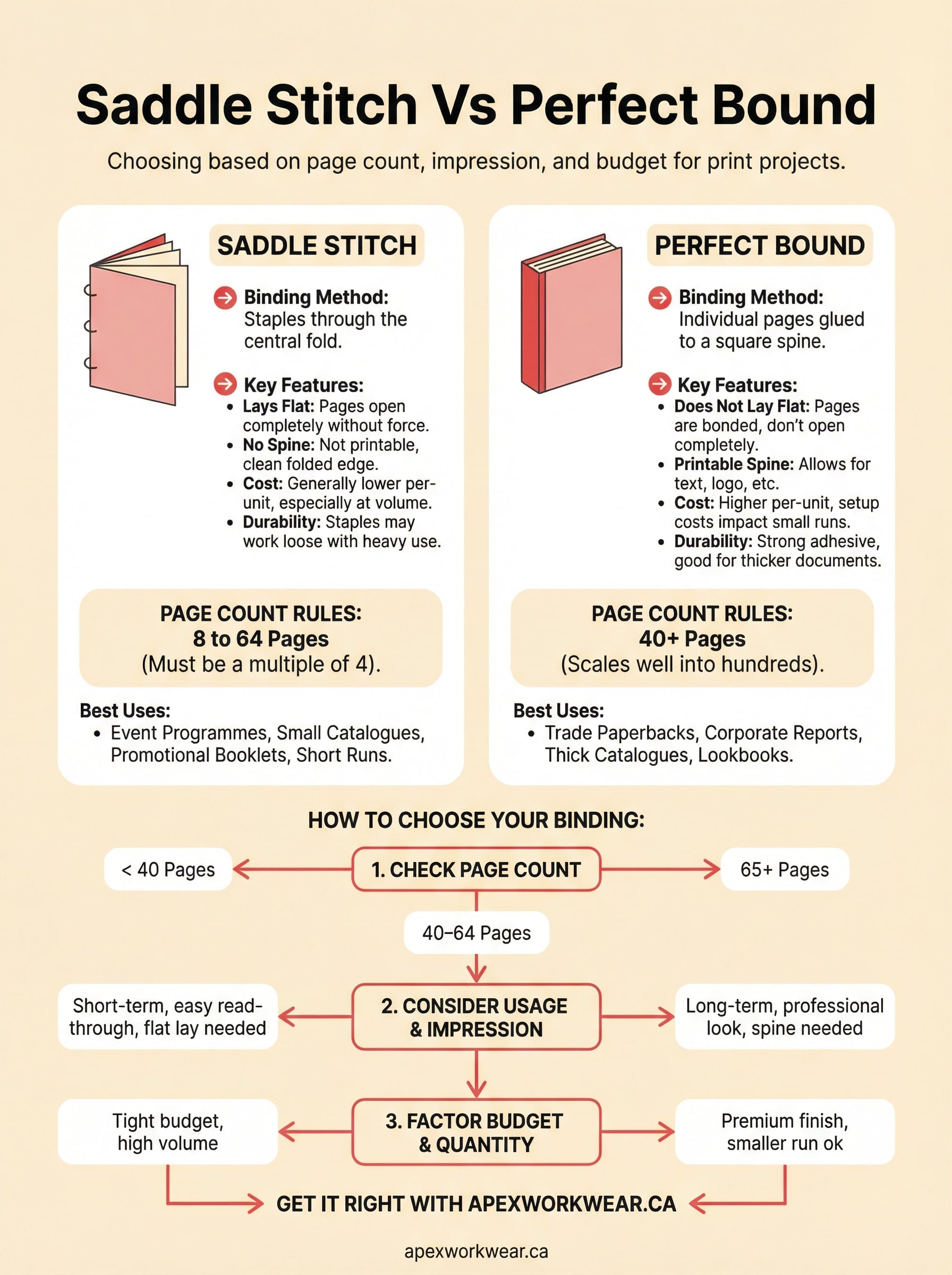
Page count is the single most important constraint when choosing your binding method. Saddle stitching requires your total page count to be a multiple of four, because every sheet folds into four printable sides. Your practical range runs from 8 pages on the low end to around 64 pages on the high end; beyond that, the folded spine becomes too thick and the staples lose their hold. Perfect binding starts where saddle stitching stops, typically at 40 pages minimum, and scales comfortably into several hundred pages without compromising the glued edge.
If your project sits between 40 and 64 pages, both methods are technically possible, so your decision shifts to cost, appearance, and how the piece will be used.
Paper weight and cover stock
Paper choice affects how well each binding holds up under use. Saddle-stitched booklets work best with text-weight paper in the range of 60 to 100 lb, paired with a slightly heavier cover stock to give the piece a defined front and back. Because all pages fold as a unit, you do not need a separate cover specification beyond that weight difference.
Perfect-bound pieces require a heavier, separate cover to wrap around the spine and bond cleanly with the adhesive. Covers typically run at 80 to 100 lb cover stock or heavier, and the cover is scored before folding to prevent cracking along the spine edge.
Spine width and printability
Your spine width in a perfect-bound booklet depends directly on your page count and the paper thickness, commonly expressed as pages per inch (PPI). A 100-page booklet on standard text stock typically produces a spine between 6 mm and 8 mm, which is wide enough to print a title and logo clearly. Saddle-stitched pieces have no spine at all, so this consideration simply does not apply.
How to choose the right binding for your print job
When you’re weighing saddle stitch vs perfect bound for a real project, the decision comes down to three questions: how many pages do you have, where will this piece be used, and what’s your budget? Answer those honestly and the right method becomes clear quickly.
Match your page count first
Page count is your clearest starting point. Most projects fall into an obvious range, and the binding method follows naturally from that. Here’s a quick guide:
- Under 40 pages: saddle stitching is your practical choice
- 40 to 64 pages: both methods work; let context and budget decide
- 65 pages or more: perfect binding is the only viable option
Your page count alone eliminates one option in most cases, so always confirm your final page count before committing to a spec.
Consider how the piece will be used
A training manual or product reference guide that employees reach for regularly benefits from the flat spine and polished look of perfect binding. A promotional booklet or event programme that gets handed out and read once works perfectly well as a saddle-stitched piece, and you’ll keep production costs lower without sacrificing quality.
Think about who picks it up and how often. If your print piece needs to sit on a client’s shelf and be found by title, a printable spine makes a real practical difference. If you need fast distribution across a large audience, saddle stitching keeps your unit cost manageable without compromising the finished look.
Factor in quantity and budget
Smaller print runs hurt more with perfect binding because the setup cost spreads across fewer copies. If you’re printing fewer than 100 units, saddle stitching typically gives you stronger value per dollar spent. Larger runs close that gap, and at high volumes the added cost of perfect binding is often worth it for the professional finish it delivers.
If cost is tight but quality still matters, saddle stitching on heavier paper stock can produce a piece that looks and feels premium. The binding method and the materials work together, so adjusting one often compensates for the other.
Next steps
The saddle stitch vs perfect bound decision gets a lot easier once you know your page count, your budget, and how the piece will actually be used. Short runs under 40 pages point toward saddle stitching. Thicker, frequently referenced documents point toward perfect binding. Everything in between comes down to context, and now you have the information to make that call with confidence.
Your print materials shape how people perceive your business before they read a single word, so getting the binding right matters as much as the design and paper stock. If you’re ready to move forward with a booklet, catalogue, or any branded print project, the team at Apex Workwear can walk you through your options, review your files, and help you produce something that holds up and looks right. Get a quote within 24 hours and put that decision to rest.