Hand someone a business card with a standard matte or glossy finish, and they’ll glance at it. Hand them a soft touch business card, and they’ll actually stop to feel it. That velvety, smooth texture creates an instant impression of quality, and first impressions are hard to undo. It’s a small detail that signals you take your brand seriously, which is exactly why this finish has become a go-to choice for professionals across industries.
But what exactly makes a soft touch coating different from other finishes? Is it worth the extra cost? And how does it hold up compared to matte or glossy alternatives? These are fair questions, especially if you’re ordering cards for the first time or considering an upgrade. At Apex Workwear, we print business cards daily for small businesses, contractors, and startups across Canada, so we’ve seen firsthand how finish choices affect the final product.
This guide breaks down everything you need to know about soft touch business cards: what the finish actually is, how it compares to other coatings, what it costs, and whether it’s the right fit for your brand. No guesswork, no fluff, just the practical details to help you make a confident decision before you order.
Why soft touch business cards stand out
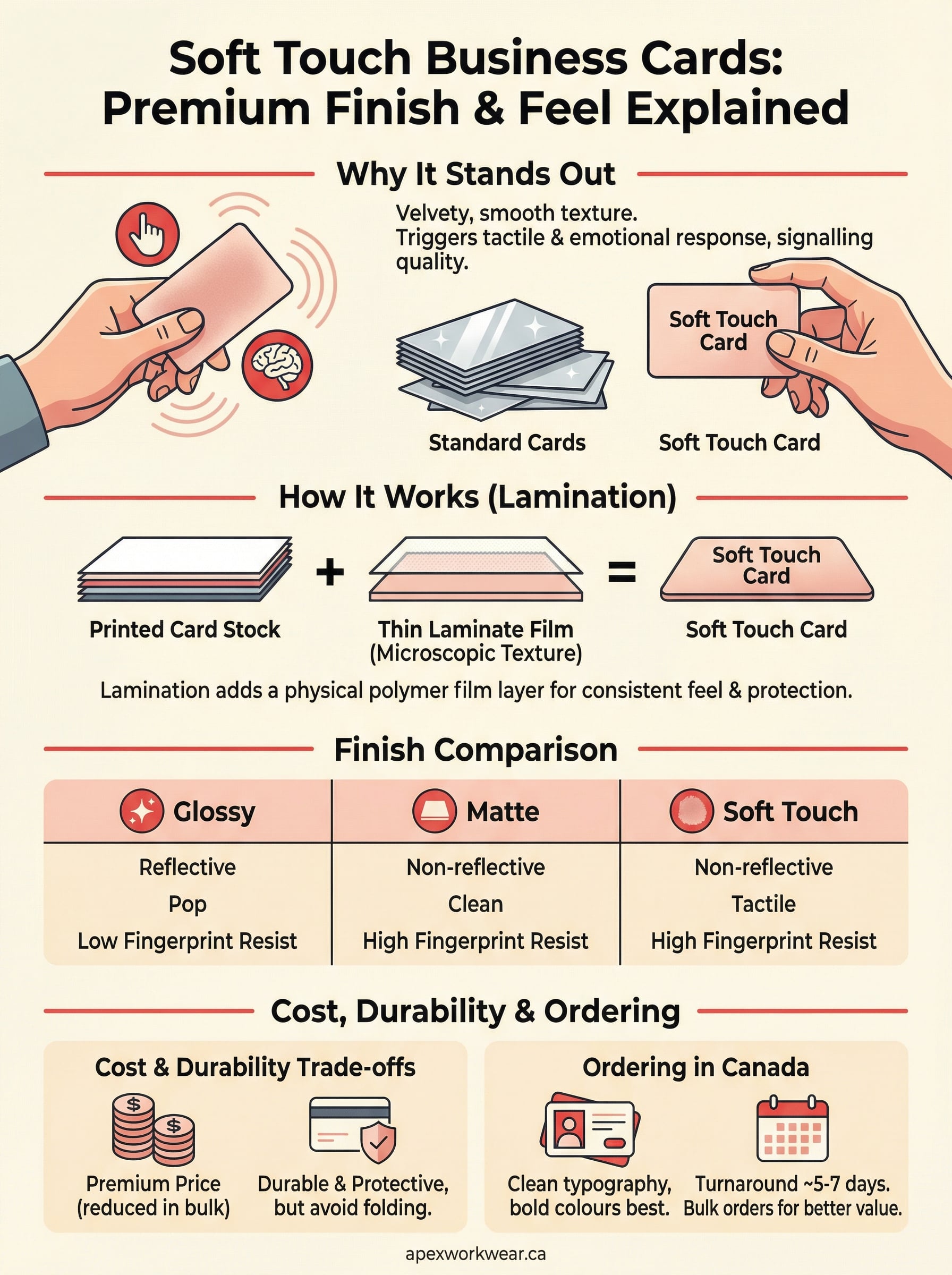
Soft touch business cards create a physical reaction that standard cards simply can’t match. The moment someone picks one up, the velvety, premium coating signals quality before they’ve even read your name. That tactile response is powerful because it triggers an emotional connection, and that connection makes your card far more memorable than a stack of glossy alternatives sitting in someone’s desk drawer.
The way a card feels in someone’s hand directly influences how they perceive the person who gave it to them.
The tactile advantage in a crowded market
Most business cards compete on design alone, but soft touch cards compete on two levels: what people see and what they physically feel. That dual impression is hard to replicate with a flat finish. Research in sensory marketing consistently shows that texture influences perceived value, which means a card that feels premium is more likely to be kept rather than tossed. When you hand someone a soft touch card, you’re not just sharing contact details; you’re communicating that you invest in quality across everything your brand touches.
Your card is often the last tangible item someone takes away from a meeting, so making it stand out physically is a legitimate strategy, not just a nice-to-have upgrade.
Who benefits most from this finish
Not every business needs a soft touch finish, but certain professionals gain more from it than others. Creative professionals, consultants, real estate agents, and premium service providers tend to see the biggest return because their clients are already attuned to quality cues. If your brand positions itself at the mid-to-high end of its market, the finish reinforces that positioning without saying a word. Contractors and tradespeople can also benefit, since a well-crafted card signals reliability and attention to detail, two qualities clients weigh before hiring someone.
How soft touch lamination works
Soft touch lamination is a thin polymer film bonded to the surface of your printed card using heat and pressure. The film contains a microscopic texture that scatters light rather than reflecting it, which is what gives the card its matte, velvety appearance. Unlike a standard coating sprayed onto the card, lamination adds a physical layer that bonds directly to the stock, making the finish both consistent and durable.
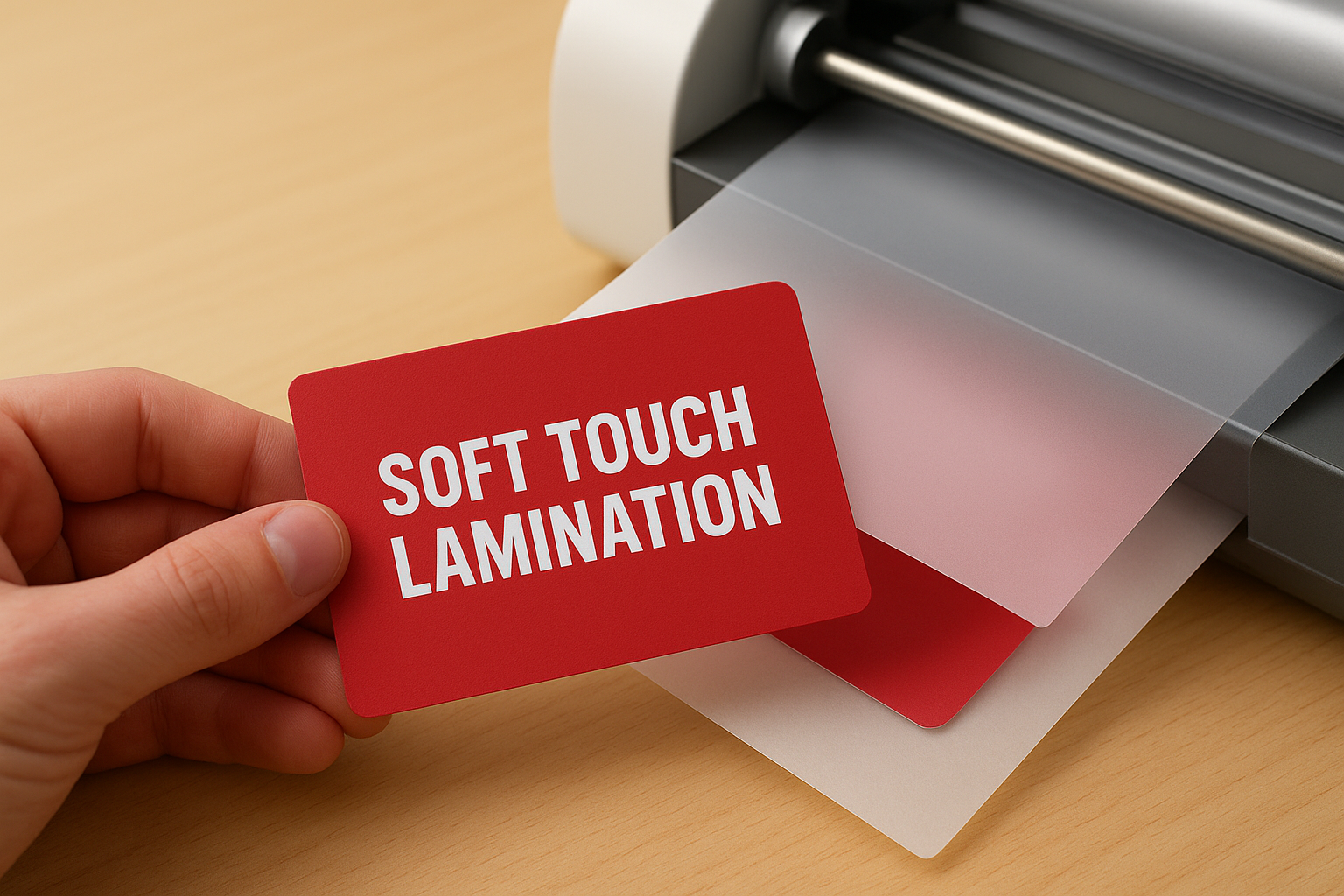
The key difference between soft touch and other coatings is that lamination actually changes the surface structure, not just its appearance.
What happens during production
Your card gets printed first, then fed through a laminating machine that applies the film to one or both sides under controlled heat. The bonding process locks the film to the card stock, which is why soft touch cards feel noticeably thicker and stiffer than standard coated cards. Most printers apply the laminate to one side only unless you specifically request double-sided coverage, which adds cost but creates a completely uniform feel.
What the film actually does
The film does two jobs at once. It protects the print layer underneath from scuffing and moisture, and it creates that signature velvety texture on the surface. Soft touch business cards printed this way hold their finish well over time, as long as you store them flat and away from prolonged heat.
Soft touch vs matte vs glossy finishes
All three finishes start with the same printed card stock, but they diverge sharply in how they look, feel, and perform day to day. Glossy lamination reflects light strongly, which gives colours a vivid pop but also picks up fingerprints quickly. Matte lamination cuts the glare and delivers a cleaner look than gloss, but the surface still feels flat and unremarkable compared to soft touch.
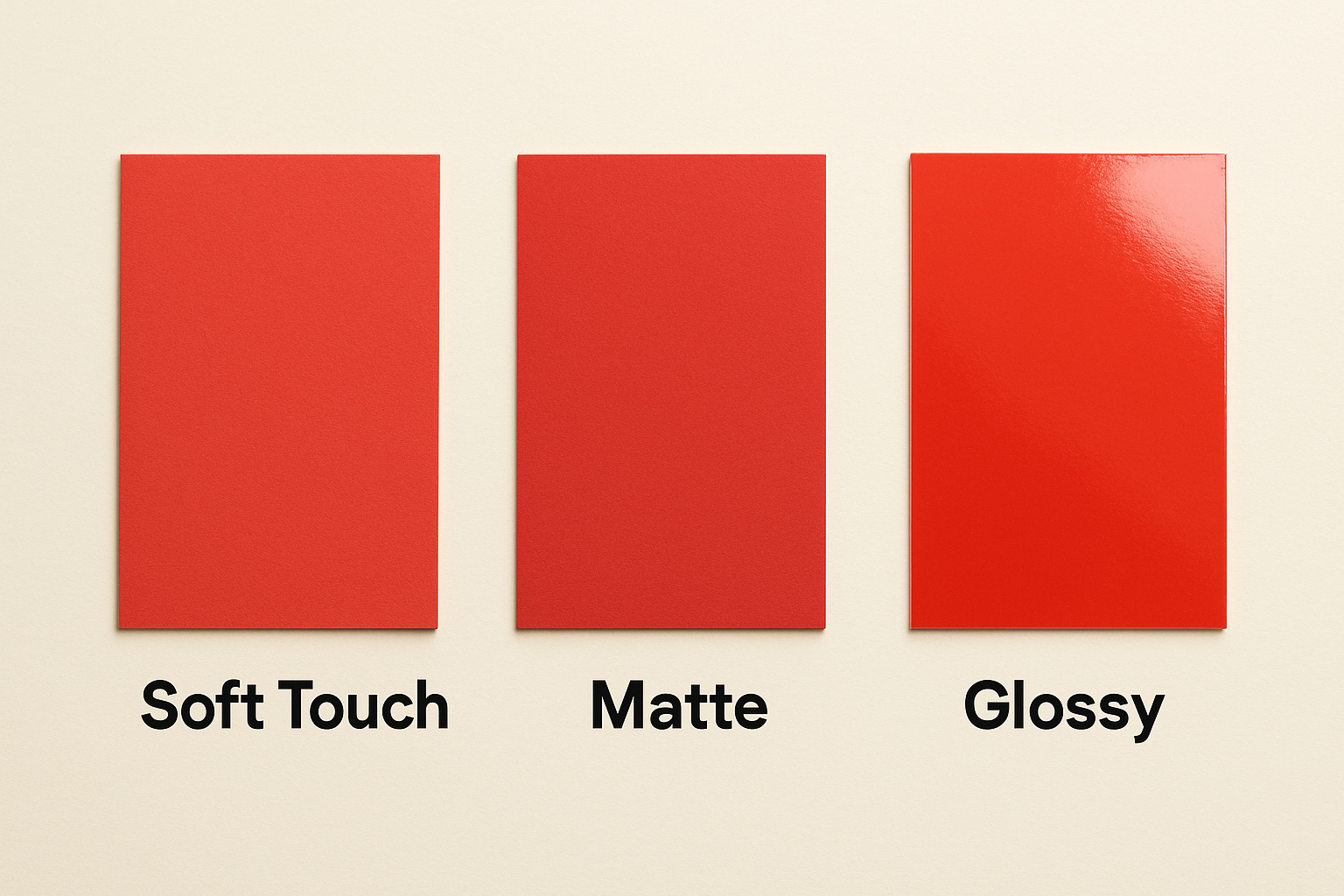
Choosing a finish isn’t just an aesthetic decision; it directly shapes how someone perceives your brand the moment they hold your card.
How to pick the right finish for your brand
Your brand positioning and the context in which you hand out cards should drive this decision. If you distribute cards in high volume and need to keep costs down, matte is a dependable option. If your card carries vivid photography or bold colour blocks, gloss amplifies those visuals effectively. Soft touch business cards are the right call when you need the physical feel of the card to reinforce a premium brand identity without adding complex design elements.
| Finish | Texture | Fingerprint Resistance | Best Used For |
|---|---|---|---|
| Glossy | Smooth, shiny | Low | Bold imagery, photography |
| Matte | Flat, smooth | High | Clean, text-heavy designs |
| Soft Touch | Velvety, tactile | High | Premium or luxury branding |
Cost, durability, and everyday trade-offs
Soft touch business cards typically cost more than standard matte or glossy options because the lamination film and bonding process add extra production steps. In Canada, you can expect to pay roughly 20% to 40% more per batch compared to a basic matte finish. That gap narrows significantly when you order in larger quantities, so if you’re printing 250 cards or more, the per-card cost becomes much more manageable.
The price premium is real, but it’s modest when you consider the impression the finish creates.
What affects the price
Your final cost depends on card stock thickness, single or double-sided lamination, and total quantity. Heavier stock, such as 16pt or 18pt card weight, pairs well with soft touch and tends to hold the film better, but it adds to your unit cost. Ordering in bulk is the most straightforward way to reduce your per-card spend without sacrificing quality.
How durable are they day to day
The laminate film makes these cards reasonably resilient against light moisture and everyday handling, but they’re not indestructible. Folding or bending will crack the film at the crease, and prolonged exposure to heat can cause the laminate to lift slightly at the edges. Store them flat in a card holder and they’ll hold up well through regular use.
How to design and order soft touch cards in Canada
Ordering soft touch business cards in Canada is straightforward once you understand what the finish needs to work well. Because the velvety coating slightly softens fine details, you’ll get the best results with clean, bold typography and strong colour contrast. Avoid very thin fonts or intricate line work smaller than 6pt, as those elements can blur under lamination.
Your design choices should work with the finish, not against it.
What to prepare before you place your order
Before you submit your files, confirm a few key details with your printer. Card thickness and lamination coverage (one side or both) need to be decided upfront because they affect both production time and cost. Most Canadian printers, including Apex Workwear, accept standard file formats like PDF, AI, or high-resolution PNG at 300 DPI or above. If your design needs minor adjustments to fit the card dimensions, a good printer will flag that before going to press.
Turnaround times for soft touch cards in Canada typically run five to seven business days, with rush options available if your deadline is tight. Ordering in a batch of 250 or more is the most practical way to reduce your per-card cost while maintaining the quality the finish demands.
A quick wrap-up and what to do next
Soft touch business cards offer something most finishes simply can’t: a physical response that makes your card worth holding onto. The velvety coating signals quality, pairs well with clean, bold designs, and holds up reliably through everyday use. Yes, the finish costs more than standard matte or gloss, but that gap shrinks fast when you order in reasonable quantities, and the impression it creates is difficult to match with a cheaper alternative.
Your next step is straightforward. Get a quote, confirm your file specs, and let a Canadian printer handle the rest. At Apex Workwear, you’ll get expert review on your design, digital proofs before anything goes to press, and fast turnaround with free local shipping across the GTA. Ready to make your cards count? Order your custom business cards today and see the difference the right finish makes.