Most business cards get handed over and forgotten. A spot UV business card changes that, the glossy, raised coating catches light and invites touch, which makes people pause and actually look at what you’ve given them. It’s one of the simplest upgrades you can make to a card, and it creates a noticeably stronger first impression than a standard matte or gloss finish alone.
But ordering spot UV cards isn’t quite the same as ordering a regular batch. The file setup is different, pricing varies depending on your design choices, and not every print provider handles the finish the same way. If you skip the details, you can end up with misaligned coatings or results that don’t match what you had in mind, and that’s money wasted.
This guide covers exactly what spot UV is, what it costs, how to set up your files correctly, and what to watch for when placing an order. At Apex Workwear, we print spot UV business cards in-house here in Canada, with free design proofs before production, so if you’re ready to order or just exploring your options, we can help you get it right the first time.
Why spot UV business cards stand out
Most print finishes work in one dimension: you see them. Spot UV adds a second dimension: touch. The coating sits slightly raised above the card’s surface, so when someone runs their finger across your card, they feel the texture shift from matte to gloss in the exact shape of your logo, name, or design element. That physical reaction holds attention in a way that flat printing simply cannot, and it’s immediately noticeable even in a dim room or a crowded networking event.
The sensory effect that makes people notice
When you hand someone a spot UV business card, two things happen almost immediately. First, the glossy areas catch light differently from the base stock, creating contrast that draws the eye to specific parts of your design. Second, the tactile texture triggers curiosity, and people tend to examine the card more closely rather than pocket it without a second thought. That extra few seconds of attention is exactly what you want when you’re trying to make a lasting connection.
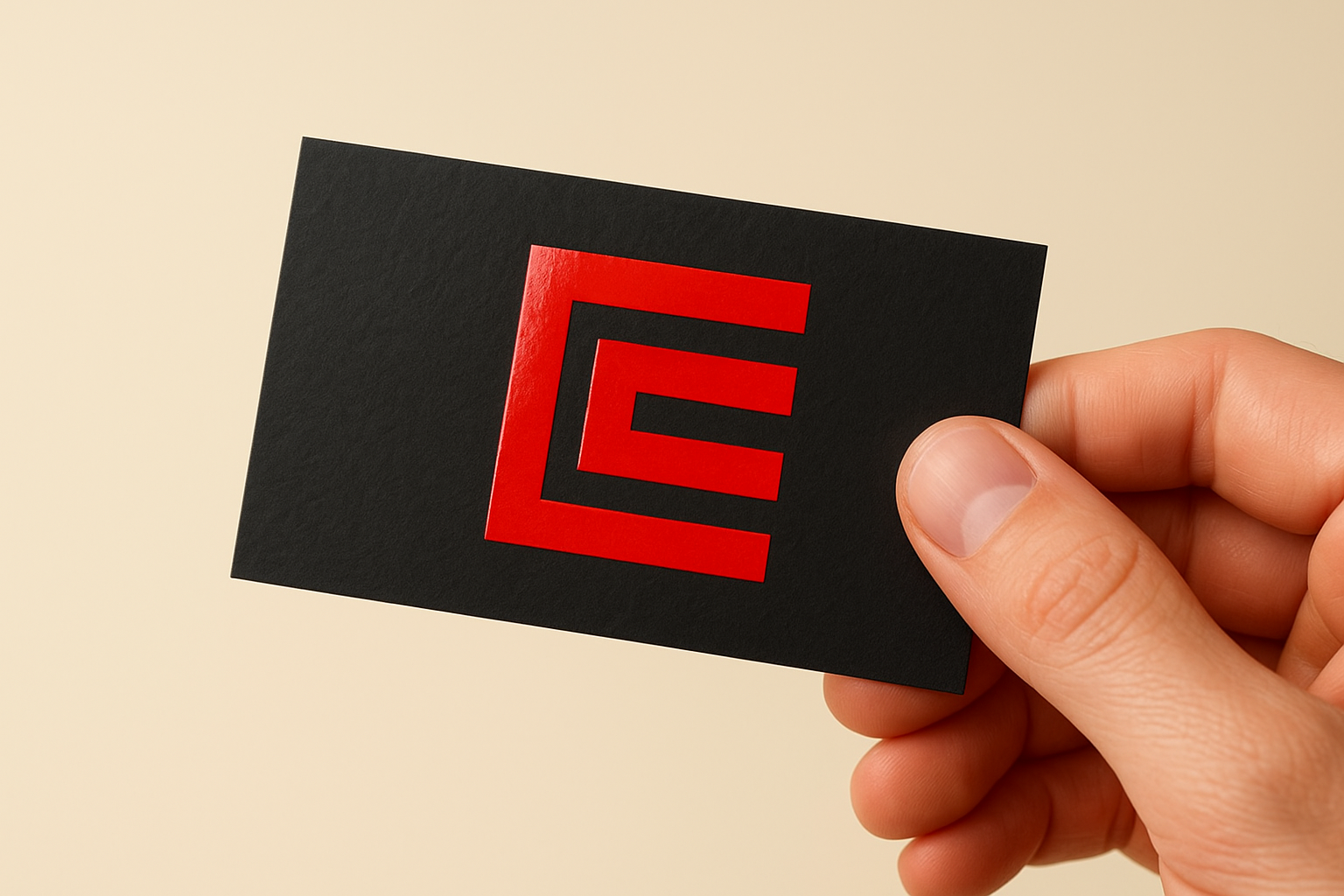
The tactile element of spot UV is what separates it from a standard gloss laminate: people feel the difference, not just see it.
Both effects work together because the coating is applied selectively to specific areas. You choose which parts of your card get the treatment, so you’re directing attention to what matters rather than adding shine uniformly across the whole surface. That precision is what makes the finish feel intentional rather than decorative.
When spot UV works best for your brand
The finish performs strongest when your design has clear focal points to highlight. A bold logo, a single strong graphic, or a line of large text all make excellent candidates for spot UV treatment. Cards with too much going on, or complex backgrounds, can lose the contrast effect entirely because there’s no plain surface for the gloss to stand against.
Spot UV business cards are a particularly strong fit for professionals where first impressions carry real weight: photographers, architects, consultants, and sales roles all benefit from a card that signals quality before a word is spoken. That said, any business that wants to communicate attention to detail can use the finish effectively, as long as the design is clean enough to let the coating do its job.
How spot UV business card printing works
Printing spot UV business cards involves two separate production steps rather than one. Your design goes through standard printing first, and then the UV coating is applied on top in a second pass. This two-stage process is why file preparation matters more than with regular cards: the two layers need to align precisely, or the glossy areas won’t land where you intended.
The two-layer process
Your card starts as a standard print on your chosen stock, whether silk, matte, or uncoated. Once that layer is complete and dry, a UV-sensitive liquid is applied through a separate plate that corresponds only to the areas you’ve designated for coating. A high-intensity UV light then cures the liquid almost instantly, hardening it into that signature raised, glassy finish. The rest of the card stays exactly as the base stock looks.
How the coating gets applied
The coating plate works similarly to a stencil: it only allows the UV liquid through in the specific shapes you’ve defined in your artwork file. This is why your design file needs a separate spot UV layer that outlines those shapes in solid black. If that layer is missing or misaligned, the printer has no accurate guide, and the coating can shift off-target.
Getting the file right before production saves you from costly reprints, so always review your proof carefully before approving.
Most professional printers, including Apex Workwear, will send you a digital proof before production so you can confirm alignment before anything is committed to print.
How much spot UV business cards cost in Canada
Spot UV business cards cost more than standard cards, and that gap comes from the extra production step the finish requires. In Canada, prices typically range from around $60 to $150 or more for 250 cards, depending on your chosen stock, the size of the coated area, and the printer you use. Ordering in higher quantities brings the per-card cost down significantly, so if you go through cards quickly, it’s worth ordering more upfront.
What drives the price up or down
Several factors push your total in either direction. Card stock choice has a real impact: premium silk or soft-touch laminate stocks cost more than standard uncoated options, though they tend to show the spot UV contrast more clearly. Coverage area is the other major variable, since applying the coating across a large portion of the card uses more UV material than a small logo treatment.
A tight, minimal spot UV design is not only stronger visually; it’s also the more cost-efficient approach.
Here’s a quick breakdown of the main cost factors:
- Stock type: standard, silk, or soft-touch laminate
- Coverage area: small element vs. large surface treatment
- Quantity: higher volumes lower the per-card cost
- Turnaround speed: rush orders typically carry a premium
What to budget at common quantities
For 250 cards, expect to pay toward the lower end of the range if your design is straightforward. 500 cards usually offer the best value per unit, and bulk pricing from Canadian providers like Apex Workwear makes that quantity a smart starting point for most businesses.
How to design spot UV business cards
Getting your design file ready for spot UV printing takes a few extra steps compared to a standard card order. The key is making sure your artwork includes two distinct components: the main card design and a separate layer that tells the printer exactly where to apply the coating.
Set up a separate spot UV layer
Your file needs a dedicated spot UV layer built in 100% solid black, with no gradients or transparency. This layer acts as a map for the coating plate, so the shapes you draw there are exactly what gets coated on your finished card. Most designers work in Adobe Illustrator or InDesign and name this layer clearly so it’s immediately obvious to the printer.
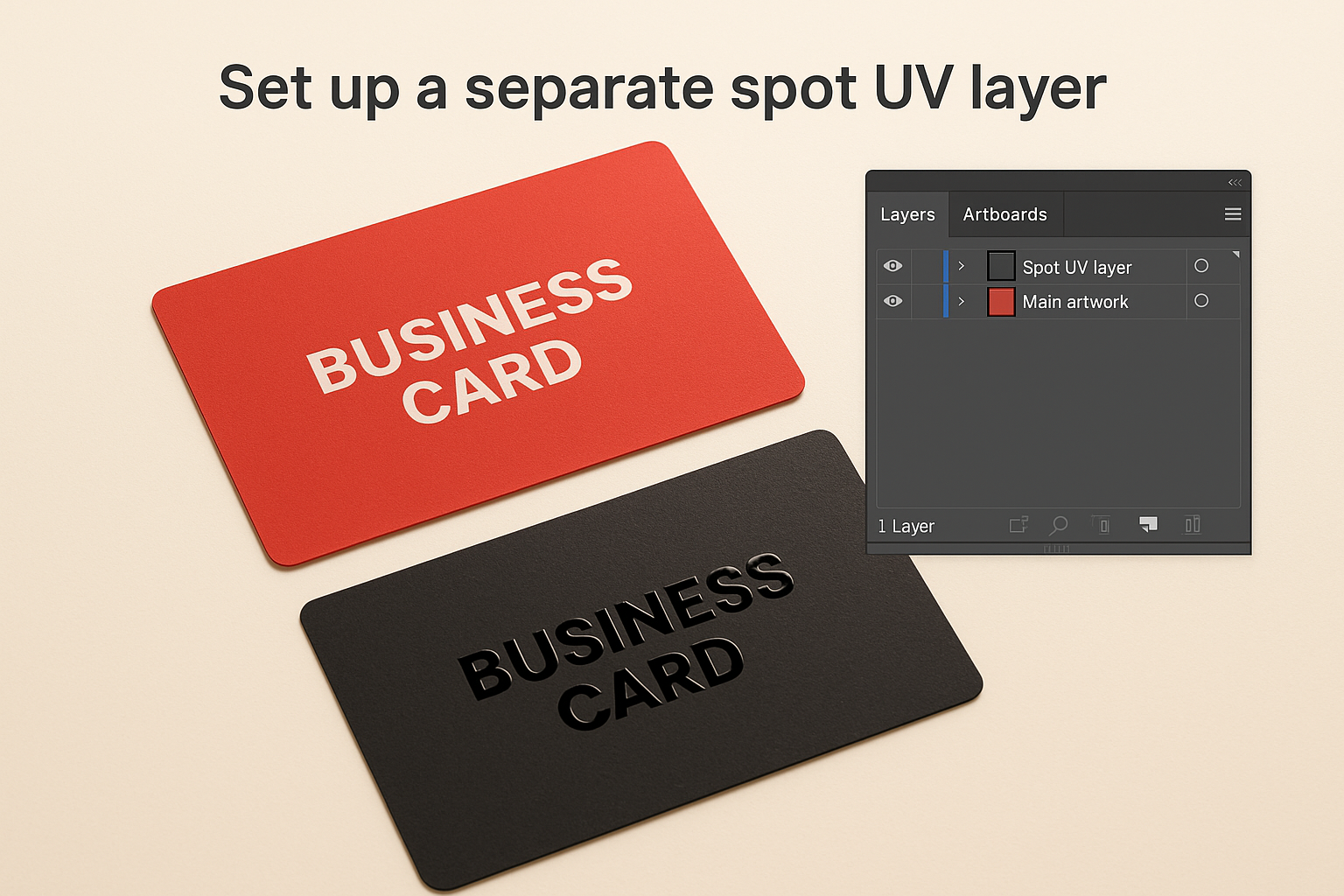
A clean, clearly labelled spot UV layer is the single most important thing you can do to avoid misalignment on your finished cards.
Here is what that layer should include:
- Solid black shapes placed over every element you want coated
- No gradients or soft edges on the spot UV shapes
- Exact alignment with the corresponding elements in your main artwork
Choose the right elements to coat
When ordering spot UV business cards, focus the coating on one or two strong design elements rather than spreading it across the whole card. Your logo and name are the most common choices because they are already the natural focal points. Coating a large background area reduces contrast and makes the effect harder to notice, which undercuts the whole point of using the finish in the first place.
What to check before you place an order
Before you commit to production, a few quick checks will save you from reprints and delays. Spot UV business cards require more careful review than standard cards because two separate layers need to align, and mistakes at this stage are far easier to fix than after printing begins.
Review your proof carefully
Most printers will send you a digital proof before production starts, and this is your last real chance to catch alignment issues. Check that the spot UV layer sits directly over the elements you intended to coat, with no visible offset between the glossy shapes and the underlying artwork. If anything looks even slightly off, flag it before you approve.
A few minutes spent reviewing your proof can prevent you from receiving 500 cards that go straight in the bin.
- Confirm the spot UV shapes align with your logo and text
- Check that no coated area bleeds into an unintended zone
- Make sure the base card design itself is correct before looking at the UV layer
Confirm your file specs
Your printer needs your files in the correct format and resolution before production can begin. Most providers require a minimum of 300 dpi for the base artwork, with the spot UV layer supplied as a separate page or layer in the same PDF or AI file. Ask your printer directly if you are unsure, since file requirements vary and submitting the wrong format can push your delivery date back.
Quick recap and where to go next
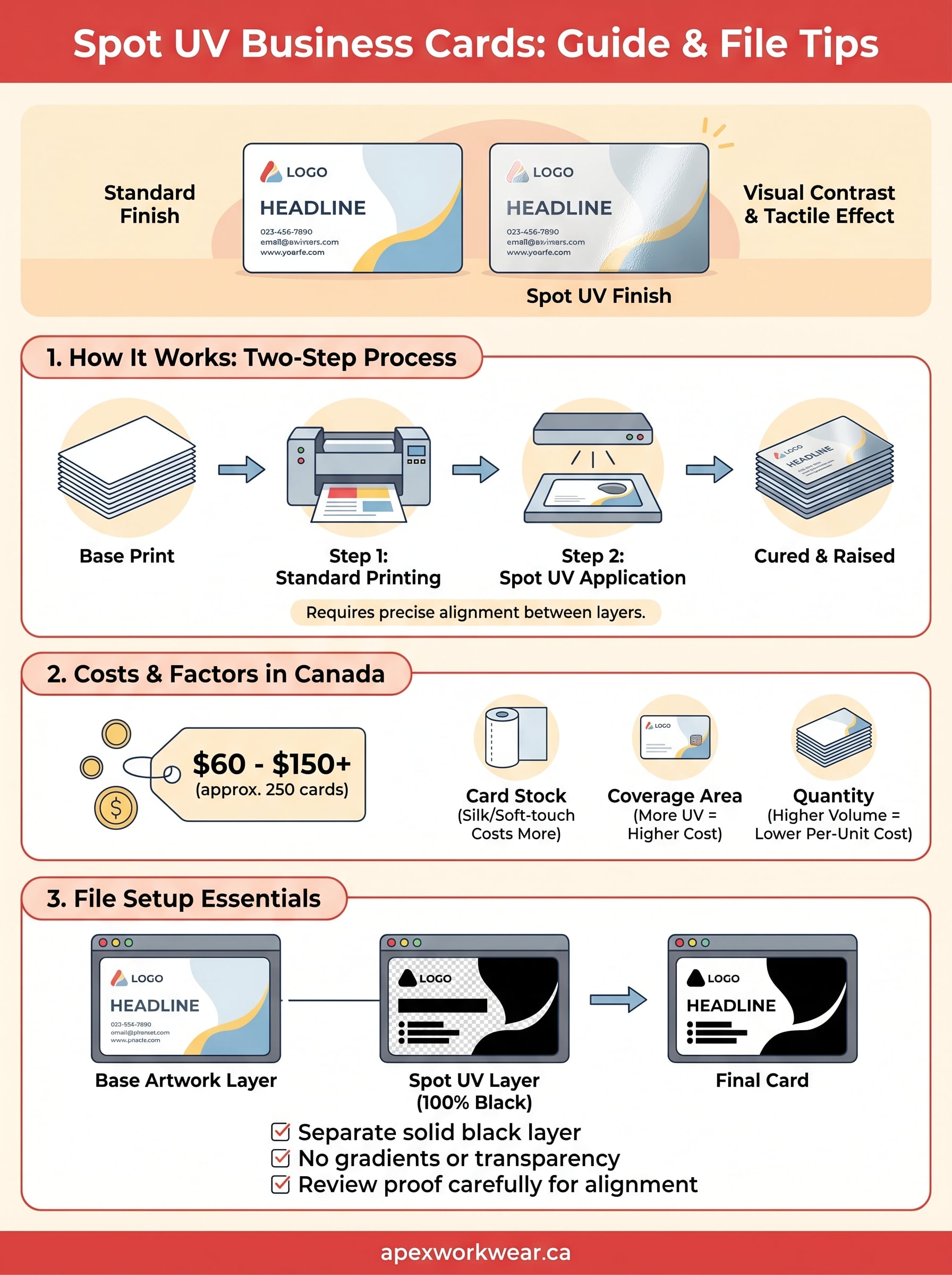
Spot UV business cards work because they combine a visual contrast effect with a physical texture that flat printing cannot replicate. The coating gets applied in a second pass over your base print, so file setup and layer alignment are critical to getting the result you want. Costs in Canada typically start around $60 to $150 for 250 cards, with higher quantities bringing your per-unit price down. Keep your design clean, focus the coating on one or two strong elements, and always review your digital proof before approving production.
If you’re ready to order or want to talk through your design before committing, Apex Workwear prints spot UV cards in-house here in Canada, with free proofs and no minimum order requirements on select products. You can get a quote within 24 hours. Visit Apex Workwear to request your estimate and get your cards started.