If you’ve ever wondered how does DTF printing work, you’re asking the right question at the right time. Direct-to-Film printing has quickly become one of the most versatile methods for putting custom designs onto apparel, and it’s changing what’s possible for small businesses, teams, and creators who want professional results without massive order quantities.
The process itself is straightforward in concept but precise in execution. A design gets printed onto a special film, coated with adhesive powder, cured, and then heat-pressed directly onto fabric. The result? Sharp, full-colour graphics that hold up wash after wash. But the real advantage is flexibility, DTF works on cotton, polyester, blends, and even materials that give other printing methods a hard time.
At Apex Workwear, we use DTF alongside other techniques like embroidery and direct-to-garment (DTG) printing to produce custom apparel right here in Canada. Knowing how the process works helps you make smarter decisions about your next order. This article breaks down the full DTF printing process step by step, covers the gear involved, and compares it to other decoration methods so you can figure out exactly what fits your project.
Why DTF printing matters for custom apparel
Custom apparel has always been a powerful way to build brand recognition and create team unity, but traditional methods came with real barriers. Screen printing required large minimum orders to justify setup costs, embroidery struggled with detailed gradients, and sublimation only worked reliably on polyester. DTF changed the equation. It removed many of those barriers without sacrificing the print quality that businesses and individuals actually need.
No minimums and full-colour freedom
One of the biggest practical advantages of DTF is that it works equally well on a single garment or a run of hundreds. If you’re a small business ordering five branded hoodies for your team, or an event coordinator who needs twelve custom shirts for a one-day event, DTF handles both without driving up your per-unit cost dramatically. The setup process doesn’t require screens or plates, which means you’re not paying for tooling that only makes sense at high volumes.
DTF lets you print detailed, multi-colour designs in small quantities at a cost that actually makes sense for small businesses and teams.
Colour range is another area where DTF delivers. You can reproduce photographic images, gradients, and intricate logos without simplifying your artwork to fit within a colour limit. Screen printing typically charges per colour, so a six-colour design costs noticeably more than a two-colour one. With DTF, your full design prints in a single pass, which keeps costs predictable regardless of complexity.
Works on more fabrics than most methods
Understanding how does DTF printing work helps explain why it’s so adaptable. The transfer film acts as a carrier, so the adhesive bonds directly to the fabric fibres rather than relying on the fabric to absorb ink. That means DTF works on cotton, polyester, nylon, leather, and blended fabrics without requiring special pre-treatment or specific fabric compositions.
This flexibility matters in practice. Your supplier doesn’t need to stock different garment types for different printing methods. You can order a single custom design and apply it across a range of materials, from a heavyweight cotton hoodie to a lightweight polyester performance shirt, using the same file and the same process. That consistency simplifies ordering and keeps your branding cohesive across your entire product range.
The cost and quality balance
DTF produces a soft, flexible print that moves with the fabric rather than sitting rigid on top of it. The finish feels closer to a screen print than a vinyl transfer, which matters to people who wear their branded gear regularly. At the same time, the durability is genuine. Properly cured DTF prints resist cracking, peeling, and fading through repeated washing.
For businesses that need professional-looking results at accessible price points, DTF hits a practical sweet spot. You’re not compromising on appearance to get affordability, and you’re not paying premium rates just to achieve quality output. That combination is exactly why DTF has become a go-to method for custom apparel across so many industries.
How DTF printing works step by step
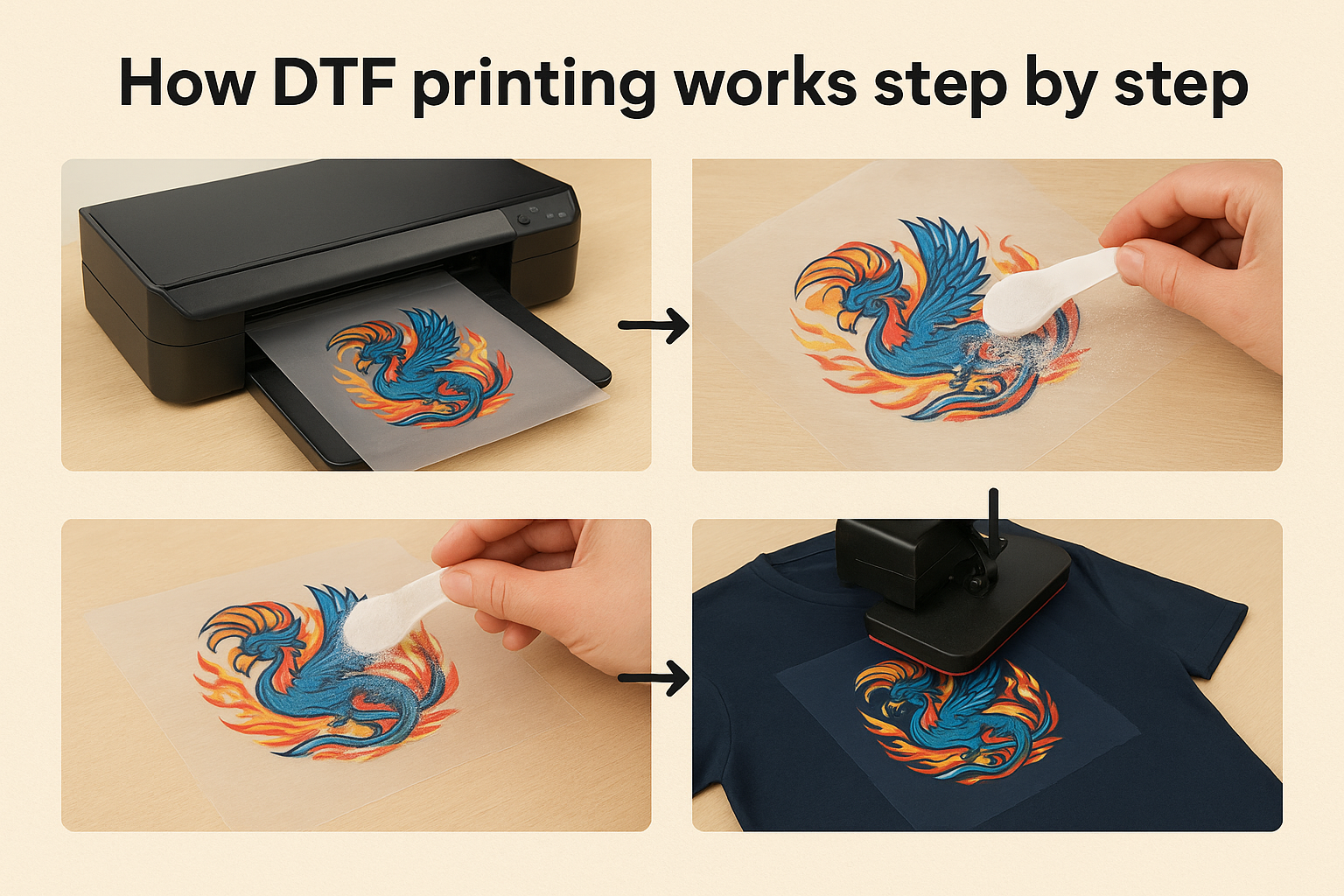
Understanding how does DTF printing work starts with seeing the process as a sequence of distinct, connected steps. Each stage builds directly on the last, and getting the details right at every point determines whether your finished garment looks sharp and holds up through regular wear and washing.
Step 1: Printing the design onto film
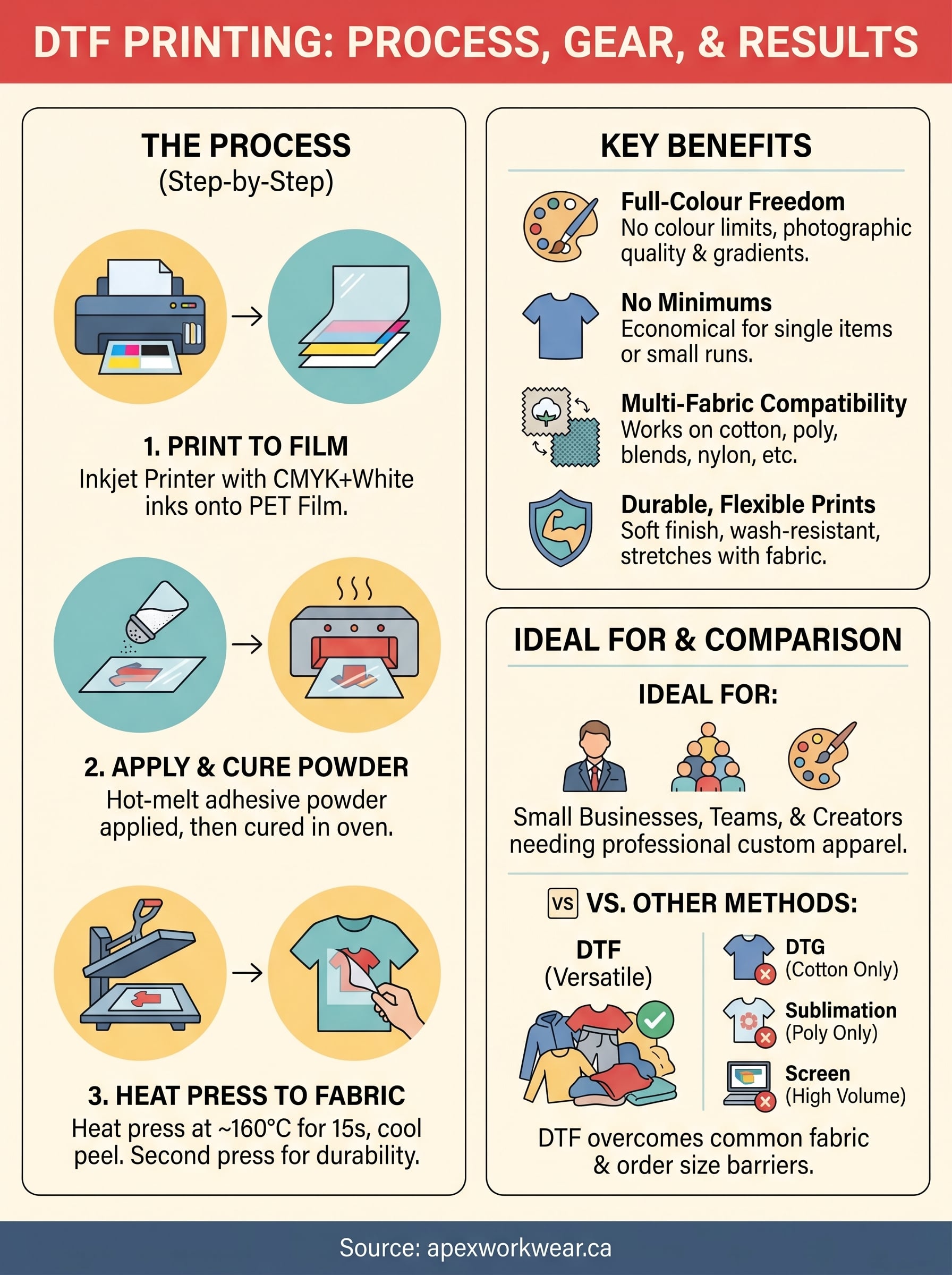
The process begins with a modified inkjet printer loaded with special DTF inks, typically CMYK colours plus white. Your design gets printed in reverse onto a clear PET film sheet, with the white ink layer printed last to act as a base coat. That white layer is what makes DTF effective on dark fabrics, since it prevents the darker material from muting your colours.
Here is how the ink layers stack up on the film:
- CMYK inks print first to build the full-colour image
- White ink prints on top as the base layer
- The white layer faces the fabric during transfer
Step 2: Applying and curing the adhesive powder
Once the ink sits on the film, hot-melt adhesive powder gets applied across the entire printed surface while the ink is still wet. The powder sticks only where the ink sits, so excess powder shakes off cleanly. The film then moves through a curing oven or under a heat gun, which melts the adhesive into a smooth, even layer and bonds it permanently to the ink beneath.
This curing stage is critical. Under-cured adhesive leads to poor bonding and early peeling, so both temperature and dwell time need to be precise.
Step 3: Transferring onto fabric
With the film fully cured, you place it adhesive-side down on your garment and press it with a heat press at around 160 to 165 degrees Celsius for roughly 10 to 15 seconds. The heat reactivates the adhesive and bonds the ink directly to the fabric fibres. After a short cool-down, you peel the film away and the design remains cleanly on the garment. A second press with parchment paper over the top locks in the finish and improves long-term durability.
The gear and materials you need for DTF
Getting a handle on how does DTF printing work at a practical level means knowing what equipment drives the process. The good news is that the core kit is more accessible than screen printing infrastructure, and each piece of equipment has a clear, specific role in the workflow.
The printer and inks
DTF printing requires a modified inkjet printer configured to handle DTF-specific inks. These are not standard inkjet cartridges. DTF inks contain CMYK pigments plus a dedicated white ink, and the white channel is essential for producing vibrant prints on dark or coloured fabrics. Most professional DTF setups use printers modified from brands like Epson, with printheads capable of handling the thicker white ink without clogging.
Keeping your white ink channel circulating regularly prevents clogs and maintains consistent output quality, which directly affects how clean your finished transfers look.
The ink itself needs to stay well-mixed because white ink settles faster than colour ink. Many DTF printers include automatic circulation systems to address this, but manual agitation or regular test prints help on smaller setups.
The film, powder, and heat press
PET transfer film is the surface your design prints onto. It comes in cut sheets or rolls and is specifically coated to hold DTF inks without smearing before the powder stage. Choosing the right film thickness matters because thinner film can wrinkle under heat, while heavier film gives you more consistent results during transfer.
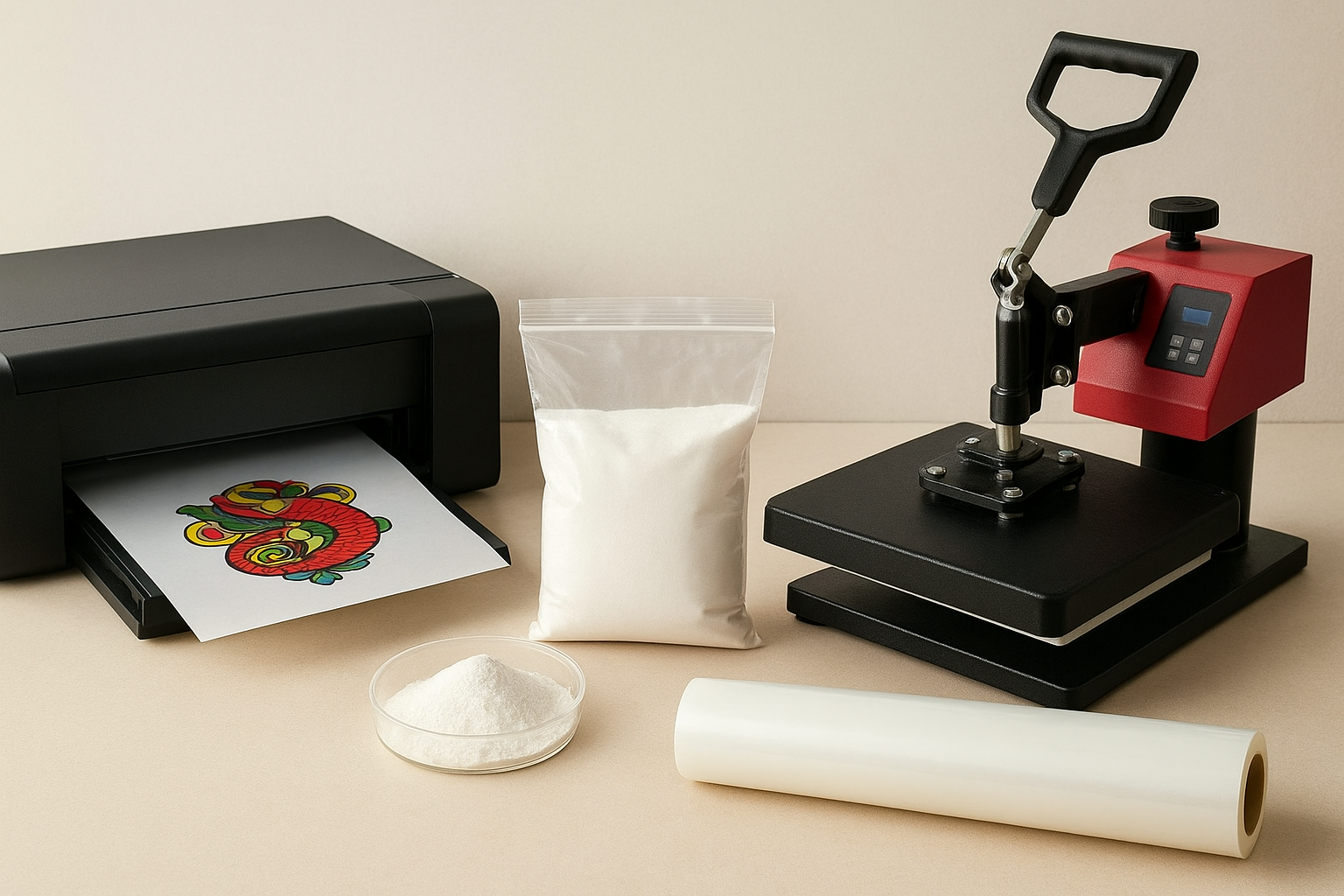
Hot-melt adhesive powder is the bonding agent that connects your ink to the fabric. It comes in fine and coarse grades, and fine-grain powder works better for detailed designs with small text or tight gradients. After powder application, a curing oven or heat tunnel melts the powder evenly across the film.
Your heat press completes the process. A quality press with even platen pressure and precise temperature control makes the difference between transfers that last and ones that peel early.
What results to expect and how to make them last
Once you understand how does DTF printing work, the results start to make sense. A well-executed DTF print delivers sharp edges, vibrant colours, and smooth gradients across the full design. The finish sits slightly raised from the fabric surface but remains flexible, so it moves naturally when you wear or wash the garment rather than cracking the way older heat-transfer vinyl tends to do.
Print quality and colour accuracy
DTF produces a consistent, photographic-quality output that holds fine detail well, including small text, thin lines, and complex artwork with multiple colour transitions. You won’t need to simplify your logo or reduce your design to a limited colour palette. The white ink base coat keeps colours looking accurate and saturated even on dark fabrics, which is where many other methods fall short.
Colour accuracy depends on how well your design file is prepared. Using the correct colour profile and supplying high-resolution artwork at 300 DPI or above gives you the best match between what you see on screen and what ends up on the garment.
That said, results vary based on press temperature, dwell time, and the quality of materials used. A professional setup with calibrated equipment produces noticeably better output than a lower-grade consumer printer running cheap inks on off-brand film.
Washing and care to protect your print
DTF prints are durable when cared for correctly. To extend the life of your design, wash garments inside out in cold or warm water and avoid high-heat cycles in both the washer and the dryer. High heat is the main factor that breaks down the adhesive bond over time.
Here are the key care steps to follow:
- Wash inside out on a gentle or normal cycle in cold to warm water
- Tumble dry on low heat or hang dry where possible
- Avoid ironing directly on the print and never dry clean
- Skip bleach and fabric softeners, both degrade the ink layer
Following these steps consistently keeps your custom apparel looking clean and professional through dozens of washes.
DTF vs DTG, screen printing, and sublimation
Choosing the right decoration method comes down to your fabric type, order size, and design complexity. Each method has genuine strengths, and understanding where DTF fits alongside the alternatives helps you pick the right option for each specific project rather than defaulting to a single approach every time.
DTF vs DTG
Both methods produce full-colour prints with no minimum orders, but they work differently at the substrate level. DTG prints ink directly onto the fabric, which means it performs best on 100% cotton garments that can absorb the ink properly. Polyester and blended fabrics often produce dull or uneven results with DTG unless the garment is pre-treated carefully. DTF bypasses that limitation entirely because the transfer film carries the design onto virtually any fabric. If your order involves mixed fabrics or non-cotton materials, DTF gives you more reliable, consistent output across the full run.
DTF is generally the stronger choice when your garments include polyester, blends, or any material that DTG struggles to bond with effectively.
DTF vs screen printing
Screen printing produces bold, long-lasting prints and remains the most cost-effective method at high volumes. Each colour in your design requires a separate screen, so setup costs are real, and they only make sense when you are ordering large quantities of the same design. DTF removes the colour-count and minimum-order barriers, which makes it the practical choice for smaller runs or designs with complex artwork. Screen printing still wins on unit cost once you cross into the hundreds, but for most small business and team orders, DTF delivers comparable quality without the volume requirement.
DTF vs sublimation
Sublimation produces smooth, permanent prints by bonding dye directly into polyester fibres, making it ideal for all-over printing on performance wear. The main limitation is that it only works on high-polyester fabrics, and it cannot produce white ink, so printing on dark garments is not possible. Understanding how does DTF printing work makes this contrast clear: DTF bonds a physical transfer layer to the fabric surface, which means it works on dark garments and a far wider range of materials than sublimation allows.
Final takeaways
Understanding how does DTF printing work gives you a real advantage when planning your next custom apparel order. The process moves from printed film to cured adhesive to heat-pressed transfer, and each step contributes directly to the sharpness and durability of the finished result. DTF works on cotton, polyester, blends, and more, handles complex full-colour designs without colour limits, and suits both single pieces and larger runs without driving up your per-unit cost.
Your choice of decoration method always comes down to your specific project. For small runs with detailed artwork across mixed fabrics, DTF consistently delivers professional results that hold up through regular wear and washing. Screen printing makes more sense at high volumes, DTG suits heavy cotton, and sublimation handles all-over polyester prints. Knowing the differences puts you in control of the decision.
Ready to put this into practice? Get a custom apparel quote from Apex Workwear and see what DTF can do for your brand.