You’ve got a logo, a deadline, and a decision to make: screen printing vs embroidery. Pick wrong and you end up with hoodies that crack after a few washes or a polo with a logo so simplified it’s unrecognisable. Both methods produce solid, professional results, but they suit different fabrics, budgets, and use cases, and mixing them up wastes money on a reprint.
The short answer is that screen printing works best for large orders on cotton tees with bold, colourful designs, while embroidery holds up better on structured items like hats, jackets, and polos where durability and a premium finish matter more than flat colour detail. Neither one is universally "better", it depends on what you’re branding and how it’ll be worn or used.
In this guide, we’ll break down how each method actually works, compare cost per unit against long-term durability, and walk through which fabrics and garment types favour one technique over the other. By the end, you’ll know exactly which option fits your next order, whether that’s team uniforms, event merch, or client giveaways.
Why the right decoration method matters for your brand
First impressions are stitched or printed, not spoken
Your branded apparel is often the first thing a client, customer, or new hire notices before they read a word about your company. A cracked print on a work shirt or a logo that’s already fraying at the edges tells people you cut corners, even if your actual work is excellent. Choosing between screen printing and embroidery isn’t a cosmetic detail tucked into your marketing plan, it’s a decision that shapes how professional your team looks on day one and how that impression holds up six months later.
Durability decides how long that impression lasts
Think about how your gear actually gets used. A contractor’s hoodie gets washed weekly and snagged on job sites. An event t-shirt might get worn once and then live in a drawer. Embroidery durability comes from thread stitched directly into the fabric, so it resists cracking, peeling, and fading through repeated washes, which is why it’s the standard for uniforms and outerwear that need to last years, not months. Screen printing, especially with quality inks, holds up well too, but it sits on top of the fabric rather than through it, so heavy abrasion and industrial laundering will wear it down faster.
The decoration method you choose today decides how professional your brand looks a year from now.
Budget and order size shift the calculation
Cost isn’t just about the invoice you get from your printer, it’s about cost per wear over the life of the garment. Screen printing has a setup cost per design that gets divided across your order, so it’s genuinely cheap once you’re printing dozens or hundreds of identical shirts. Embroidery digitising also has an upfront fee, but the per-unit cost stays fairly flat whether you’re ordering 5 polos or 50, which makes it forgiving for smaller teams that don’t need bulk quantities. Getting this backwards, ordering embroidery for a 500-piece bulk giveaway, or screen printing for a five-person leadership team’s dress shirts, means you’ll either overspend or under-deliver on quality.
What’s actually at stake if you choose wrong
A mismatched method doesn’t just look worse, it costs you a reorder. Here’s what typically goes wrong when businesses pick the wrong technique:
- Screen-printed logos on stiff or technical fabrics that crack or peel within a few washes.
- Embroidered designs with fine gradients or photo-like detail that lose all nuance once stitched.
- Small embroidery runs that cost far more per piece than expected because of digitising fees.
- Large screen-printed orders on premium jackets that look cheaper than the garment itself.
Getting the decision right the first time saves you the cost, and the embarrassment, of reprinting an order your team has already worn once.
How to choose between screen printing and embroidery
Start with the fabric and garment type
Look at what you’re decorating before anything else. Cotton t-shirts, tote bags, and lightweight hoodies take screen printing well because the ink bonds cleanly to a flat, flexible surface. Structured pieces like polos, caps, and jackets favour embroidery because the stitching sits naturally into thicker weaves and stays put through wear and washing. If your fabric choice is stretchy activewear or performance gear, embroidery can sometimes pucker the material, so ask your printer whether a lighter thread weight or a screen print is the safer call.
Match the method to your order size
Run the numbers before you commit. A single design with dozens or hundreds of garments almost always favours screen printing, since the setup cost spreads thin across the batch. Smaller orders, say under twenty pieces, usually make more sense with embroidery, because you avoid paying for screens you’ll only use once. Somewhere in the middle, get a quote for both. Order size alone shouldn’t decide everything, but it’s the fastest filter to narrow your options.
Consider the design complexity and colour count
Simplicity favours embroidery, detail favours screen printing. Fine gradients, photo-realistic artwork, or more than six or seven colours get expensive fast in stitching and often lose clarity. A clean logo with two or three solid colours embroiders beautifully and looks premium on a cap or polo.
Run through this quick checklist before you order:
- Garment type: soft and flat, lean screen print; structured and thick, lean embroidery.
- Quantity: bulk order, screen printing; small run, embroidery.
- Design detail: bold and simple, either works; fine gradients, screen printing only.
- End use: everyday wear or uniforms, embroidery for longevity; one-off events, screen printing for cost.
Work through those four points and you’ll land on the right method almost every time, without guessing or paying for a reprint later.
Screen printing vs embroidery: comparing the details
A side-by-side look at the numbers
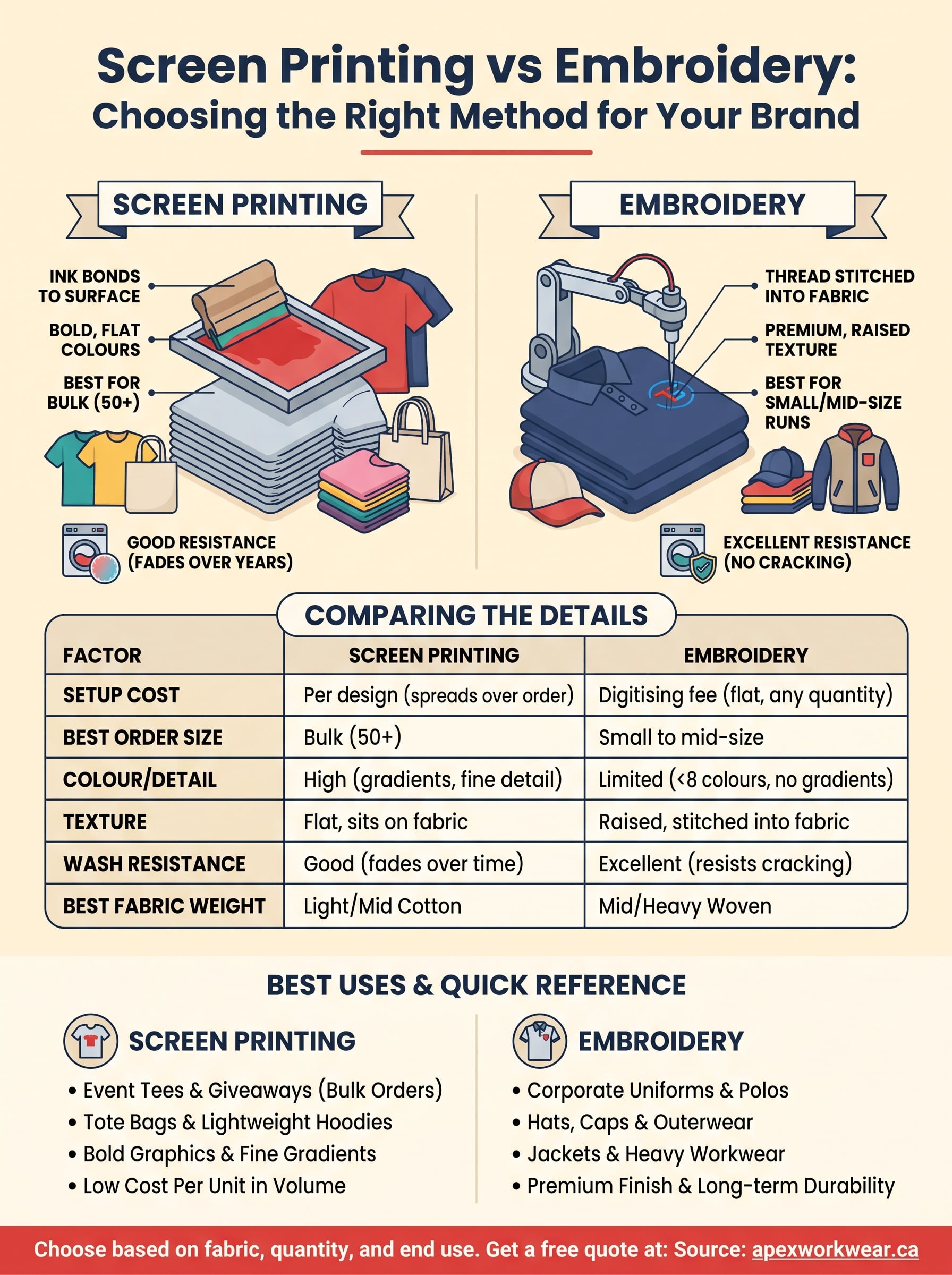
Numbers settle the debate faster than opinions do. Cost per unit for screen printing drops fast as your order grows, while embroidery pricing stays flat no matter the quantity, and the two methods differ just as much in weight, stretch, and how they hold up over time. The table below lays out the details that matter most when you’re weighing screen printing vs embroidery for a real order.
| Factor | Screen Printing | Embroidery |
|---|---|---|
| Setup cost | Per design, spreads across order | Digitising fee, fairly flat regardless of quantity |
| Best for order size | Bulk (50+) | Small to mid-size runs |
| Colour/detail limit | High, handles gradients and photo-like art | Limited, best under 8 colours |
| Texture | Flat, sits on fabric | Raised, stitched into fabric |
| Wash resistance | Good with quality ink, fades over years | Excellent, resists cracking and peeling |
| Best fabric weight | Light to mid-weight cotton | Mid to heavy-weight woven fabric |
Why texture and feel matter more than people expect
Feel is the difference nobody mentions until a customer actually touches the garment. Screen printing sits flat against the fabric, so a heavy or oversized graphic can feel stiff or plasticky against skin, especially on thin cotton tees. Embroidery texture adds a raised, tactile finish that reads as premium the moment someone runs a hand across a collar or cap brim, which is exactly why corporate polos and headwear almost always use stitching over ink.
Run your hand across the sample before you approve it, because texture tells customers as much as the logo does.
Colour range and detail versus longevity
Detail belongs to screen printing outright, since ink reproduces gradients, fine text, and a wide colour palette in a single pass without extra cost. Longevity, though, still belongs to embroidery, which explains why the two methods rarely compete for the same job once you look past the logo itself and consider how the garment will actually be worn.
Best uses for screen printing and embroidery
Where screen printing gets the job done
Event merchandise, fundraiser tees, and marketing campaigns are where screen printing shines, because you need bold graphics on cheap cotton shirts in bulk, often for a design that won’t get reordered next year. Trade show giveaways, band tour shirts, and community fun-run tees all fall into this category, where visibility and cost efficiency matter more than a decade-long lifespan on the garment.
Where embroidery earns its keep
Corporate uniforms, golf polos, and branded outerwear call for embroidery’s durability, since these garments get worn weekly for years and need a logo that survives dozens of industrial washes without cracking. Caps, in particular, almost always use embroidery because the curved surface makes screen printing impractical and the stitched finish looks sharper against structured headwear.
Choose based on how many times the garment will be washed and worn, not just how it looks on day one.
Quick reference by product type
Some products default so strongly to one method that testing the other just wastes time and money. Use this as a starting point, then adjust for your specific fabric and order size:
- T-shirts and tote bags: screen printing, for cost and colour range.
- Polos and dress shirts: embroidery, for a professional finish.
- Hoodies and sweatshirts: either works, decide by order size.
- Hats and caps: embroidery, almost without exception.
- Jackets and outerwear: embroidery, for wash resistance and structure.
- Bulk event tees: screen printing, for low per-unit cost.
Applying that shortlist before you request a quote saves you from paying for samples in the wrong technique, and it gives you a solid starting point to bring to whoever’s producing your order.
Finding the right fit for your project
Neither method wins outright, and that’s the whole point. Screen printing vs embroidery comes down to what you’re branding, how often it’ll be worn, and how many pieces you need. Bulk cotton tees for an event favour ink. Polos, caps, and outerwear that need to survive years of washing favour thread. Once you’ve matched the fabric, order size, and design detail against the checklist above, the right choice usually becomes obvious rather than a guess.
Getting this decision wrong costs you a reorder, and getting it right the first time makes your brand look sharper on day one and still sharp a year later. If you’re still weighing options for your next order, whether that’s team uniforms, event merch, or client giveaways, get a free quote from Apex Workwear and our team will help you pick the method that actually fits your project, not just the one that’s easiest to sell.