The ink you choose affects everything, how your design looks, how it feels on the fabric, and how long it holds up after dozens of washes. Understanding screen printing ink types is one of the most practical things you can do before placing a custom apparel order, whether you’re branding uniforms for your crew or printing merch for an upcoming event. Each ink behaves differently depending on the fabric, the colour of the garment, and the finish you’re going for.
At Apex Workwear, we handle custom apparel printing for small businesses, contractors, and teams across Canada, and ink selection comes up in nearly every project. Clients often know what they want a shirt to look like but aren’t sure which ink will actually get them there. That’s a gap worth closing, because the right ink choice can mean the difference between a print that cracks after a few wears and one that stays sharp for years.
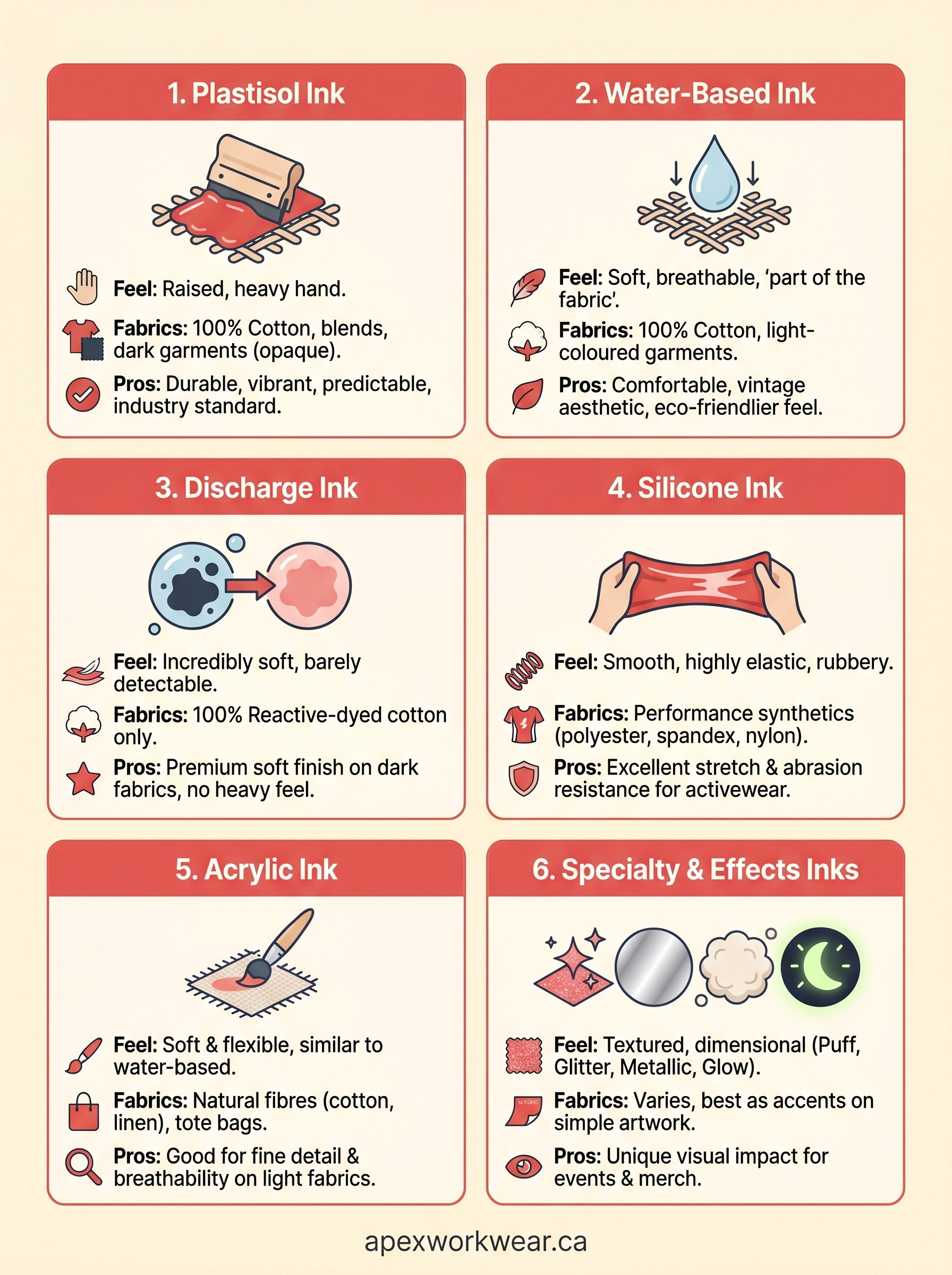
This guide breaks down six common screen printing ink types, including plastisol, water-based, and discharge, covering what each one does well, where it falls short, and which fabrics it pairs with best. By the end, you’ll have a clear sense of which ink suits your next project and why.
1. Plastisol ink
Plastisol is the most widely used ink in commercial screen printing, and for good reason. It’s a PVC-based ink that sits on top of the fabric rather than soaking into it, which makes it highly predictable and easy to work with across most production setups.
What it is and how it prints
Made from PVC particles suspended in a plasticiser, plastisol doesn’t dry at room temperature on its own. That means you won’t lose ink to an open screen between pulls. Printers push it through a mesh stencil using a squeegee, and the ink transfers cleanly onto the garment with consistent, repeatable laydown every time.
Best fabrics and products for plastisol
This ink works well on 100% cotton, cotton-polyester blends, and most woven fabrics. It prints reliably on T-shirts, hoodies, tote bags, and workwear. Be careful with high-polyester fabrics, as dye migration can cause the ink colour to shift during curing, resulting in a muddy or off-tone final print.
Look, feel, and durability
Unlike water-based options, plastisol sits on top of the fabric, so you’ll notice a raised feel underhand. The print is opaque, which makes it ideal for printing light colours on dark garments. When cured correctly, plastisol holds up well through repeated washing without cracking or peeling.
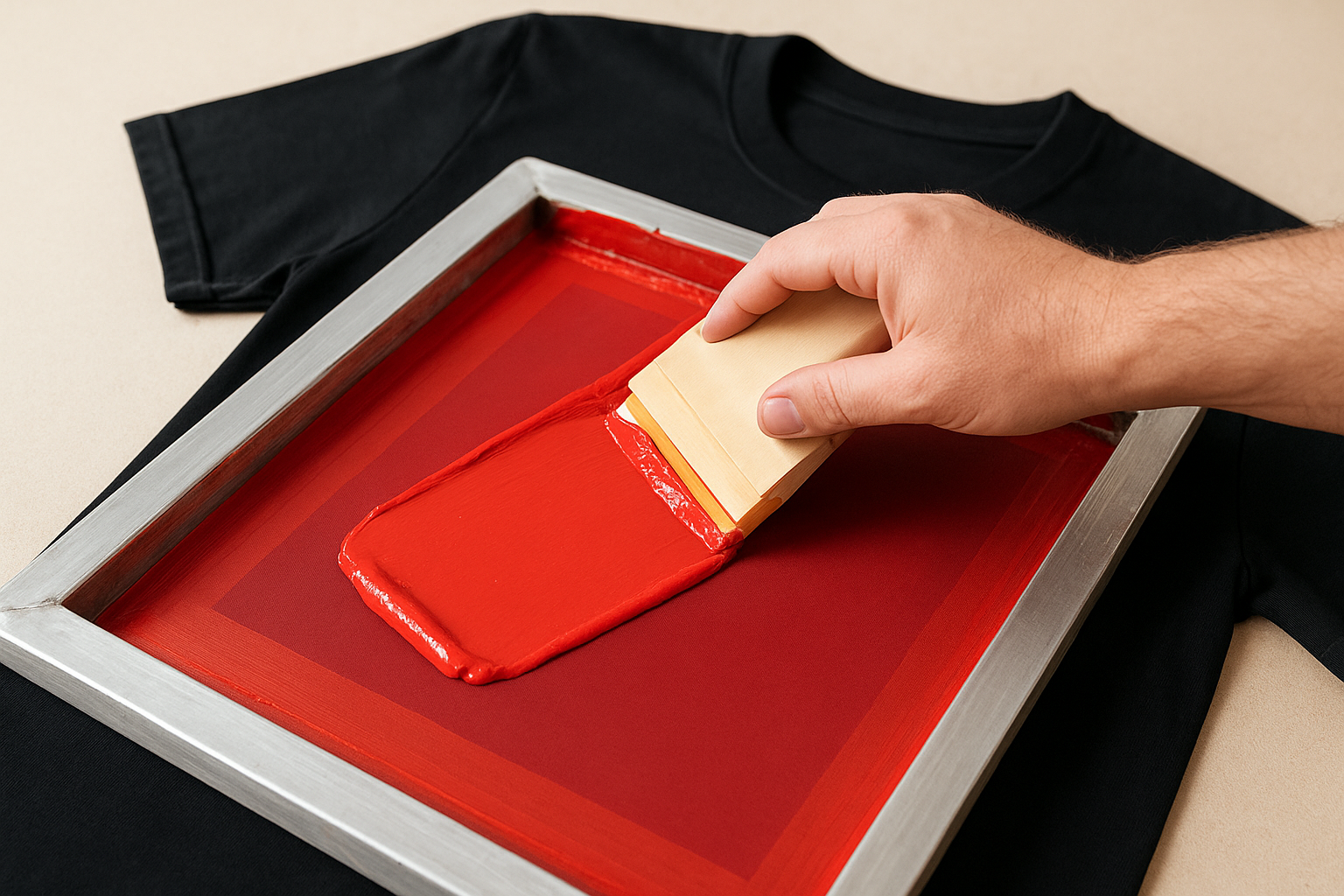
Plastisol is often the best choice when you need bold, opaque colour on a dark shirt that will see heavy use.
Curing requirements and common mistakes
To cure properly, plastisol needs to reach a core temperature of around 160°C (320°F). Under-curing is the most common mistake: the print looks fine right off the press but cracks or washes out after a few cycles. Over-curing can scorch the fabric, so monitoring temperature accurately matters more than simply extending the time.
Pros, cons, and typical use cases
High-volume runs, workwear, event T-shirts, and team uniforms are all strong fits for plastisol. The main drawbacks are its heavier hand feel and low breathability. For any project where colour vibrancy and wash durability are the priority, plastisol delivers consistently.
Cost and availability notes
Among all screen printing ink types, plastisol is the most affordable and most widely stocked. Most professional print shops carry it as a standard offering, which keeps costs and lead times predictable for your order.
2. Water-based ink
Water-based ink uses water as its carrier rather than PVC, so it soaks into fabric fibres instead of sitting on top. Prints have a noticeably softer hand feel, making this a popular choice for retail-quality garments.
What it is and how it prints
The ink penetrates the fabric fibres as it’s pushed through the mesh, bonding with them during the curing process. Because it doesn’t build up on the surface, finished prints feel like part of the garment rather than a layer added on top.
Best fabrics and products for water-based
Water-based ink works best on 100% cotton and high-cotton blends. Synthetic fabrics absorb it poorly and produce faded, uneven coverage. It suits lightweight tees, tank tops, and fashion apparel where softness is the priority.
Look, feel, and breathability
Prints deliver a muted, vintage aesthetic that many lifestyle brands actively pursue. The ink doesn’t block the fabric’s breathability, so garments stay comfortable and light against the skin.
Water-based ink is the right pick when a soft, breathable finish matters more than bold opacity.
Drying, curing, and screen drying risk
One challenge among these screen printing ink types is that water-based ink dries in the mesh if you pause mid-run. Printers must keep screens wet and maintain a steady pace throughout to avoid clogging and wasted screens.
Pros, cons, and typical use cases
Water-based ink suits premium fashion tees and light-coloured garments well. It struggles on dark fabrics without a discharge base, so project planning matters before committing to this ink.
Cost and availability notes
Water-based inks are widely available but require more setup attention than plastisol, which can slightly increase production costs on shorter runs.
3. Discharge ink
Discharge ink takes a different approach from the other screen printing ink types covered so far. Instead of sitting on top of the fabric or soaking into its fibres, it chemically removes the dye from the garment and replaces it with a new colour, leaving an incredibly soft finish that you can barely feel underhand.
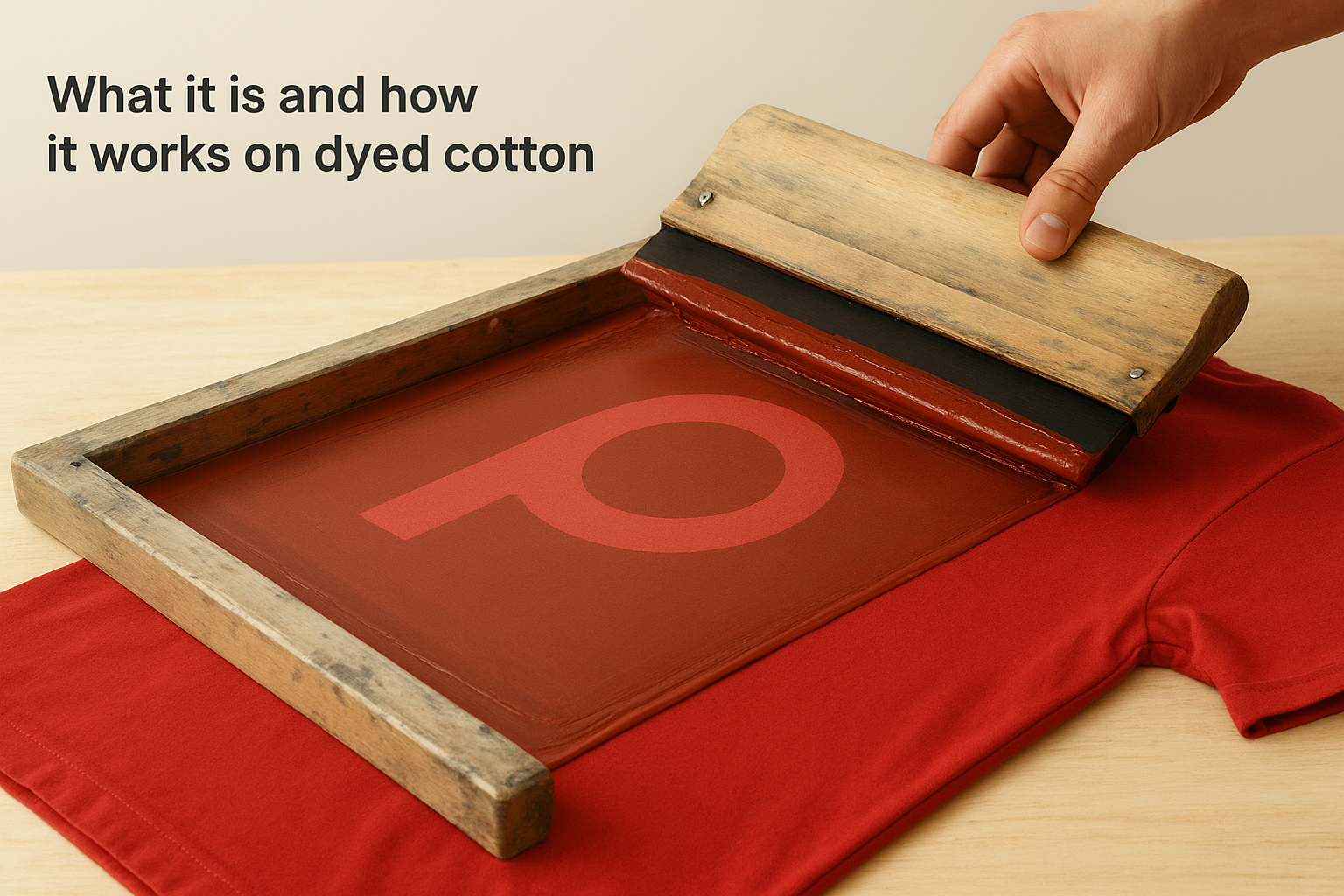
What it is and how it works on dyed cotton
Discharge ink contains an activating agent, typically zinc formaldehyde sulfoxylate (ZFS), that reacts with reactive dyes in cotton when heat is applied. The activator strips out the original garment dye in the printed area, and the pigment in the ink takes its place, bonding directly with the fabric.
When discharge works well and when it fails
This ink performs best on 100% reactive-dyed cotton garments, such as ring-spun tees. It fails on polyester, synthetic blends, and any garment dyed with non-reactive dyes, where the activator has nothing to react with and you get an uneven or washed-out result.
Always confirm the garment’s dye type before committing to discharge ink on a production run.
Look and feel compared with water-based and plastisol
The finish is softer than water-based ink and far softer than plastisol. Colours appear as a natural part of the fabric rather than a print sitting on top, which suits premium lifestyle apparel well.
Curing, ventilation, and safety considerations
Discharge ink releases formaldehyde during curing, so proper ventilation and extraction equipment are essential in the print shop. Curing temperatures are similar to water-based inks, typically around 150-160°C.
Pros, cons, and typical use cases
Discharge ink suits fashion-forward brands and premium tees where a luxurious, undetectable print is the goal. The main limitations are its fabric restrictions and safety requirements, which make it less practical for high-volume commodity printing.
Cost and availability notes
Discharge ink is more expensive than plastisol and requires careful stock management because mixed ink has a limited pot life once the activator is added. Most specialist print shops stock it, but not every facility offers it as a standard option.
4. Silicone ink
Silicone ink is a rubber-based ink that cures into a flexible layer on the fabric surface. It belongs in a different category from the other screen printing ink types here because it was specifically engineered for performance and athletic applications.
What it is and why it exists
Silicone ink is made from platinum-catalysed silicone rubber, giving it exceptional elasticity and UV stability. It was developed to solve the problem of print cracking and peeling on stretchy fabrics that traditional inks simply couldn’t handle reliably.
Best fabrics and products for silicone
This ink excels on synthetic and performance fabrics such as nylon, spandex, and polyester blends. You’ll typically see it applied to athletic jerseys, compression gear, and swimwear where other inks would fail quickly under stress.
Stretch, abrasion resistance, and performance wear
Silicone ink stretches with the fabric without cracking, making it ideal for compression and activewear. It resists abrasion exceptionally well, so prints hold up even on gear that sees constant friction and heavy movement.
Silicone ink is the right choice when the garment itself stretches significantly during normal use.
Mixing, pot life, and curing considerations
Silicone ink requires a two-part mixing process before printing, combining a base with a catalyst. Once mixed, it has a limited pot life, so only prepare what you’ll use in a single session to avoid wasting material.
Pros, cons, and typical use cases
The main advantages are stretch, durability, and compatibility with synthetic fabrics. The drawback is that setup and material costs run higher than plastisol or water-based ink, which makes it less practical for everyday apparel printing.
Cost and availability notes
Silicone ink is a specialist product with a noticeably higher price point than most standard inks. Not every print shop stocks it, so confirm availability early if your project requires it.
5. Acrylic ink
Acrylic ink is a water-based formula that uses acrylic polymer as its binder rather than PVC or silicone. It occupies a specific niche among screen printing ink types, sitting closer to water-based ink in feel but with distinct handling characteristics that suit certain applications well.
What it is and where it fits in screen printing
Acrylic ink is made from acrylic polymer emulsions suspended in water, which gives it a flexible, breathable finish once cured. It prints well through finer mesh counts and suits detailed designs that require clean edges and consistent laydown.
Best fabrics and products for acrylic
This ink works best on natural fibres like cotton and linen, and it also adheres to certain treated synthetic substrates. You’ll find it used on tote bags, canvas products, and lightweight cotton apparel where a flexible, low-profile print is the goal.
Opacity, colour behaviour, and hand feel
Acrylic ink delivers semi-opaque to opaque coverage depending on the number of passes and mesh count used. Colours print with good vibrancy on lighter garments, and the hand feel is soft and flexible, similar to water-based ink.
Acrylic ink prints best on light or mid-tone garments where you need clean colour without a heavy build-up on the surface.
Drying and curing considerations
Acrylic ink dries through water evaporation and requires heat to fully cure. Like water-based ink, it can dry in the mesh during slow production runs, so maintaining a consistent printing pace is important.
Pros, cons, and typical use cases
The key strengths are soft hand feel and compatibility with natural fabrics. The main limitation is weaker opacity on dark garments compared with plastisol.
Cost and availability notes
Acrylic ink is moderately priced and available through most print supply distributors, though it remains less common in commercial shops than plastisol.
6. Specialty and effects inks
Specialty and effects inks sit apart from the standard screen printing ink types covered above because their purpose is visual impact rather than straightforward colour coverage. They add texture, movement, or dimension to a print that flat inks simply cannot replicate.
Common effects and what they do
Effects inks include glitter, metallic, puff, glow-in-the-dark, and high-density inks, each producing a distinct result. Puff ink swells during curing to create a raised, three-dimensional texture. Metallic inks contain fine metal particles that produce a reflective sheen. Glitter inks add coarse sparkle, while glow-in-the-dark inks absorb light and emit it in dark conditions.
Effects inks work best as accents on a design rather than as the primary ink for the entire print.
Mesh, stencil, and artwork considerations for effects
Glitter and metallic inks contain larger particles that require a coarser mesh count to pass through cleanly without clogging. Fine detail work is difficult with these inks, so bold, simple artwork performs far better than intricate linework when using effects options.
Curing and wash-durability considerations
Most effects inks cure at temperatures similar to plastisol, around 160°C, but puff inks need precise heat control since over-curing collapses the raised texture. Wash durability varies across effects types, with metallic inks generally holding up well and glitter inks prone to gradual particle loss over time.
When to use effects inks and when to avoid them
Effects inks suit event merch, limited-edition drops, and branded promotional items where standing out matters most. Avoid them on workwear or uniforms where durability and function take priority over visual flair.
Cost and availability notes
Effects inks are more expensive than plastisol or water-based options, and not every print shop stocks the full range. Confirm availability with your printer before building a design around a specific effect to avoid late-stage changes to your artwork.
Next steps
Now that you understand the six main screen printing ink types, you can make a far more informed decision before your next order. Whether you need bold plastisol on workwear, a soft water-based finish on fashion tees, or a specialty effect for an event drop, matching the ink to your fabric and goal makes a real difference in the final result.
Before you commit to a design or garment, think about the fabric content, the garment colour, and how the finished print will be used. Those three factors will point you toward the right ink faster than anything else.
If you’re ready to get a print done right, get a custom apparel quote from Apex Workwear and let our team review your design. We’ll guide you through the best ink option for your specific project, with no minimum order requirements and fast turnaround across Canada.