Every custom hoodie, printed tee, or embroidered hat goes through more steps than most people realise before it’s ready to wear. The fabric gets cut and sewn, sure, but the real difference between a garment that looks professional and one that doesn’t comes down to what is garment finishing and how well it’s executed. It’s the stage where raw construction becomes a polished, retail-ready product, and it touches everything from how a shirt feels against your skin to whether a print stays crisp after dozens of washes.
At Apex Workwear, we see the results of garment finishing every day. The custom apparel we produce for businesses, teams, and contractors across Canada depends on properly finished base garments, because no amount of quality printing or embroidery can save a piece that wrinkles, shrinks, or falls apart at the seams. Understanding this process helps our customers make smarter decisions about the products they order and the standards they expect.
This article breaks down garment finishing from start to finish: what it actually means, the specific methods and steps involved, the chemical and mechanical treatments that improve fabric performance, and the practical benefits these processes deliver. Whether you’re sourcing custom apparel for your brand or simply want to understand what separates quality workwear from the rest, you’ll find clear, straightforward answers below.
Why garment finishing matters
Understanding what is garment finishing helps explain why two garments made from the same fabric can feel, look, and last so differently. Finishing is what converts a structurally complete piece of clothing into something that’s actually ready to wear, sell, or brand. It covers a range of physical and chemical treatments applied after the main sewing is done, and the quality of those treatments directly affects the garment’s appearance, durability, and feel. Skip or rush this stage, and even well-constructed clothing can shrink unpredictably, pill quickly, or arrive looking like it came out of someone’s laundry basket.
It shapes the first impression your brand makes
When you order custom apparel for your business, the garment is representing your brand before anyone reads a word of copy or sees your logo clearly. A wrinkle-free, properly pressed shirt with clean seams signals professionalism. A puckered hem or uneven collar signals the opposite. Garment finishing is what ensures the piece arrives looking the way it was intended to look, not the way it looks straight off a production line with no further treatment applied.
The moment a customer or colleague sees your branded workwear, they’re forming an opinion about your business, and finishing determines whether that first impression is sharp or sloppy.
Businesses that invest in high-quality custom workwear often underestimate how much finishing contributes to the final presentation. The print or embroidery gets the attention, but it’s the flat seams, the consistent colour, and the structured fit that make the garment look intentional and polished rather than rushed.
It affects how a garment performs over time
A garment that hasn’t been properly finished tends to reveal its flaws after the first few washes. Fabric that hasn’t been pre-shrunk during the finishing process can shrink noticeably once exposed to heat, turning a well-fitted work shirt into something your team won’t want to wear. Colour that hasn’t been fixed correctly will fade unevenly, which means your branded apparel stops looking consistent after a few months of regular use.
Proper finishing treatments also affect abrasion resistance and tensile strength, particularly in workwear used on job sites or in physically demanding environments. A contractor’s jacket that goes through daily wear and frequent washing needs fabric that’s been treated to handle that load. Finishing processes that reinforce seams, stabilise fibres, and improve moisture management all contribute to how long a garment actually lasts before it needs replacing.
Workwear durability isn’t solely about the fabric weight or the stitch count. How the garment was finished plays an equally significant role in determining whether your investment holds up over months and years of real use.
It determines comfort and wearability on the job
Comfort might not be the first thing that comes to mind when you think about manufacturing steps, but garment finishing has a direct impact on how a piece of clothing feels against the skin. Softening treatments reduce stiffness in natural fibres like cotton. Anti-static finishes prevent synthetic fabrics from clinging uncomfortably. Moisture-wicking treatments improve how fabric handles sweat during physical work, which matters when your team is active all day.
For crews that wear custom apparel throughout their shift, these differences are noticeable. An uncomfortable uniform reduces focus and morale, particularly in hot or physically demanding working conditions. A properly finished garment that breathes well, sits flat, and doesn’t irritate the skin is one that your team will actually wear consistently rather than leave behind.
The practical side of garment finishing also extends to fit consistency across an order. When garments are finished with proper heat setting and dimensional stabilisation, every size in your order behaves the same way after washing. You don’t end up with some shirts that shrink two sizes and others that stay true to the label. That consistency matters when you’re outfitting an entire crew and need everything to look uniform from day one through year two.
Garment finishing vs fabric finishing
People often use these two terms interchangeably, but they refer to distinct stages in the production process that happen at different points in a garment’s life. Knowing the difference helps you ask better questions when sourcing custom apparel and understand exactly what you’re getting when a supplier describes their finishing standards.
What fabric finishing involves
Fabric finishing happens at the mill level, before any cutting or sewing takes place. It’s the set of treatments applied to raw textiles once the weaving or knitting process is complete. At this stage, the fabric is still in large rolls, and the goal is to prepare the material for garment construction by stabilising its properties and improving its performance characteristics.
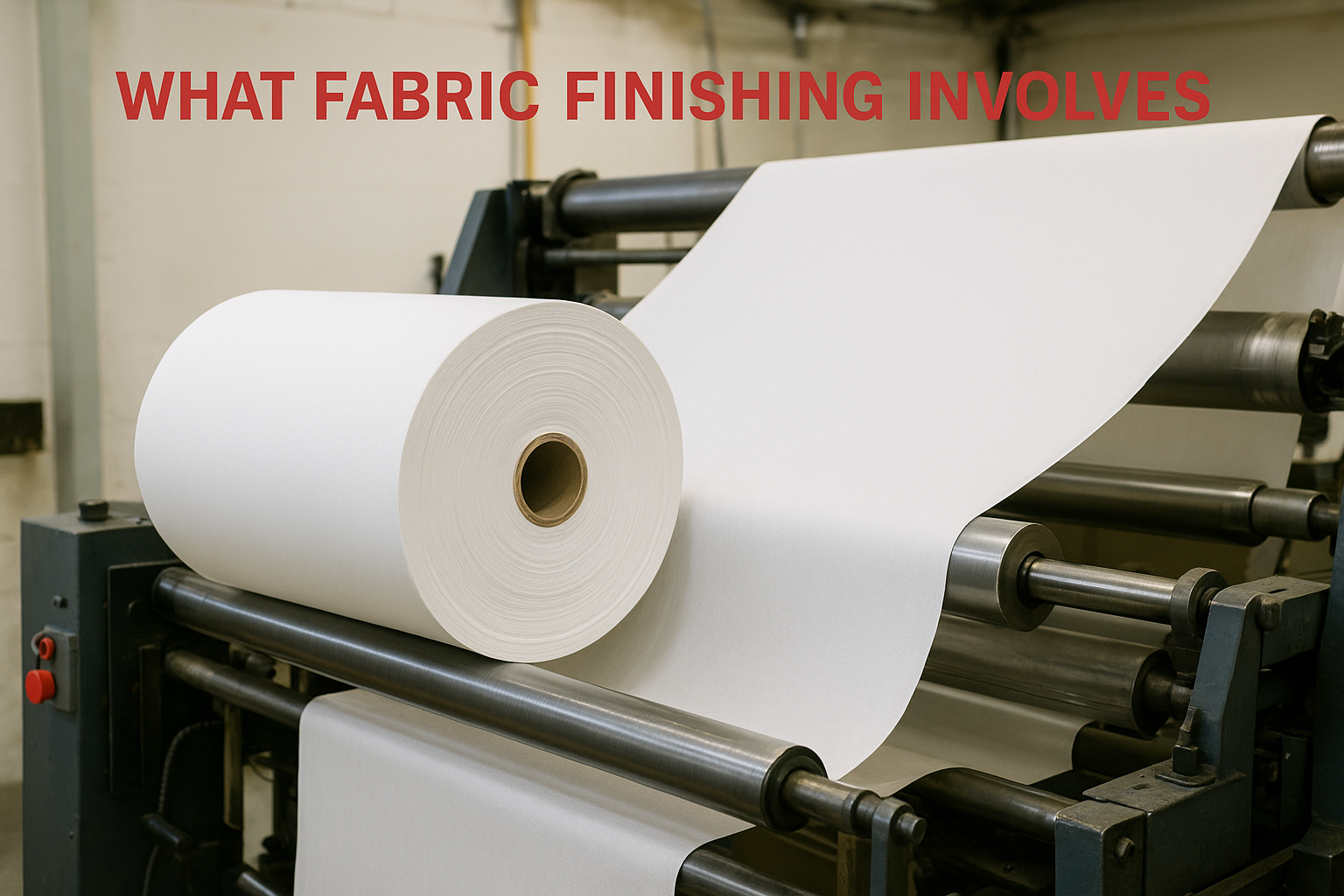
Treatments at this stage include scouring to remove impurities, bleaching to achieve a consistent base colour, dyeing, and various mechanical processes like calendering, which smooths the fabric surface using heated rollers. Pre-shrinking also happens here in many cases, using a process called sanforisation that compresses the fibres before cutting so the finished garment has more predictable dimensions after washing. By the time fabric leaves the mill and arrives at a cut-and-sew facility, it should already meet the baseline standards required for the garment type it’s intended for.
What garment finishing covers
Garment finishing, which is the subject of what is garment finishing as explored throughout this article, picks up where fabric finishing leaves off. Once the garment has been sewn together, a separate set of treatments and processes is applied to the completed piece rather than the raw material. This is the stage where the actual clothing item is pressed, shaped, inspected, treated with any additional chemical applications, and prepared for packaging and shipping.
The key distinction is that fabric finishing improves raw material, while garment finishing transforms a sewn piece into a finished, retail-ready product.
This stage addresses issues that only become apparent once the garment is fully constructed, such as seam pucker, collar shape, and overall dimensional consistency. It’s also where any brand-specific finishing requirements are applied, including special washes, enzyme treatments, or softening processes that give the garment its intended hand feel and appearance.
Why the distinction matters for custom orders
When you’re ordering custom-branded workwear for your team or business, both stages affect the final result. A garment built from well-finished fabric but poorly processed after construction will still arrive creased, misshapen, or inconsistent. Conversely, excellent post-construction finishing can’t fully compensate for fabric that wasn’t properly pre-treated at the mill.
Understanding both stages gives you a clearer picture of the full production chain and helps you evaluate quality claims more accurately. When a supplier tells you their garments are pre-shrunk, ask whether that happened at the fabric stage or the garment stage, because the timing affects how reliably the garment holds its size across your entire order.
Common garment finishing steps in factories
Once the sewing is done, the garment moves through a structured sequence of operations before it’s ready to leave the factory. Understanding what is garment finishing at this level means tracing a piece of clothing through each physical step in that sequence, from the moment the last seam is stitched to the moment it’s folded and packed for shipping. Each step has a specific purpose, and skipping or rushing any one of them typically creates a visible problem that shows up when your order arrives.
Thread trimming and loose end removal
The first task after sewing is removing every loose thread from the finished garment. Operators inspect the entire piece and trim threads left over from seam construction, bar tacking, buttonholes, and label attachment. In higher-volume factories, automated thread-sucking machines pull loose ends off the fabric surface before a manual check catches anything the machine missed. This step seems minor, but visible threads on a finished garment signal poor quality and undermine the professional appearance that custom workwear is supposed to project.
A single loose thread caught in embroidery or a printed panel can pull the design apart after a few washes, which is why this step is not treated as optional.
Factories working at scale often divide this task between machine processing and manual inspection by trained quality checkers who know exactly where threads tend to accumulate on specific garment types, including around cuffs, collar seams, and hem allowances.
Checking and mending
After thread trimming, the garment goes through a detailed inspection pass. Quality checkers look for seam skips, stitch inconsistencies, fabric defects, and any construction errors that made it past the sewing floor. Items that can be corrected are sent to the mending station, where operators re-stitch problem areas or address minor fabric flaws. Garments with defects that can’t be corrected are flagged and removed from the batch entirely rather than being packed and shipped.
This step is where factories catch the issues that would otherwise arrive in your order. A well-run finishing line doesn’t just press and pack garments; it filters out anything that falls below the agreed standard and ensures your branded pieces all meet the same quality threshold across every size in the run.
Pressing and shaping
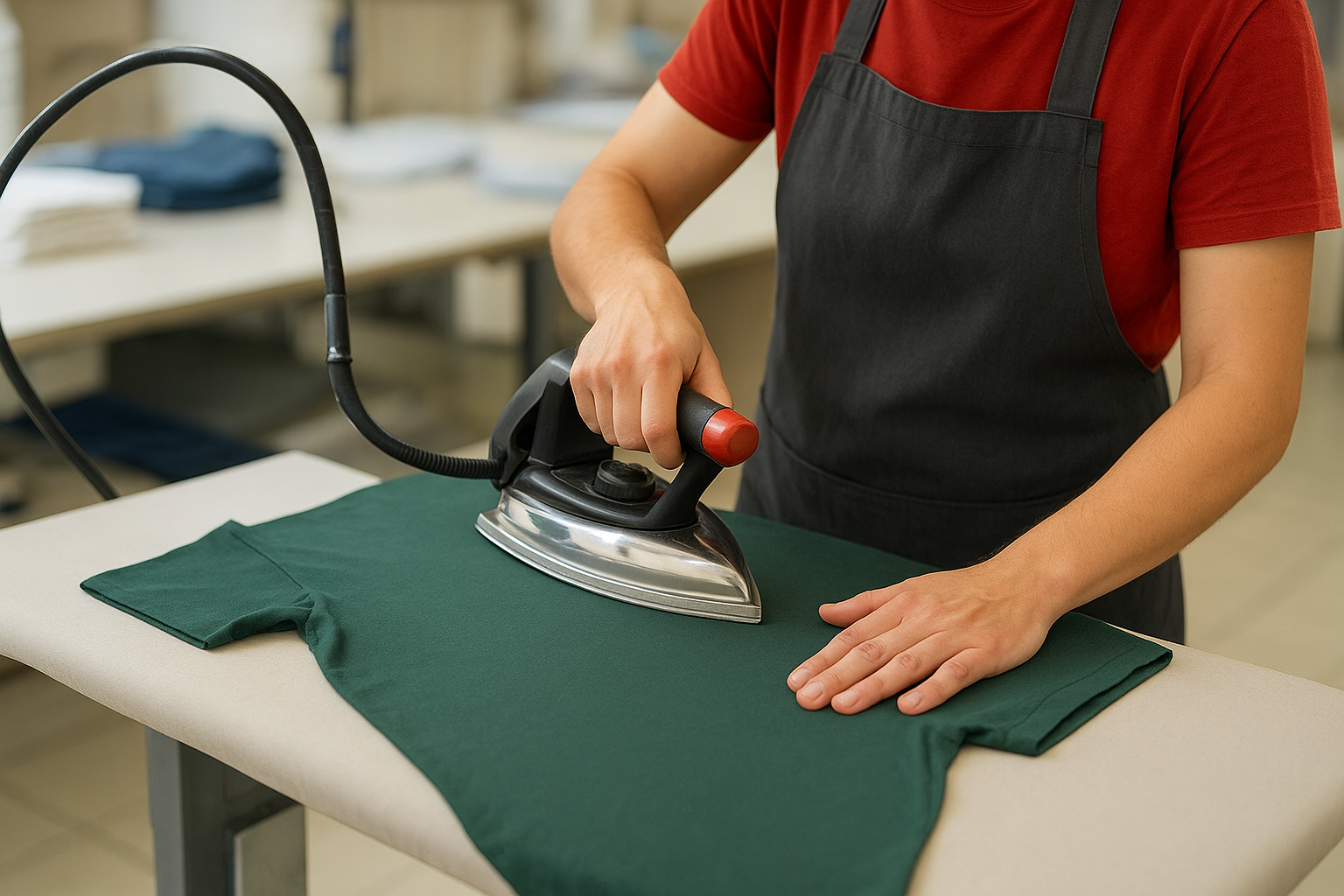
Pressing is arguably the most visible finishing step because it directly determines how the garment looks when you take it out of the packaging. Steam irons, flat presses, and form-finishing equipment remove construction creases, flatten seams, and give the garment its intended silhouette. Different garment types require different pressing techniques, with collared shirts needing careful attention around the neckband and sleeves requiring specific board shapes to press cleanly without adding new fold marks.
Tagging and packing follow pressing. Hang tags, size stickers, care labels, and any brand-specific labels are applied at this stage before the garment is folded to a consistent template and placed into polybags or shipping boxes ready for dispatch.
Mechanical finishing methods
Mechanical finishing methods use physical force, heat, and pressure rather than chemicals to alter how a fabric looks and behaves. These processes are central to understanding what is garment finishing at a production level, because they determine the surface texture, dimensional stability, and overall hand feel of the finished piece without introducing additional substances into the fabric. Factories apply a range of machines to achieve these treatments, each calibrated to the specific fabric type and garment construction being processed. Choosing the right mechanical treatments for your garment type makes a measurable difference in how the piece performs and presents over its working life.
Calendering and surface smoothing
Calendering passes fabric or finished garments through a series of heated rollers under controlled pressure to produce a smooth, even surface. The rollers compress the fibre structure, which reduces surface irregularities and gives the fabric a polished, uniform appearance. For lightweight apparel like printed tees and dress shirts, calendering produces a flatter, more consistent surface that accepts printing and embroidery more cleanly, which directly affects how sharp your finished branding looks on the garment.
The smoother the fabric surface going into a print run, the more accurately ink or thread sits on the material, which is why pre-print calendering matters when you’re sourcing custom workwear.
Different roller configurations produce different results. Friction calendering creates a glazed surface effect, while standard flat calendering simply removes irregularities without adding sheen. The choice depends on the garment type and the finish your supplier is targeting for the final product.
Pre-shrinking and dimensional stabilisation
Pre-shrinking, sometimes called compressive shrinkage treatment, addresses one of the most common complaints about custom apparel: garments that change size after the first wash. The process applies controlled moisture and heat to the fabric or completed garment, then compresses the fibres in a controlled direction to release built-in tension. Once the fibres relax under these conditions, they hold their dimensions more reliably when exposed to the heat and agitation of a standard domestic wash cycle.
For workwear orders covering an entire crew or team, dimensional stability across sizes matters more than most buyers realise. A shirt labelled as a large should fit consistently as a large after ten washes, not just the first time it comes out of the bag. Factories that skip or rush this step produce orders where garments shrink inconsistently, which creates a mismatched look when your team is supposed to be wearing uniform branded apparel.
Raising and brushing
Raising passes the fabric surface over fine wire-covered rollers that lift individual fibres from the yarn structure, creating a soft, napped texture. You’ll recognise this finish on fleece fabrics and brushed cotton, where the surface feels distinctly warmer and softer than the base weave alone would suggest. Brushing performs a similar function but uses softer bristle rollers to achieve a more subtle effect without significantly altering the fabric’s structural weight. Both methods improve perceived warmth and comfort, making them relevant choices for crew jackets, hoodies, and cold-weather workwear that your team relies on through Canadian winters.
Chemical finishing methods and wash effects
Chemical finishing methods introduce functional substances directly into the fabric structure to change how a garment performs, feels, or responds to environmental conditions. Where mechanical methods use heat and pressure, chemical treatments work at the fibre level, bonding agents to the yarn to produce effects that persist through repeated washing. Understanding this dimension of what is garment finishing helps you evaluate why some custom apparel holds its properties season after season while other pieces lose their finish after a handful of wash cycles.
Softening and anti-static treatments
Softening agents are among the most widely used chemical finishes in garment production. Factories apply them to natural fibres like cotton and linen to reduce the stiffness that often appears after construction and initial washing. The softener molecules coat individual fibres and reduce friction between them, which gives the fabric a noticeably more supple hand feel without changing the garment’s structural properties. For workwear that sits against the skin all day, this treatment makes a real difference in comfort, particularly for crews working in warm conditions or performing physically demanding tasks.
Anti-static finishes address a separate but equally practical problem in garments made from synthetic or blended fabrics. Polyester and nylon naturally build up static charge during wear, which causes fabric to cling, attract lint, and create discomfort. The anti-static agent applied during finishing improves electrical conductivity at the surface, allowing charge to dissipate rather than accumulate. For your branded team apparel, this treatment keeps the garment sitting cleanly on the body and looking as intended throughout a full workday.
Wash effects and enzyme treatments
Enzyme washing changes not just how a garment looks, but how it feels from the first time you wear it, which is why it’s a standard step in premium casual and workwear lines.

Stone washing, acid washing, and enzyme washing all fall under the category of wash effects, and each produces a different surface result on the finished garment. Enzyme washing uses biological catalysts to break down surface fibres on cotton garments in a controlled way, creating a worn-in softness and slight surface variation that gives the piece a more relaxed, lived-in appearance. This treatment is particularly common in workwear brands that want their apparel to feel broken in from day one rather than stiff and new.
Colour washing and tinting treatments allow factories to apply a unified tone across a finished garment, evening out any dye inconsistencies from the knitting or weaving stage. For custom workwear orders where colour consistency across your entire team matters, these finishing washes reduce the variation that can appear when garments from different dye lots are assembled into a single order. The result is branded apparel that looks uniform whether it’s worn on day one or month twelve.
Garment finishing equipment and key settings
One of the most practical dimensions of understanding what is garment finishing is knowing which machines carry out the work and how their settings affect the final result. The equipment used across a professional finishing line isn’t interchangeable, and calibrating each machine to the specific fabric type and garment construction makes the difference between a consistently finished order and one full of heat marks, distorted shapes, or uneven surfaces. Getting these settings right is as important as choosing the right process in the first place.
Steam pressing and tunnel finishing machines
Steam presses apply controlled heat and moisture simultaneously to relax fabric tension, flatten seams, and shape the garment to its intended silhouette. Operators set temperature and steam pressure based on fibre content: cotton handles higher heat than polyester, and blended fabrics require settings that protect the more heat-sensitive component without under-pressing the rest. A chest press handles front and back panels, while specialised collar and cuff presses address the areas most likely to look uneven without targeted treatment.
Tunnel finishers run garments on hangers through a heated chamber that applies steam and hot air simultaneously, shaping the piece without direct contact. This method works particularly well for knitwear and softer fabrics where a flat press would leave unwanted marks. The conveyor speed and internal temperature profile of the tunnel determine how thoroughly the garment is finished, and factories typically run test pieces at the start of each production batch to confirm the settings are dialled in correctly before the full run proceeds.
Incorrect steam pressure on synthetic blends causes irreversible surface glazing, which is why tunnel finisher settings are checked at the start of every batch rather than assumed from a previous run.
Heat setting and temperature controls
Heat setting stabilises synthetic and blended fabrics by applying dry heat at a temperature that locks the fibre structure into a fixed position. Once heat set, the fabric holds its shape more reliably under washing conditions and resists stretching or distortion during wear. Polyester fabrics in particular require precise temperature control during this process, because too little heat fails to stabilise the fibres, while too much heat causes permanent surface damage that no downstream treatment can reverse.
Factories that process large volumes of custom workwear use stenter frames to heat-set fabric or finished pieces under tension, ensuring the width and length are fixed at the correct dimensions before the garment is inspected and packed. The stenter’s temperature, airflow speed, and dwell time are all adjusted based on the fabric specification, and these settings are recorded as part of the production file so the same results can be reproduced across repeat orders.
Folding and packaging equipment
Automated folding machines produce consistent fold dimensions across every piece in an order, which matters both for professional presentation and for efficient packing into shipping boxes. Manual folding boards are used for smaller runs where machine setup time wouldn’t be practical, but the output still follows a defined template so every garment arrives in matching condition.
Quality checks and common finishing problems
Quality control is not a separate stage that happens after finishing; it runs alongside every step in the process. When you understand what is garment finishing in practice, you quickly realise that the inspection layer is what separates a professionally finished order from one that creates complaints the moment your team opens the box. Factories that treat quality checks as a final formality rather than an integrated part of the workflow consistently produce more defects than those that build inspection points into the process from the start.
Inline inspection checkpoints
Trained inspectors check garments at multiple points throughout the finishing sequence rather than waiting until everything is packed. After thread trimming, a checker reviews each piece for loose ends and seam integrity. After pressing, a second pass looks for heat marks, uneven seams, and collar distortion before the garment moves to folding and packing. This inline approach catches problems early, when correction is still possible, rather than at the end of the line when an entire batch may already be compromised.
Catching a pressing defect after 200 units have been finished costs far more than catching it after the first five pieces, which is why experienced factories run test pieces at the start of every pressing batch.
Checkers at this stage also verify measurement consistency against the agreed size specifications, particularly for workwear orders where uniform fit across a full crew matters. Any piece that falls outside the accepted tolerance range is pulled from the batch and either corrected or replaced before the order ships.
Common finishing defects and what causes them
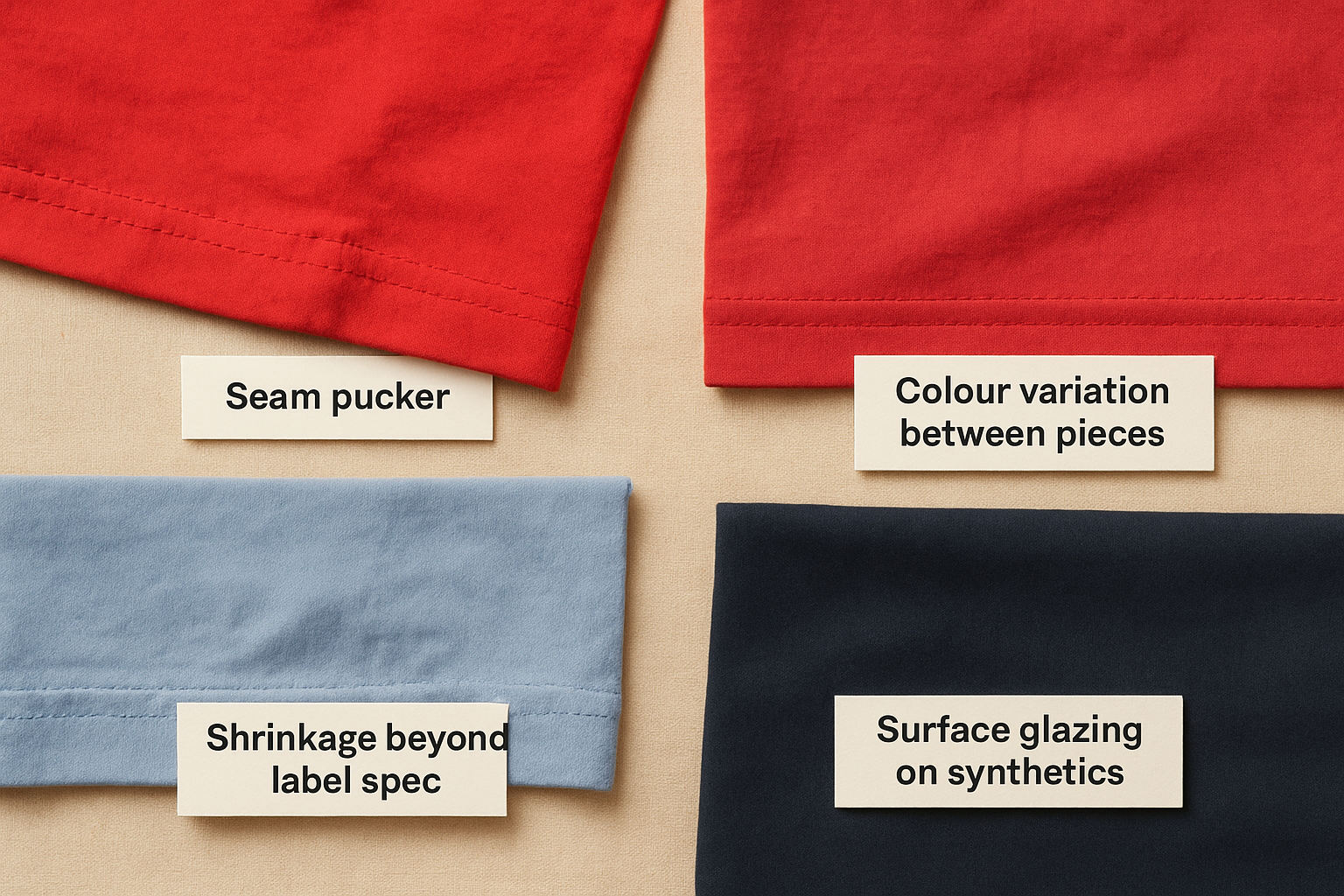
Several finishing problems appear frequently enough across custom apparel production that buyers should know what to look for when their order arrives.
| Defect | Likely cause |
|---|---|
| Seam pucker | Incorrect thread tension or under-pressing |
| Colour variation between pieces | Inconsistent dye lot or uneven wash treatment |
| Shrinkage beyond label spec | Skipped or rushed pre-shrinking step |
| Surface glazing on synthetics | Excessive heat during pressing |
| Uneven collar shape | Wrong press form or insufficient steam |
Each of these defects is preventable with the right process controls in place. Seam pucker, for example, usually points to tension settings that weren’t adjusted when switching between fabric types. Colour variation between pieces in the same order often traces back to garments being sourced from different dye lots without proper colour-matching checks before finishing began.
How finishing failures affect your branded order
When finishing defects reach your door, the impact goes beyond the individual garment. A misshapen collar or an inconsistent colour across your team’s shirts undermines the uniform look you paid for and forces you to either reorder or present your brand in a way that doesn’t reflect the standard you intended. Asking your supplier to describe their inspection process and defect rate before placing a large order is a straightforward way to filter out factories that treat quality control as an afterthought.
How to choose finishing for custom workwear in Canada
Applying what is garment finishing in theory is one thing; selecting the right finishing specification for your actual order is another. Custom workwear buyers in Canada face a specific set of conditions that should directly shape which finishing treatments you prioritise. The climate, the work environment, and the frequency with which your team wears and washes branded apparel all point toward different finishing requirements that aren’t always discussed upfront but make a measurable difference in how your order holds up over time.
Match finishing to your working conditions
Your team’s daily environment should be the starting point for every finishing decision. Crews working on job sites, in warehouses, or in outdoor conditions need garments with robust dimensional stability and strong abrasion resistance, which means pre-shrinking and mechanical treatments that reinforce the fabric structure are non-negotiable. Office-based or client-facing teams benefit more from softening treatments and a polished surface finish that holds its appearance through regular professional wear without requiring constant re-pressing between shifts.
Think carefully about how frequently your team washes their workwear. High-wash environments demand colour-fixing treatments and thorough pre-shrinking that keep the garment consistent across dozens of cycles. A shirt that shrinks unevenly after the fifth wash undermines the uniform look you paid for and creates replacement costs earlier than you planned.
Plan for Canadian winters
Canada’s climate creates a genuine workwear challenge that the right finishing choices can address directly. Brushing and raising treatments applied to hoodies, fleece jackets, and crew-neck sweatshirts improve warmth retention without adding bulk, which matters when your team moves between heated interiors and cold outdoor conditions throughout a full working day. Anti-static finishes on synthetic and blended fabrics also reduce the discomfort that builds up when people layer garments through a long Canadian winter shift.
Choosing garments with appropriate thermal and anti-static finishing treatments costs no more upfront but prevents early replacement cycles that result from apparel that wasn’t built for the season.
Moisture management finishes are equally worth specifying for active roles in summer months, where heat and physical exertion make wicking performance a practical priority rather than a nice-to-have feature.
Ask your supplier the right questions
Before finalising any custom apparel order, ask your supplier specific questions about their finishing process rather than assuming the standard production line covers everything your team needs. Confirm whether pre-shrinking happens at the fabric stage or the garment stage. Ask what pressing and heat-setting equipment they use and whether quality inspection includes inline checkpoints or only a review at the end of the line.
You should also request a pre-production sample before committing to a full run, particularly for orders covering an entire crew. A sample lets you verify hand feel, dimensional accuracy, and colour consistency before production scales up, and any supplier confident in their finishing process will provide one without hesitation.
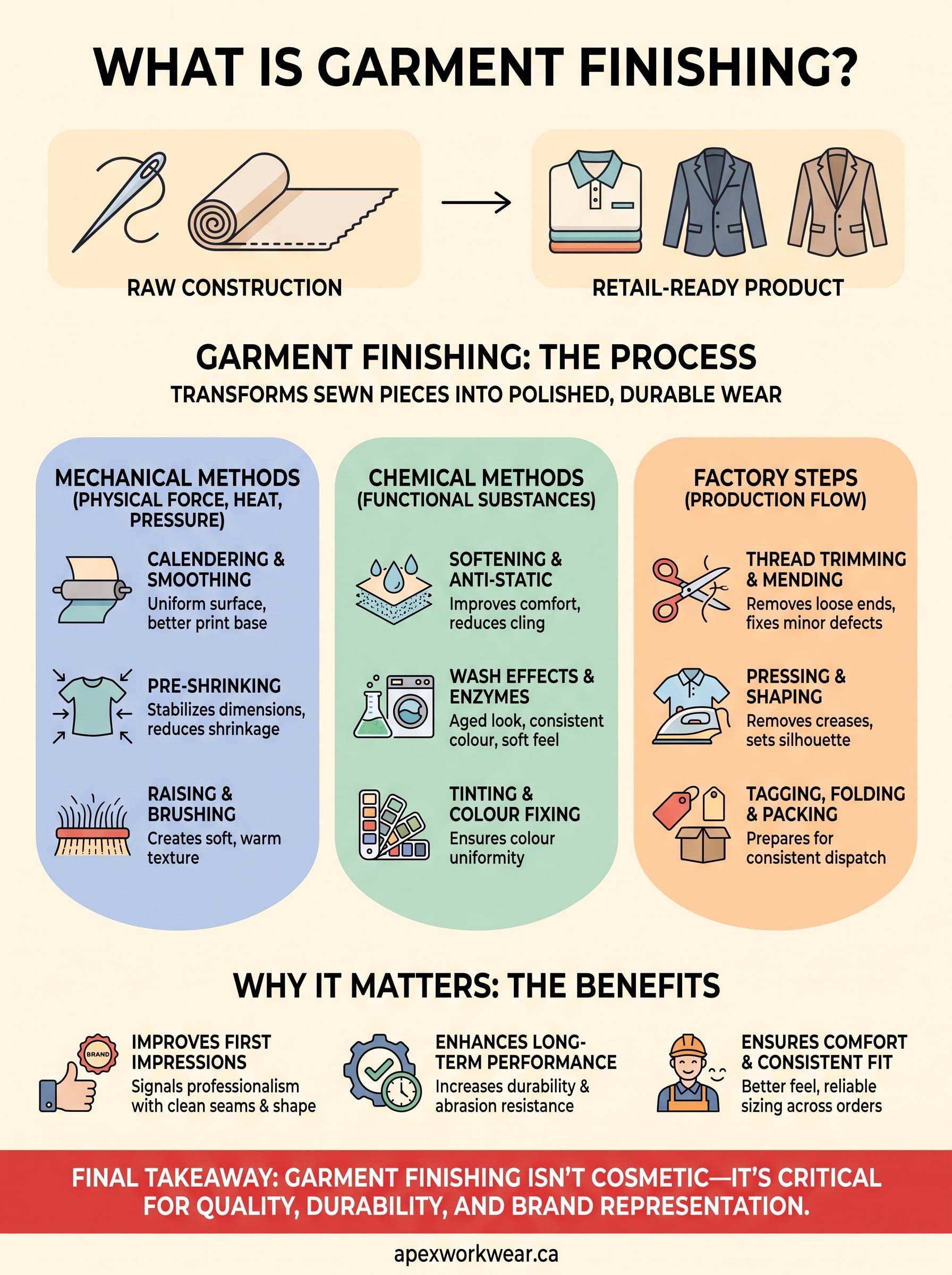
Final takeaways
Knowing what is garment finishing gives you a practical advantage every time you source custom apparel for your team or business. Finishing is not a cosmetic detail. It determines how long your garments last, how consistent they look across your crew, and how well they hold up through the specific demands of your working environment. Treatments like pre-shrinking, pressing, enzyme washing, and anti-static finishing are the difference between workwear that represents your brand reliably and apparel that disappoints after a few months of regular use.
Every decision you make about garment type, fabric weight, and print method connects back to finishing quality. Asking the right questions before you place an order protects your investment and ensures your team gets branded apparel that actually performs. If you’re ready to order custom workwear built to a professional standard, get a quote from Apex Workwear and our team will guide you through every step.