If you’ve ever noticed delicate white stitching on a christening gown or vintage linen tablecloth, you’ve likely encountered whitework embroidery without realising it. So, what is whitework embroidery exactly? It’s a broad category of needlework where white thread is stitched onto white fabric, creating texture and pattern through technique alone rather than colour contrast.
Whitework has roots stretching back centuries across Europe and Asia, yet it remains one of the most respected forms of hand embroidery today. From pulled thread techniques to cutwork and Hardanger, the variety within this single category is surprisingly deep. Understanding these methods matters whether you’re a hobbyist picking up a needle for the first time or a business owner exploring embroidery options for custom apparel, the kind of work we do daily at Apex Workwear, where we help Canadian businesses bring their branding to life through quality embroidered garments and printed products.
This article breaks down the core stitches, techniques, and history behind whitework embroidery, and offers practical guidance on how to get started. Whether you’re here out of curiosity or looking to apply embroidery knowledge to a real project, you’ll walk away with a solid foundation in one of needlework’s most elegant traditions.
Why whitework embroidery stands out
Most embroidery traditions rely on colour contrast to create visual impact, with rich threads against a neutral background doing most of the heavy lifting. Whitework removes that shortcut entirely. When you work with white thread on white fabric, every element of the design has to earn its place through structure, texture, and stitch quality. That constraint is exactly what makes whitework so compelling to both makers and admirers.
The power of tone-on-tone design
Working in a single tone forces you to think differently about how embroidery creates depth. In conventional needlework, colour draws the eye; in whitework, texture and shadow do the work instead. Raised satin stitches catch the light at certain angles, while pulled thread sections create open, lace-like voids that shift a viewer’s eye across the fabric. The result is a piece that looks different depending on where you’re standing and how the light falls on it.
Whitework’s visual effect depends almost entirely on how well the stitcher controls tension, placement, and stitch direction, which is why it remains one of the most technically demanding forms of hand embroidery.
This is also part of what makes whitework embroidery relevant beyond the craft room. When you see whitework-style texture applied to custom embroidered garments, the same tonal discipline applies: a raised logo or monogram on a white shirt achieves elegance through structure rather than colour. The approach translates directly into professional branding contexts, where subtlety often signals quality far more effectively than bold graphics.
Versatility across garments and textiles
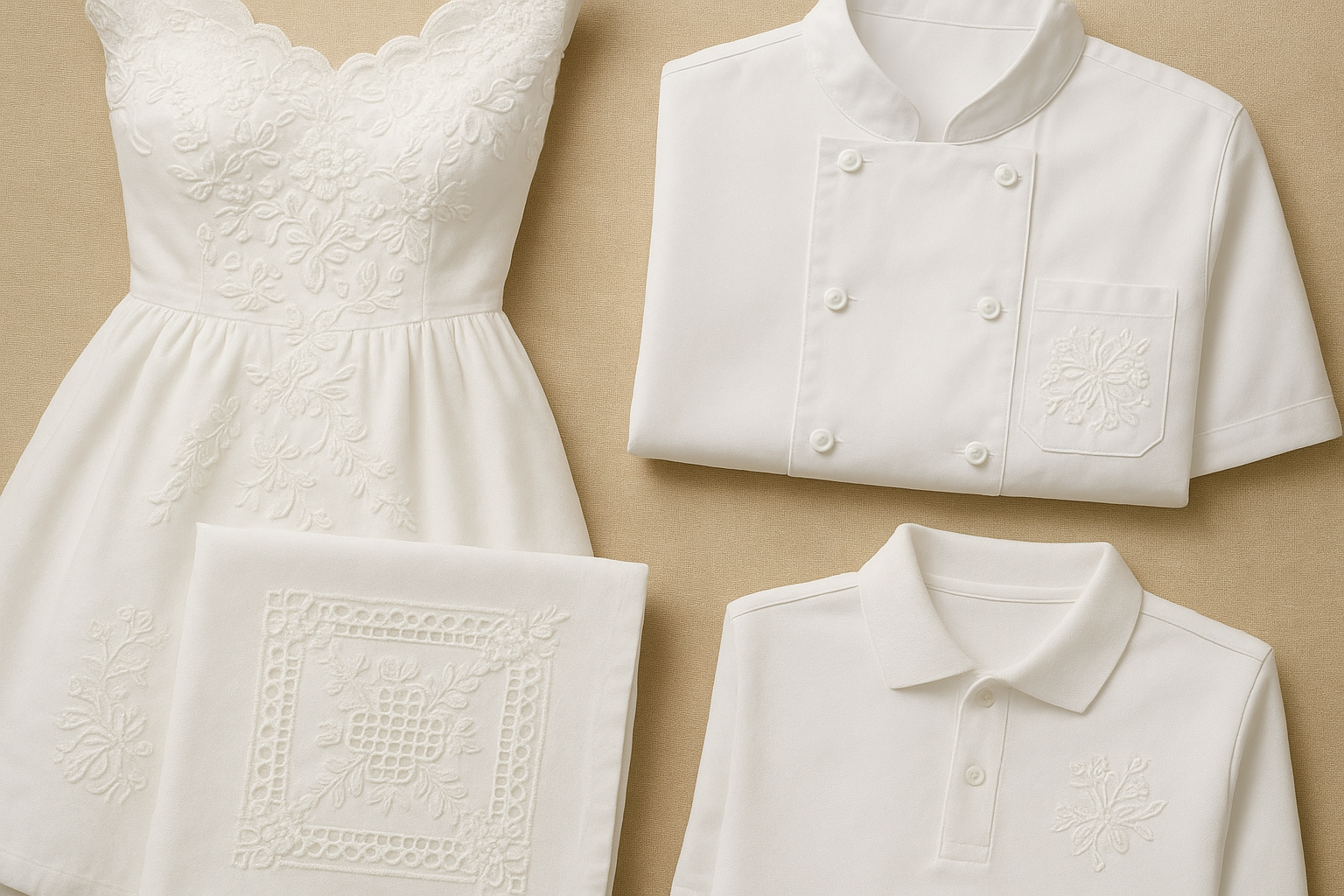
Whitework has never been confined to a single type of fabric or product. Historically, you’ll find it on fine linen, cotton lawn, and silk organza, used for everything from household linens to ceremonial dress. Today, the same principles appear on polo shirts, chef’s jackets, wedding attire, and corporate uniforms, where embroidered details in tonal thread give a garment a polished finish without demanding immediate attention.
Your choice of whitework technique also shapes the final product significantly. A Hardanger panel on linen for a decorative piece and a tonal monogram stitched onto a company polo shirt both draw from the same visual logic: let the stitchwork speak through structure, not colour. That flexibility is a core part of what is whitework embroidery’s lasting appeal, and it explains why these techniques continue to influence both hand embroidery communities and the commercial embroidery industry alike.
Core techniques and styles
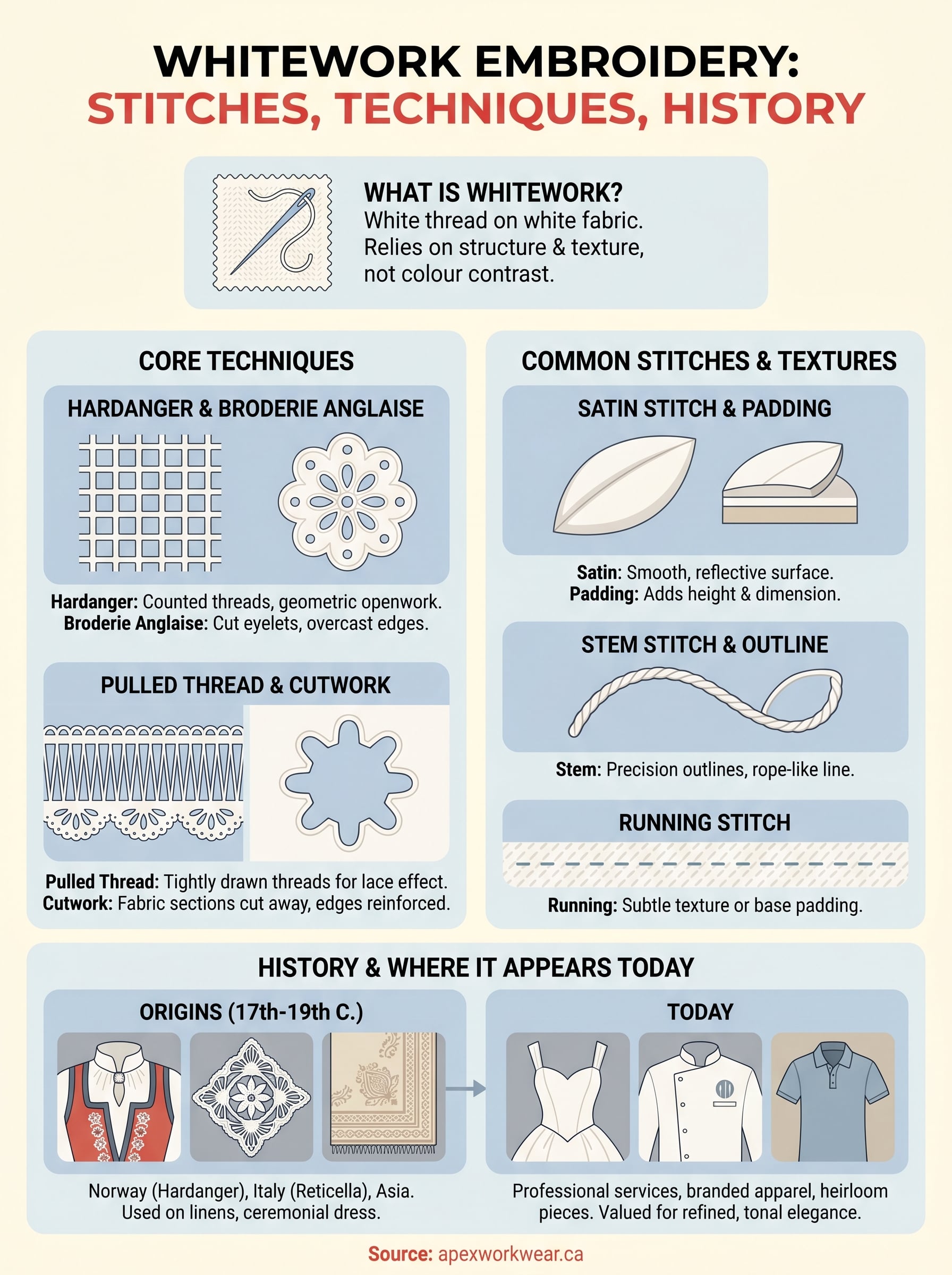
When people ask what is whitework embroidery, they often don’t realise it covers multiple distinct techniques, each producing a very different result on the fabric. Some methods build texture by layering thread on top of the fabric surface, while others create openwork by manipulating or removing threads from the fabric itself. Knowing the difference helps you choose the right approach for your project from the start.
Hardanger and Broderie Anglaise
Hardanger originates from Norway and works on evenweave fabric, where you count threads precisely to build geometric patterns. You stitch kloster blocks (small groups of satin stitches) and then cut and withdraw the fabric threads between them, leaving a structured grid of open squares. The result is rigid, architectural, and impressive on household linens or decorative panels.
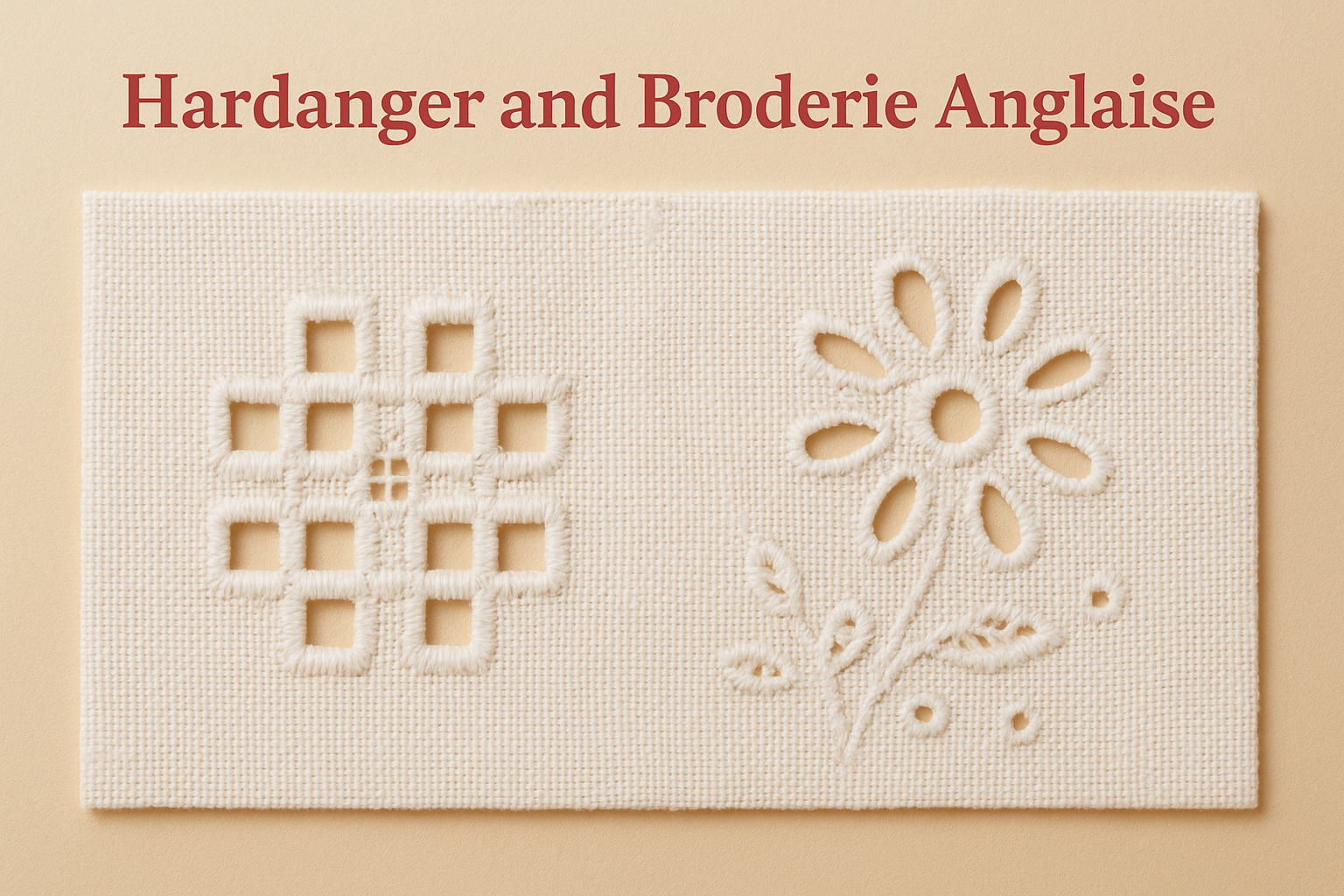
Broderie Anglaise takes a different path by using a stiletto or small scissors to cut eyelets and oval holes into the fabric, which you then overcast or buttonhole stitch around the edges to prevent fraying. You’ll see it on children’s clothing, lingerie, and vintage blouses. The technique produces a light, airy look that suits fine cotton and lawn fabrics particularly well.
Pulled thread and cutwork
Pulled thread work keeps the fabric intact but draws threads tightly together using specific stitches, creating small, lace-like holes without cutting anything away. The effect depends entirely on consistent tension, which makes it technically demanding but very rewarding once you develop the muscle memory.
Cutwork takes a bolder approach, where you cut sections of fabric away entirely and reinforce the edges with tight buttonhole stitches, creating dramatic negative space within a design.
Both techniques reward patience and precision, and both appear regularly in high-end custom embroidery contexts where tonal texture matters more than colour.
Common stitches and textures
Understanding individual stitches is where the real detail of what is whitework embroidery becomes clear. Each stitch serves a specific purpose: some build raised surfaces, others create fine lines, and a few work together to produce complex textures within a single design. Getting familiar with the core options before you start saves you from having to unpick work later.
Satin stitch and padding
Satin stitch is the foundation of much whitework surface texture. You lay flat, parallel threads closely together across a shape, creating a smooth, almost reflective surface. To build height and dimension, stitchers often add padding underneath by working a base layer of running stitches or chain stitch before the final satin layer goes on top. The raised result catches light differently from the surrounding fabric, giving the design its characteristic depth without any colour change.
Padding beneath satin stitch is what separates flat, amateur-looking work from the crisp, sculptural finish that defines high-quality whitework.
Stem stitch and outline work
Stem stitch handles curves and outlines with precision. You work it by bringing the needle up along a line, taking a short angled stitch forward, and returning partway back before repeating. Each stitch overlaps the last, producing a rope-like line that holds its shape cleanly around curved motifs. Outline stitches like this define the edges of satin-filled shapes and add crisp borders to cutwork or pulled thread sections.
Running stitch plays a supporting role across most whitework styles. Used lightly, it provides subtle texture on its own; used as a foundation, it shapes the padding that gives satin stitch its lift. Most whitework projects use at least two or three stitches in combination, which is why learning them as a group rather than in isolation speeds up your progress considerably.
A brief history and where it appears today
Whitework embroidery did not emerge from a single place or moment. Different cultures developed their own white-on-white needlework traditions independently, driven by available materials, local craft customs, and the types of textiles they valued most. What we now group together under the umbrella of what is whitework embroidery represents centuries of parallel development across Europe, Asia, and the Middle East.
Origins across Europe and Asia
Hardanger embroidery developed in the Hardanger region of Norway as far back as the 17th century, where it decorated folk costumes and household linens. Meanwhile, Broderie Anglaise became fashionable in Victorian England and spread through the British Empire, appearing on infant clothing, undergarments, and collar trimmings. Italian reticella, one of the earliest forms of needlelace, predates both of these by at least a century and laid the groundwork for later cutwork traditions across the continent.
Across Asia, particularly in India and China, white-on-white embroidery appeared on ceremonial textiles and court garments long before European techniques were documented, pointing to how broadly this approach to needlework resonates across cultures.
Where whitework appears today
Professional embroidery services still use tonal thread techniques regularly, particularly for formal garments, corporate wear, and personalised items where a refined finish matters more than bold colour. You will find whitework-style detailing on wedding attire, chef’s whites, uniform shirts, and luxury linens, where the effect reads as quality rather than decoration. The craft embroidery community has also seen a strong revival, with makers combining historical techniques like pulled thread and Hardanger with contemporary design aesthetics. Whether you encounter it in a heritage museum display or on a custom embroidered polo shirt, whitework’s core logic remains unchanged: structure and texture carry the design entirely on their own.
How to start whitework embroidery
Starting whitework embroidery does not require an expensive kit or years of prior stitching experience. What it does require is the right fabric, the right thread weight, and a clear sense of which technique you want to learn first. Trying to tackle pulled thread work and Hardanger simultaneously will slow your progress; picking one style and working through it gives you transferable skills that apply across every branch of what is whitework embroidery.
Choosing your fabric and thread
Evenweave linen is the standard starting point for most whitework styles, particularly Hardanger and pulled thread work, because its consistent weave structure makes it far easier to count threads accurately. For Broderie Anglaise or surface whitework, a tightly woven 100% cotton or cotton lawn fabric gives you a smooth base that takes satin stitch cleanly without puckering.
Match your thread weight to your fabric weight: a heavy perle cotton on fine lawn will distort the fabric, while a thin stranded cotton on coarse linen will disappear into the weave.
For thread, DMC Perle Cotton No. 8 or No. 12 suits most beginner whitework projects. Stranded cotton also works well for finer surface stitching, where you can adjust the number of strands to control line thickness.
Your first project
Start with a simple satin stitch motif, such as a small floral or geometric shape no larger than 5 centimetres across. This gives you practice controlling thread tension and stitch direction before committing to a larger design.
Once you feel confident with surface texture, you can add a basic eyelet or pulled thread element to the same piece to see how the two approaches interact in a single composition. Building one skill at a time is how most experienced whitework embroiderers developed their range.
Next steps
Whitework embroidery rewards patience and methodical practice more than almost any other needlework style. Now that you understand what is whitework embroidery covers, from pulled thread and Hardanger to satin stitch and cutwork, you have enough foundation to pick a technique, gather your materials, and start stitching. Keep your first project small, focus on consistent thread tension, and build your stitch vocabulary one method at a time.
When you’re ready to take that embroidery knowledge beyond the craft room, the same principles of tonal texture and structured detail apply directly to custom embroidered garments and branded apparel. Whether you need a refined logo on a polo shirt or a personalised monogram on a uniform jacket, professional results come from the same attention to craft that whitework demands. Get a free quote from Apex Workwear and see how quality embroidery can sharpen your brand’s image.