If you’ve been researching custom apparel methods, you’ve probably come across the term DTF, and wondered what it actually means. With DTF printing explained properly, you’ll see why this technique has gained serious traction among small businesses, contractors, and anyone who needs durable, full-colour designs on garments without the headaches of traditional methods.
DTF (Direct-to-Film) printing works by transferring a design from a special film onto fabric using heat and adhesive powder. It sounds simple, and compared to many alternatives, it is. But there are trade-offs worth understanding before you commit, from cost per print to durability, and how it stacks up against screen printing, sublimation, and DTG. Not every method suits every job, and picking the wrong one can mean wasted time and money.
At Apex Workwear, we produce custom apparel for businesses and teams across Canada, so we know firsthand how choosing the right print method matters. This guide breaks down exactly how DTF printing works, where it shines, where it falls short, and what it’ll cost you, so you can make a confident decision for your next order.
What DTF printing is and when it makes sense
DTF printing is a garment decoration method where a design is printed onto a thin PET (polyethylene terephthalate) film using a specialised inkjet printer loaded with water-based inks. Once printed, a heat-activated adhesive powder is applied to the wet ink and then cured with heat. The resulting transfer is pressed onto fabric using a heat press, bonding the design firmly to the material. Unlike methods that print directly onto the garment itself, DTF creates a ready-to-apply transfer that you can use right away or store for later production runs.
How DTF differs from direct fabric printing
Understanding DTF printing explained properly means recognising what separates it from other direct fabric methods. With direct-to-garment (DTG) printing, the printer applies ink straight onto the fabric, which means the garment must be pre-treated and loaded into the machine. DTF skips that stage entirely. You print onto film first, so the garment never enters the printer, and you can apply the same transfer to almost any fabric type, including cotton, polyester, nylon, leather, and blended materials.
DTF transfers work on fabrics that DTG and sublimation simply cannot handle well, making it one of the most versatile decoration methods available today.
This flexibility is a genuine advantage. Because the transfer bonds to the surface of the fabric rather than soaking into the fibres, DTF works on both light and dark garments without requiring a white base layer pre-treatment the way DTG does. That alone removes a significant step from the production process and reduces the chances of inconsistent results across a batch.
When DTF printing makes the most sense
DTF printing earns its place when you need short to medium run orders with complex, full-colour artwork. If you’re ordering 10 branded hoodies for a small team or 50 shirts for a corporate event, DTF handles both without forcing you into screen printing minimums or the per-garment setup costs that come with those larger commitments. The no-minimum flexibility is particularly useful for small businesses and contractors who need professional results without committing to large quantities upfront.
You’ll also find DTF valuable when your design includes fine detail, gradients, or photographic elements. Screen printing struggles with those types of artwork unless you invest in expensive multi-colour setups. DTF reproduces intricate designs accurately because the inkjet process lays down colour with precision. If your logo features a detailed illustration or a smooth colour fade, DTF delivers that faithfully without compromise, which is why so many small businesses have shifted toward it for their branded apparel.
How the DTF printing process works step by step
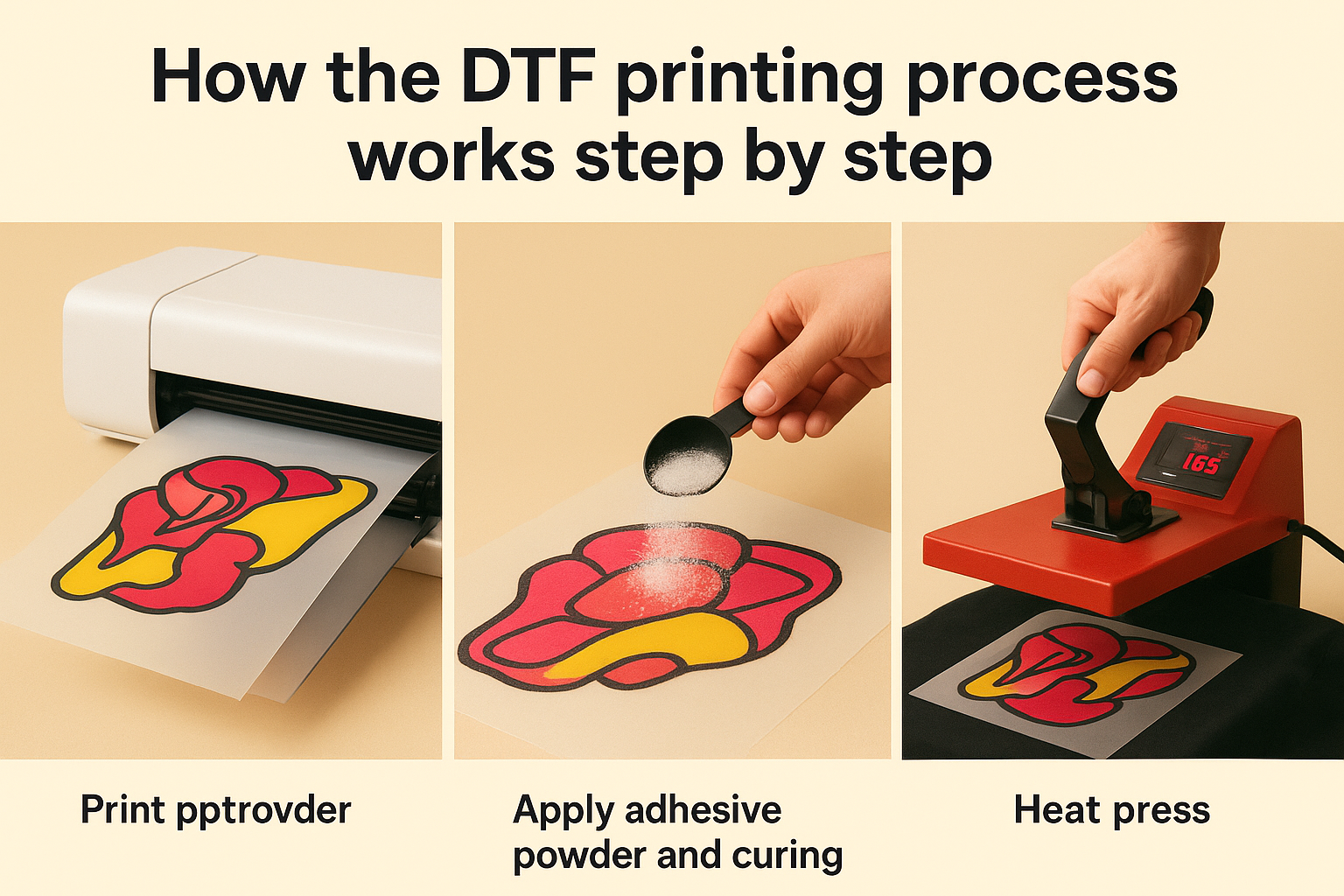
The DTF process involves several distinct stages, and understanding each one helps you see why the results look so clean and last as long as they do. With dtf printing explained at a process level, you’ll find it easier to communicate with your print provider about what you actually need and what to expect from your finished garments.
Printing the design onto film
Your print provider starts by loading the artwork into a specialised inkjet printer fitted with CMYK inks and a dedicated white ink channel. The printer outputs the design onto a transparent PET film, laying down the colours first and then printing a white ink base layer underneath. That white layer is critical because it acts as the foundation that makes colours appear vivid and accurate on dark or mid-tone fabrics once the transfer is applied.
Applying adhesive powder and curing
While the ink is still wet, your provider dusts the printed film with a fine hot-melt adhesive powder, which clings to the ink surface and nowhere else on the film. The excess powder is shaken off, and the film moves through a curing oven or heat tunnel, where the adhesive melts into the ink and sets firmly. This curing step is what gives DTF transfers their flexibility and wash durability because the adhesive forms a solid, even layer across the entire design.
The adhesive powder is what separates DTF from standard inkjet transfers: it creates a mechanical bond with fabric fibres rather than simply resting on the surface.
Pressing the transfer onto your garment
Once cured, the transfer is ready to apply immediately or can be stored flat for future production runs. Your provider places the film face-down onto the garment and applies a heat press at a controlled temperature, typically between 160 and 165 degrees Celsius for around 10 to 15 seconds. After pressing, the film peels away cleanly, leaving a smooth, full-colour design firmly bonded to the fabric.
Pros and cons of DTF prints in real use
With dtf printing explained at a technical level, the next question is whether it fits your specific needs. Like any print method, DTF has clear strengths and real limitations that show up in everyday production. Knowing both sides helps you avoid surprises when your order arrives.
Where DTF printing delivers
DTF’s biggest advantage is its fabric versatility. You can apply transfers to cotton, polyester, nylon, denim, leather, and blended materials without changing your production workflow. That consistency means you can brand multiple garment types in a single run without switching methods or reformatting your artwork.
Few other print methods match DTF for working across such a wide range of fabrics and colours in one straightforward process.
The colours also hold up well. DTF prints show vivid, accurate reproduction across the full colour spectrum, including gradients and fine detail that screen printing typically cannot handle without significant added cost. Wash durability is another genuine strength: properly cured DTF transfers resist cracking and peeling through repeated machine washes when applied correctly.
- Works on light and dark fabrics without pre-treatment
- Reproduces fine detail and full-colour gradients accurately
- Stores flat for future use, reducing waste on short runs
- No minimum order requirements for most providers
Where DTF falls short
DTF transfers sit on top of the fabric rather than soaking into the fibres, which gives prints a slightly raised feel compared to DTG or sublimation. On lightweight fabrics especially, you can feel the transfer edge with your fingertips, and some customers find that texture less premium than a fully embedded print.
Calibration matters more than you might expect. If the temperature or pressure is off during application, you risk incomplete bonding, which leads to peeling at the edges after washing. This makes quality control more important than with some other methods, particularly if you are working with a less experienced provider.
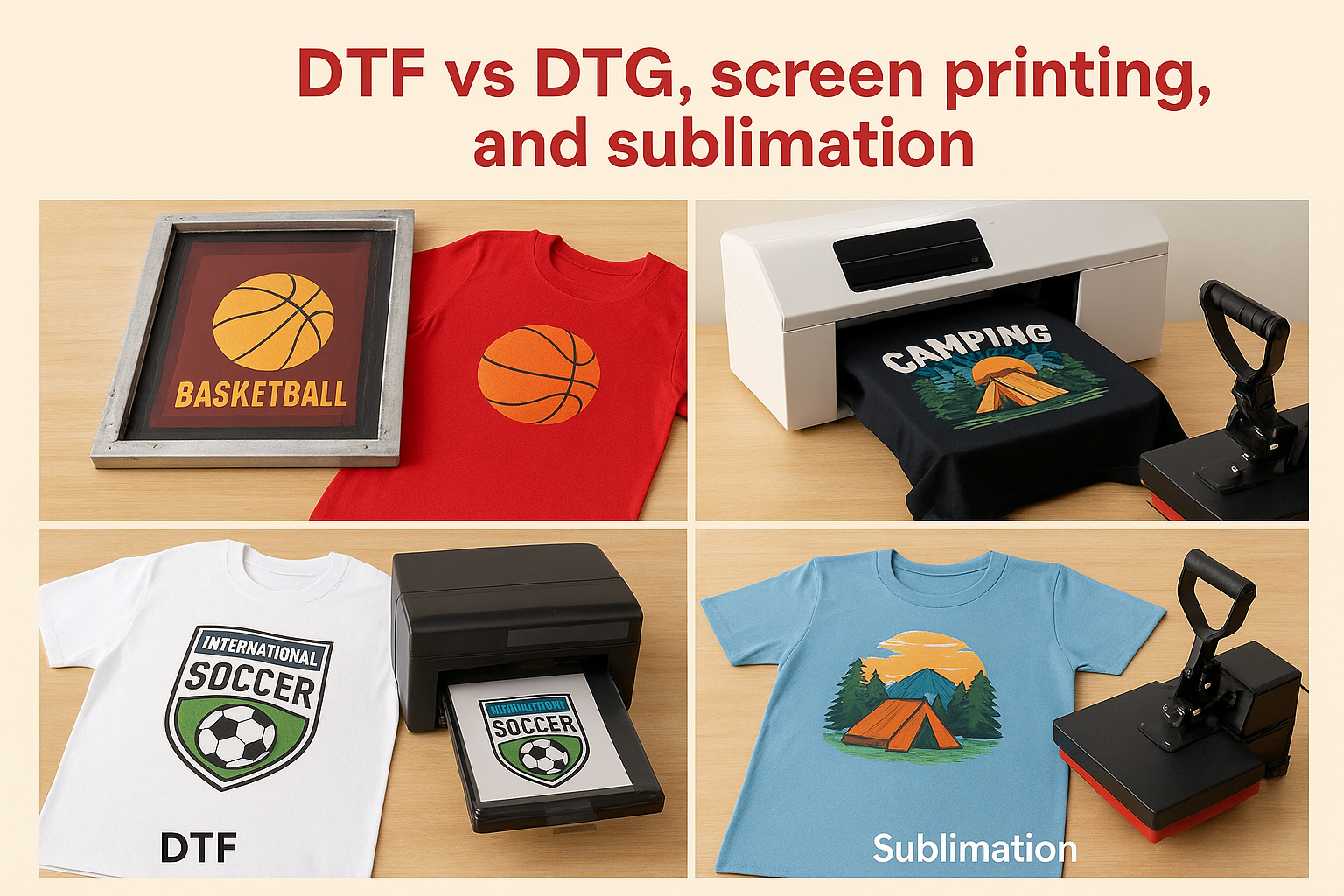
DTF vs DTG, screen printing, and sublimation
Choosing between print methods comes down to your specific job requirements. Each technique has a different sweet spot, and dtf printing explained against its alternatives makes that much clearer. Once you understand where each method fits, you stop guessing and start specifying the right one for the job.
DTF vs DTG
DTG prints ink directly into the fabric, which produces a soft, breathable feel that DTF cannot match. However, DTG requires pre-treatment on dark garments and works best on 100% cotton fabrics, which limits your garment options significantly. DTF skips pre-treatment entirely and bonds to nearly any material, making it the faster, more flexible choice for mixed-fabric orders.
If your team wears polyester-blend uniforms or you need to brand non-cotton items, DTF covers that territory where DTG consistently falls short.
DTF vs screen printing
Screen printing delivers exceptional durability and a premium texture on simple, bold designs, and the per-unit cost drops sharply at high volumes. The problem is that screen printing requires separate screens for each colour, which pushes setup costs up fast for complex artwork. DTF handles gradients and photographic detail without setup fees, making it the smarter pick for short runs or intricate logos.
- Screen printing: best for large runs, simple designs, and spot colours
- DTF: best for short runs, full colour, fine detail, and mixed fabrics
DTF vs sublimation
Sublimation dyes soak directly into polyester fibres, producing a permanently embedded print with no raised texture and no visible transfer edge. That sounds ideal, but sublimation only works on light-coloured, high-polyester fabrics. You cannot sublimate onto a navy cotton hoodie or a dark nylon jacket. DTF works on both, which gives you far more flexibility when your branded items span different garment styles and colours.
Each method serves a real purpose, and the right choice depends on your fabric and your artwork. For most small business orders with varied garment types and detailed designs, DTF sits squarely in the middle of the performance-to-cost curve.
DTF printing costs and equipment basics
Getting dtf printing explained from a cost perspective means separating what print providers spend on equipment from what you pay per finished garment. Both figures matter, especially if you’re deciding whether to outsource your printing or invest in an in-house setup. Most small businesses find outsourcing far more practical, and understanding why starts with knowing what the equipment actually costs.
What DTF equipment costs
A professional-grade DTF printer capable of consistent, production-ready output starts at roughly $5,000 to $15,000 CAD for entry-level commercial units, with higher-end systems running $20,000 or more. On top of the printer, you need a curing oven or powder shaker unit to apply and set the adhesive, which adds another $1,500 to $5,000 depending on capacity. Heat presses run from $400 for basic models to $3,000 or more for dual-platen commercial units. Inks, film, and adhesive powder are ongoing consumables that add up quickly, particularly during high-volume production.
For most small businesses, the capital investment in DTF equipment makes outsourcing to a print provider far more cost-effective than building an in-house operation.
What you’ll pay per print
Per-transfer pricing from a print provider typically ranges from $2 to $8 CAD depending on print size, design complexity, and order quantity. Larger designs and smaller quantities push the per-unit cost higher, while bulk orders bring that number down substantially. When you factor in the cost of the garment itself, a finished branded T-shirt through a provider like Apex Workwear lands well within a reasonable budget for professional results.
Your total cost also depends on garment selection and turnaround time. Standard production timelines of five to seven business days carry no rush premium, but expedited orders will add to your invoice. Ordering a mix of garment styles in a single run stays straightforward with DTF, since one transfer works across multiple fabric types without reformatting costs or additional setup fees.
Final takeaways
With dtf printing explained from process to cost, you now have a clear picture of where this method fits and where it doesn’t. DTF works best for short to medium runs with full-colour, detailed artwork across varied fabric types. It isn’t the right choice for every job, but for most small business branded apparel orders, it delivers professional results without the setup costs or minimums that screen printing requires.
Your next step is clear. If you need custom apparel printed with full-colour accuracy on any fabric type, partnering with an experienced Canadian provider saves you time, avoids equipment investment, and gets your order done right the first time. Get a custom apparel quote from Apex Workwear and find out how quickly we can bring your branded designs to life.