Choosing between DTF printing vs screen printing usually comes down to one order that needs to go out fast, look sharp, and not blow the budget. Maybe you’re outfitting a construction crew, printing hoodies for a local sports league, or ordering shirts for a pop-up event, and every supplier seems to push a different method without explaining why it matters for your specific job.
The short answer: screen printing wins on large runs of simple designs where cost per shirt drops fast, while DTF transfers shine on small batches, detailed artwork, and mixed fabric types where setup fees would otherwise sink your budget. Durability and colour vibrancy differ too, and those differences show up after a dozen washes, not on day one.
In this guide, we break down print quality, long-term durability, turnaround speed, and real cost comparisons across order sizes, drawing on what we see daily producing custom apparel for GTA businesses at Apex Workwear. By the end, you’ll know exactly which method fits your next order.
Why the printing method you choose matters
Picking a print method feels like a small decision until the shirts come back from the wash looking cracked, faded, or peeling at the edges. Custom apparel is often the first physical thing a client, employee, or event attendee touches that represents your brand, and a poor print job undercuts every other effort you’ve put into your logo, your pitch, or your event setup. The debate over dtf printing vs screen printing isn’t academic. It directly affects how your brand looks on a hoodie six months from now, not just on the day it arrives.
The print method you choose today decides how your brand looks after twenty washes, not just on delivery day.
First impressions form fast, and cheap prints kill them
Customers and coworkers notice apparel quality faster than most business owners expect. A cracked logo on a work shirt or a faded design on a team jersey signals that a company cut corners, even if the fabric itself is solid. Screen printing done right lays down thick, opaque ink that holds its colour through dozens of washes, while a poorly executed DTF transfer can peel at the corners within weeks if the wrong film or press settings were used. Neither method is inherently bad; the mismatch happens when a supplier applies the wrong process to your fabric or design complexity.
The real cost isn’t the invoice, it’s the reprint
Many businesses focus purely on the quoted price per shirt and miss the costs that show up later. Choosing screen printing for a twelve-shirt order with a five-colour gradient design means paying for screens you’ll barely use once. Choosing DTF for a five-hundred-unit run of a simple one-colour logo means paying a per-print premium that scales badly compared to screen printing’s near-flat cost curve past a few hundred units. Get the match wrong and you’re looking at:
- Reorder costs when prints fail early and clients demand replacements
- Wasted setup fees on screens that never get reused for future orders
- Delayed launches when a rush reprint pushes your event or product launch back a week
- Reputation damage with repeat clients who notice their branded gear looks worn after a few months
At Apex Workwear, we’ve reprinted orders for clients who came to us after a previous supplier used screen printing on a run of eight jackets with a photo-realistic design, a job DTF handles far better and far cheaper at that volume.
What happens to the ink and fabric over time
The two methods behave differently once a garment leaves the shop and enters real life, and that difference only becomes obvious after repeated wear and washing.
| Factor | Screen printing | DTF transfer |
|---|---|---|
| Wash durability (50+ washes) | Excellent when cured properly | Good, depends on press temperature and film quality |
| Feel on fabric | Can feel thick or plasticky on multi-colour designs | Softer, thinner layer even with full colour |
| Fabric stretch | Ink can crack on stretchy blends | Flexes with fabric, less cracking |
| Colour vibrancy on dark garments | Requires underbase, adds cost | Vibrant without extra setup |
| Fine detail and gradients | Limited without extra screens | Handles photo-quality detail easily |
Garments printed with the wrong method for their fabric type often fail exactly where you’d expect: at stretch points on athletic wear, along seams on work jackets, or across large solid-colour areas that see constant friction. Understanding these failure points before you order saves you from finding out the hard way, usually after fifty units are already in your team’s hands. That’s really why this comparison matters so much: it’s not about which method sounds more modern, it’s about which one survives the actual life of the garment you’re ordering.
How to choose between DTF and screen printing
Sorting through dtf printing vs screen printing gets easier once you stop asking "which is better" and start asking "which fits this specific order." Every job has three variables that matter more than personal preference: how many units you need, how complicated the design is, and what fabric you’re printing on. Get those three answers first, and the method usually picks itself.
Start with your order quantity
Quantity drives cost more than any other factor in this decision. Screen printing requires burning a physical screen for every colour in your design, so a five-shirt order carries the same setup cost as a fifty-shirt order, just spread across fewer garments. DTF transfers skip that setup entirely since the design prints digitally onto film first, which makes small runs affordable without the per-screen penalty. As a rough guide:
- Under 24 units: DTF almost always wins on price and speed
- 25 to 100 units: it’s close, and design complexity becomes the tiebreaker
- Over 150 units of a simple one or two colour design: screen printing pulls ahead on cost per piece
Factor in design complexity before quantity
Quantity matters less once your artwork includes gradients, photo-realistic images, or more than three colours. Screen printing needs a separate screen for each colour, so a five-colour gradient logo can mean five screens, five setup charges, and five chances for registration to shift slightly during printing. DTF handles unlimited colours and fine detail in a single pass because it’s printed digitally, the same way an inkjet printer handles a photo. If your design has fine text, small logos, or photographic elements, DTF protects the detail regardless of order size.
If your design has more than three colours or fine detail, DTF usually beats screen printing even at higher quantities.
Match the method to fabric type and timeline
Fabric compatibility often gets overlooked until the order is already placed. Screen printing performs best on cotton and cotton-blend garments where ink can bond properly with the weave. Polyester, performance blends, and stretchy athletic fabrics can cause screen printing ink to crack or migrate colour from the shirt dye, a problem DTF avoids because the transfer film adheres without needing the same ink penetration. Timeline plays a role too: DTF orders typically move faster since there’s no screen-burning stage, which matters if you’re printing for an event next week rather than next month.
Running through these three checks, quantity, complexity, and fabric, before you request a quote means you walk into the conversation with your supplier already knowing roughly what to expect, rather than accepting whichever method they happen to push first.
Comparing costs across different order sizes
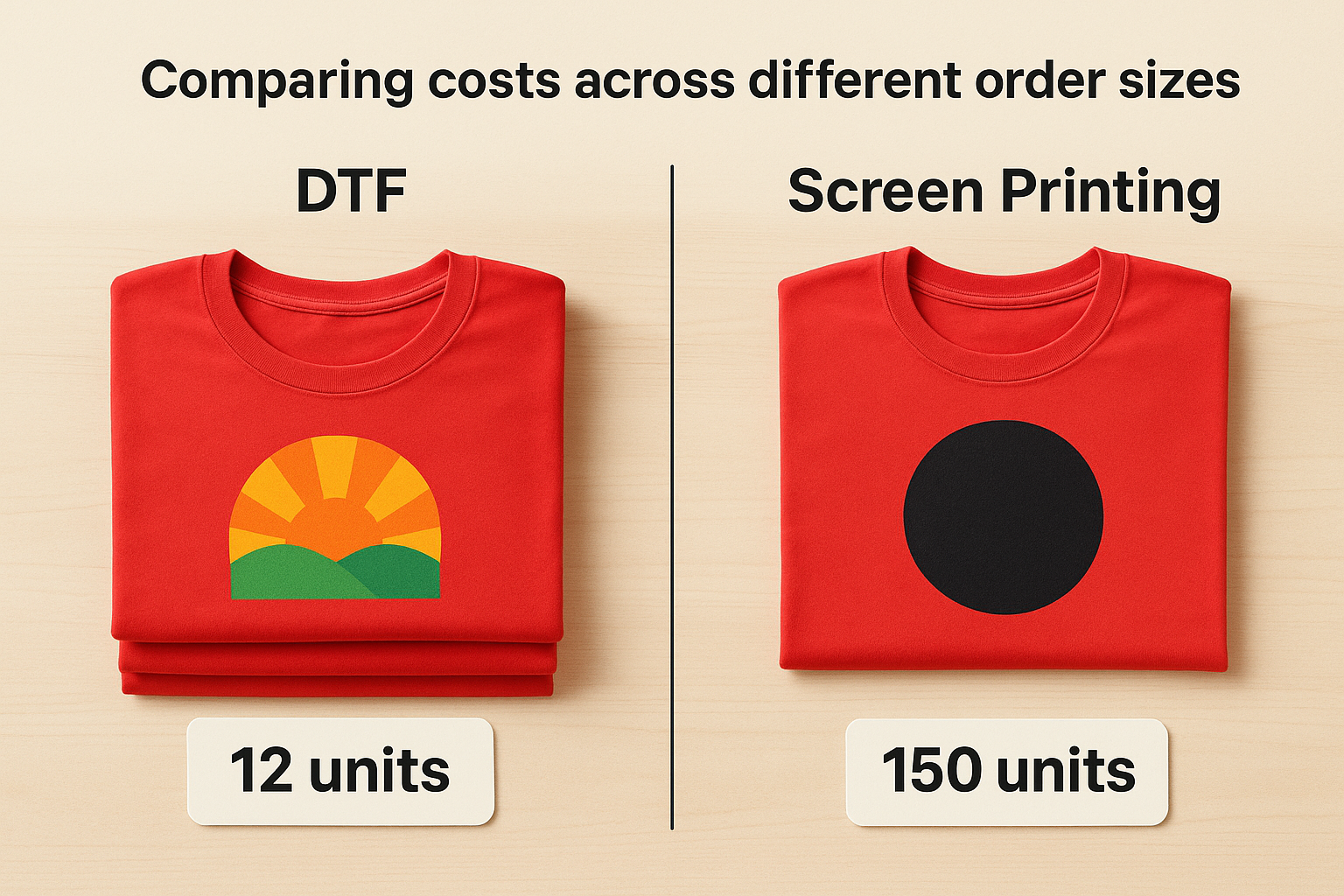
Numbers settle most arguments about dtf printing vs screen printing faster than opinions do. Setup fees, per-unit pricing, and how those two interact as quantity climbs explain almost every price quote you’ll get from a print shop. Rather than guessing, it helps to walk through what actually happens to your cost per shirt at three common order sizes.
Small runs where DTF dominates
Under two dozen units, screen printing rarely makes financial sense unless you’re reusing screens from a previous order. Burning a screen for each colour costs money regardless of how many shirts you print on it, so a ten-shirt order with a three-colour logo can carry nearly the same setup charge as a hundred-shirt order with identical artwork. DTF transfers skip that fixed cost entirely because the design prints digitally onto film, meaning your price per unit stays consistent whether you order five shirts or twenty-five.
Below 24 units, DTF almost always beats screen printing on price because there’s no screen to burn.
The mid-size range where it gets competitive
Between 25 and 150 units, the gap narrows and design complexity starts deciding the winner rather than quantity alone. Simple one or two colour logos push screen printing’s cost per shirt down as the setup fee spreads across more garments, often landing below DTF’s flatter per-print rate. Complex designs with gradients or four-plus colours keep DTF competitive here because each added colour means another screen and another setup charge on the screen printing side.
Large orders where screen printing pulls ahead
Past roughly 150 units of a straightforward design, screen printing’s economics take over. The fixed setup cost becomes a rounding error once it’s divided across hundreds of shirts, and ink costs for screen printing stay lower than film costs for DTF at that scale. Here’s how the two methods typically compare across order sizes for a simple two-colour design:
| Order size | Screen printing (approx. cost/unit) | DTF (approx. cost/unit) |
|---|---|---|
| 12 units | High (setup dominates) | Lower, flat rate |
| 50 units | Moderate, dropping | Similar to screen printing |
| 150 units | Low | Higher than screen printing |
| 500+ units | Lowest | Noticeably higher |
Getting a firm quote from your supplier at your actual quantity matters more than relying on general rules, since ink coverage, garment colour, and number of print locations all shift the maths slightly. At Apex Workwear, we run both methods, so we quote whichever comes out cheaper for your specific order rather than pushing one process regardless of fit.
Quality, durability and fabric compatibility compared
Beyond setup costs, the print itself needs to survive real wear, and that’s where dtf printing vs screen printing shows its clearest differences. Buyers who only compare a fresh sample straight off the press often miss how each method ages after repeated washing, stretching, and daily friction against skin or work gear. Looking past day-one appearance and into month-six condition tells you far more about which method actually fits your order.
How each method holds up wash after wash
Properly cured screen printing ink bonds into the fabric weave and typically survives 50 or more washes without significant fading when done on cotton or heavy cotton-blends. DTF transfers rely on the adhesive layer between film and fabric, and quality varies more depending on the supplier’s press temperature, dwell time, and the film brand used. A well-pressed DTF transfer holds up nearly as well as screen printing, but a rushed job can start lifting at the corners within a few dozen washes.
A properly cured screen print and a properly pressed DTF transfer both last 50+ washes; the failures come from rushed production, not the method itself.
Colour vibrancy and how the print feels on skin
Colour output separates the two methods more than most buyers expect before ordering. Screen printing on dark garments needs a white underbase layer to keep colours from muddying, which adds cost and a slightly thicker feel to the final print. DTF handles vibrant colour on any garment shade without an extra underbase step, and the finished layer sits thinner and softer against skin, which matters for anyone wearing a printed shirt for a full shift.
Fabric types that make or break each method
Getting fabric compatibility wrong causes more print failures than any other factor on this list. Certain materials simply don’t hold screen printing ink well, no matter how skilled the printer is:
- 100% cotton and heavy cotton-blends: ideal for screen printing, ink bonds cleanly into the weave
- Polyester and performance athletic fabrics: prone to dye migration with screen printing, better suited to DTF
- Stretchy blends (spandex, lycra mixes): screen printing ink cracks at stretch points, DTF flexes with the fabric
- Nylon and coated shells: neither method bonds perfectly, but DTF generally holds better without pretreatment
- Heavyweight cotton hoodies and workwear: screen printing performs excellently and often costs less at volume
Running your fabric choice past this list before locking in a print method saves you from a durability problem that only shows up after the order has already shipped to your team or clients.
Which method suits your project: common scenarios
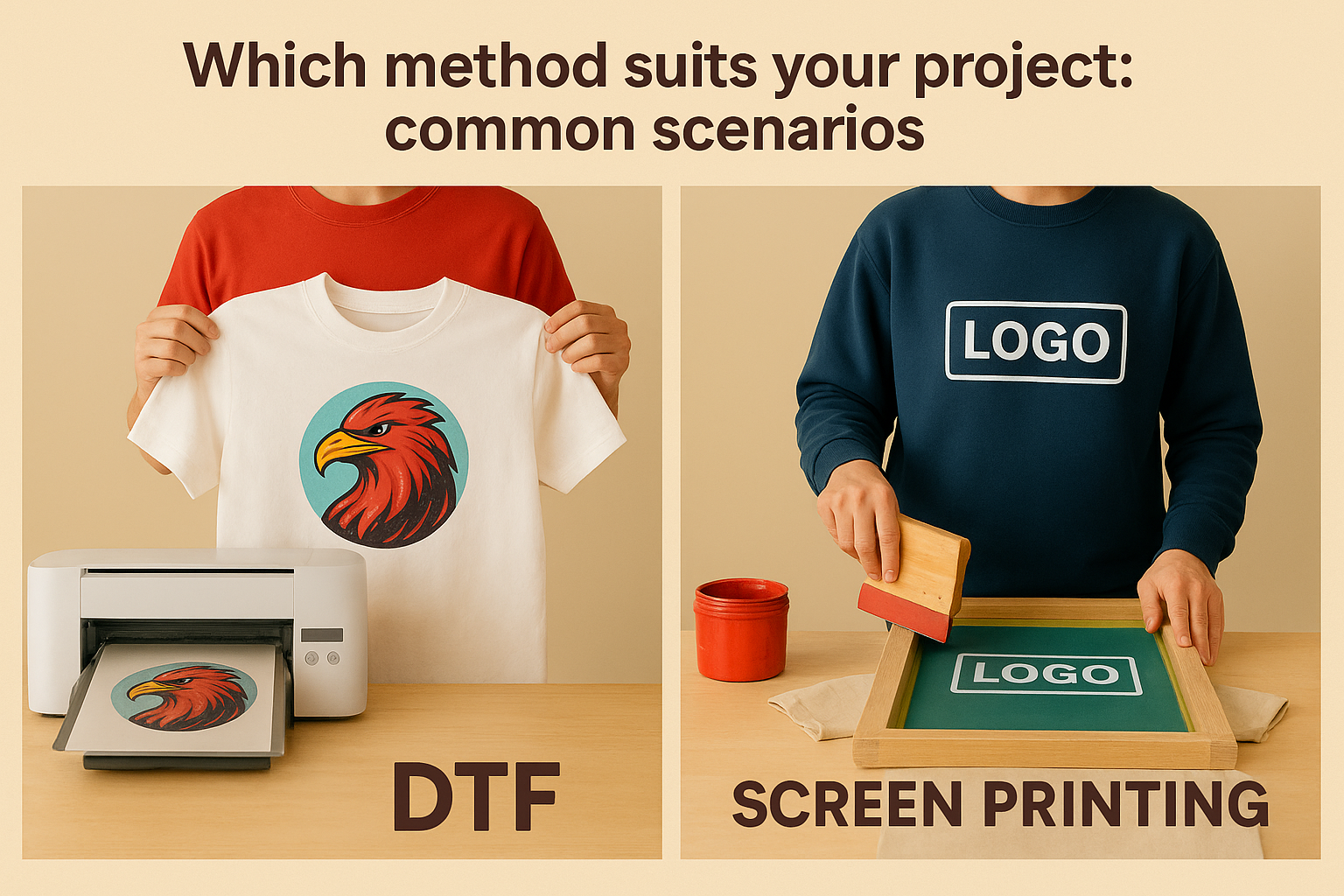
Theory only gets you so far, so let’s match dtf printing vs screen printing against situations you’re likely facing right now. Reading through a scenario close to your own often clarifies the decision faster than any spec sheet.
Launching a small business or running a pop-up event
Startups and pop-up vendors usually need a handful of shirts, hoodies, or tote bags with a detailed logo, and they need them fast. DTF transfers fit this brief almost perfectly since there’s no screen-burning delay and no setup fee punishing you for ordering fifteen units instead of five hundred. If your launch date is two weeks out and your logo has more than two colours, DTF gets you a polished product without forcing you to compromise on design just to hit a budget built for bulk printing.
Outfitting a sports league or recreational team
Team jerseys usually involve a simple one or two colour logo repeated across thirty to eighty identical shirts, which sits right in screen printing’s sweet spot. The setup cost spreads across enough units to bring the per-shirt price down, and screen printing’s thick, opaque ink holds up well through a season of sweat, washing, and rough outdoor play. Where DTF pulls ahead is if your league wants individual player names and numbers on each jersey, since printing unique text on every unit favours DTF’s digital process over cutting a new screen for every name.
Equipping a construction crew or trade business
Work jackets and heavyweight cotton hoodies printed with a straightforward company logo are classic screen printing territory, especially once you’re ordering fifty or more pieces for a growing crew. The ink bonds well into thick cotton weaves and survives job-site abuse better than a thinner transfer might. But if your fleet uses polyester safety vests or performance-blend outerwear, DTF avoids the dye migration and cracking that screen printing risks on those synthetic fabrics.
Match the fabric and quantity to the method first; the "right" choice changes with every scenario, not with brand loyalty to one process.
Running a corporate rebrand or large campaign
Company-wide rebrands often mean printing hundreds of shirts with a simple, consistent logo across multiple departments, which plays directly to screen printing’s cost advantage at scale. Agencies and event coordinators managing several smaller client orders at once, each with different artwork, tend to lean on DTF instead, since it handles varied designs without carrying screen costs across unrelated jobs. Knowing which camp your project falls into before requesting quotes keeps you from paying for setup work you don’t actually need.
Mistakes to avoid when picking a print method
Most printing regrets trace back to the same handful of avoidable errors, not to some fundamental flaw in either method. Watching dtf printing vs screen printing decisions go wrong at the quoting stage, long before ink touches fabric, is far more common than watching a well-matched order fail after the fact. Catching these mistakes early saves you a reprint, a missed deadline, or an awkward conversation with a client about why their branded gear looks tired after two months.
Chasing the lowest quoted price
Comparing quotes on price per shirt alone, without checking quantity breaks and design complexity, leads plenty of buyers to the wrong method. A supplier quoting screen printing cheaply for a nine-shirt order with a gradient logo is often cutting corners on colour accuracy or padding the invoice with a setup fee that dwarfs the print cost itself. Ask for a breakdown of setup versus per-unit cost before comparing two quotes side by side, since the headline number rarely tells the full story.
The cheapest quote on paper often becomes the most expensive order once reprints and reputation damage get factored in.
Ignoring fabric type until after ordering
Skipping a fabric check before choosing a print method causes more failed orders than any pricing mistake. Polyester safety vests printed with screen printing ink can develop dye migration within weeks, and stretchy athletic blends crack at the seams if the wrong method gets applied. Run through this quick check before confirming your order:
- Confirm the exact fabric blend, not just "cotton" or "poly"
- Ask your supplier which method they’d choose for that specific blend
- Request a small test print on the actual garment if the order is large or high-stakes
Skipping a physical sample or digital proof
Rushing past the proof stage to hit a deadline creates problems that are far more expensive to fix afterwards. A digital proof catches colour mismatches and layout errors, but only a physical sample shows you how the print actually feels and stretches on the real fabric. Apex Workwear provides digital proofs before production runs, and we’d rather add a day to the timeline than ship five hundred shirts with a print that peels after one wash.
Assuming a single method fits every product line
Locking your whole business into one print method regardless of the job wastes money on every order that doesn’t fit that method’s strengths. A company ordering both cotton team shirts and polyester event lanyards needs two different approaches, not a single default. Treating each order on its own merits, rather than out of habit or loyalty to whichever method you used last time, keeps costs down and print quality consistent across your whole product range.
Finding the right fit for your next order
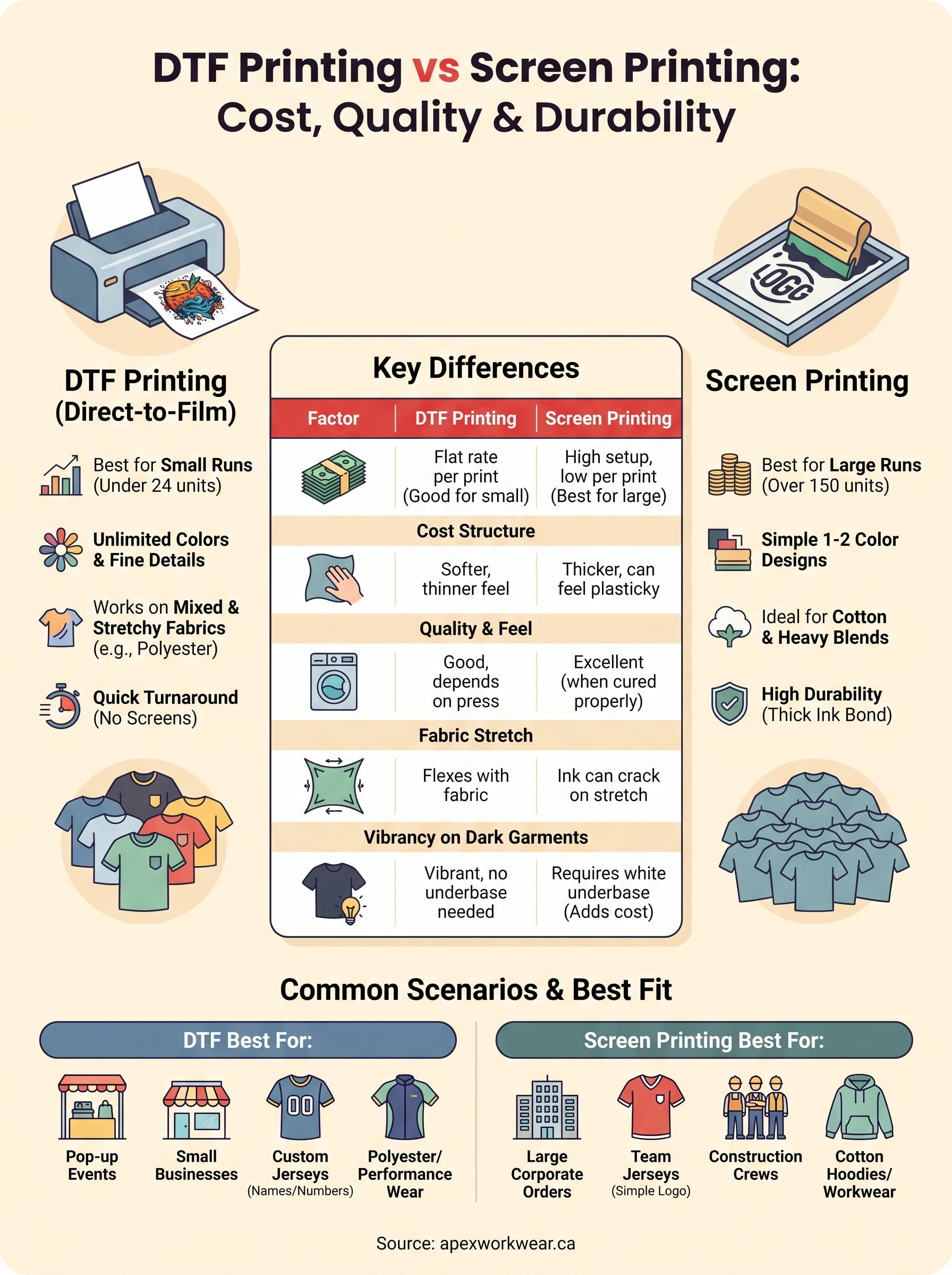
Weighing dtf printing vs screen printing always comes back to three questions: how many units, how complex the design, and what fabric you’re working with. Small runs and detailed artwork favour DTF. Large orders of simple logos on cotton favour screen printing. Everything else sits in between, and that’s exactly where a supplier who runs both methods earns their keep, instead of pushing whichever process they happen to have set up that week.
You don’t need to become a print expert to get this right. You just need a straight answer about which method suits your specific order, backed by someone who’ll tell you when the cheaper option isn’t actually the better one. That’s the conversation worth having before you commit a budget to either process.
Ready to get it sorted? Request your free quote from Apex Workwear and we’ll recommend the method that actually fits your order, not just the one that’s easiest to sell.