Choosing between DTF transfers vs sublimation can feel like a coin toss if you don’t know what separates them. Both methods produce vibrant, professional results, but they work differently, cost differently, and suit different materials and use cases. Picking the wrong one means wasted time, wasted product, or a finished piece that doesn’t hold up.
The core difference comes down to how each method bonds ink to fabric. Sublimation uses heat to turn ink into gas that fuses with polyester fibres, while DTF (direct-to-film) prints a design onto a special film and transfers it onto nearly any fabric type, including cotton. That distinction alone changes everything, from your material options to your per-unit costs.
At Apex Workwear, we work with Canadian businesses, teams, and individuals on custom apparel projects every day, so we see first-hand how the right printing method affects the final product. This guide breaks down the technical differences, costs, durability, and ideal applications of both methods so you can make a confident decision for your next order.
Why the difference matters for your business
The printing method you choose directly affects what fabrics you can print on, how long the design lasts after washing, and what you pay per unit. If you’re ordering branded workwear for a crew, custom merch for an event, or promotional apparel for a client, choosing poorly means reprints, complaints, or a finished product that doesn’t hold up to regular use. Understanding dtf transfers vs sublimation before you place an order saves you money and a lot of frustration down the line.
Material compatibility changes everything
Not every fabric works with every printing method. Sublimation only bonds properly with polyester (or polyester-coated surfaces), which means it performs brilliantly on sportswear, athletic gear, and synthetic performance fabrics, but it fails completely on cotton. If you try sublimating onto a cotton shirt, the ink won’t bond to the fibres, and the result will be dull and wash out almost immediately. DTF transfers adhere to virtually any fabric, including cotton, cotton blends, nylon, and even leather, which gives you far more flexibility across product types.
If most of your apparel orders involve cotton or blended fabrics, sublimation simply is not a practical option for you.
Here’s how each method handles common fabric types:
| Fabric | DTF Transfer | Sublimation |
|---|---|---|
| 100% cotton | Works well | Not suitable |
| 100% polyester | Works well | Works well |
| Cotton/poly blend | Works well | Limited results |
| Nylon | Works well | Works on coated surfaces only |
| Dark-coloured fabrics | Works well | Not suitable |
Colour vibrancy and design detail
The printing method also affects how your colours look on the finished product. Sublimation produces a soft, smooth feel because the ink becomes part of the fabric rather than sitting on top of it, making it ideal for all-over prints with gradients and photographic detail. Colours on sublimated polyester are vivid and won’t crack or peel over time. DTF transfers sit on top of the fabric, but modern transfer films produce sharp, detailed graphics and handle fine lines and small text better than many older transfer methods.
Order size and per-unit cost
Your order volume plays a bigger role than most people expect. Sublimation scales efficiently for larger runs of polyester garments and works well when you’re producing a consistent product line. DTF transfers work at any quantity, including single items, which makes them a strong fit for small businesses, one-off custom orders, or anyone testing a new design before committing to a full production run. Knowing your typical order size before you decide on a method helps you avoid overpaying on short runs or missing out on savings at volume.
How DTF transfers work and when to use them
DTF printing works by printing a design onto a special PET film using water-based inks, then coating the wet ink with a hot-melt adhesive powder before curing the whole thing with heat. Once cured, you apply the film to your garment using a heat press, which bonds the adhesive layer directly to the fabric fibres. After pressing, you peel the film away and are left with a clean, detailed graphic sitting on the surface of the material.
The DTF printing process
The process breaks down into a few clear steps. First, the design prints in reverse onto the PET film. Then, hot-melt adhesive powder is applied over the ink while it’s still wet, and the film goes through a curing stage to melt the powder into the ink layer. After that, the transfer is ready to press onto fabric using a heat press set to around 160-170°C. The finished print is flexible and stretches with the fabric without cracking or flaking, even after repeated washing.
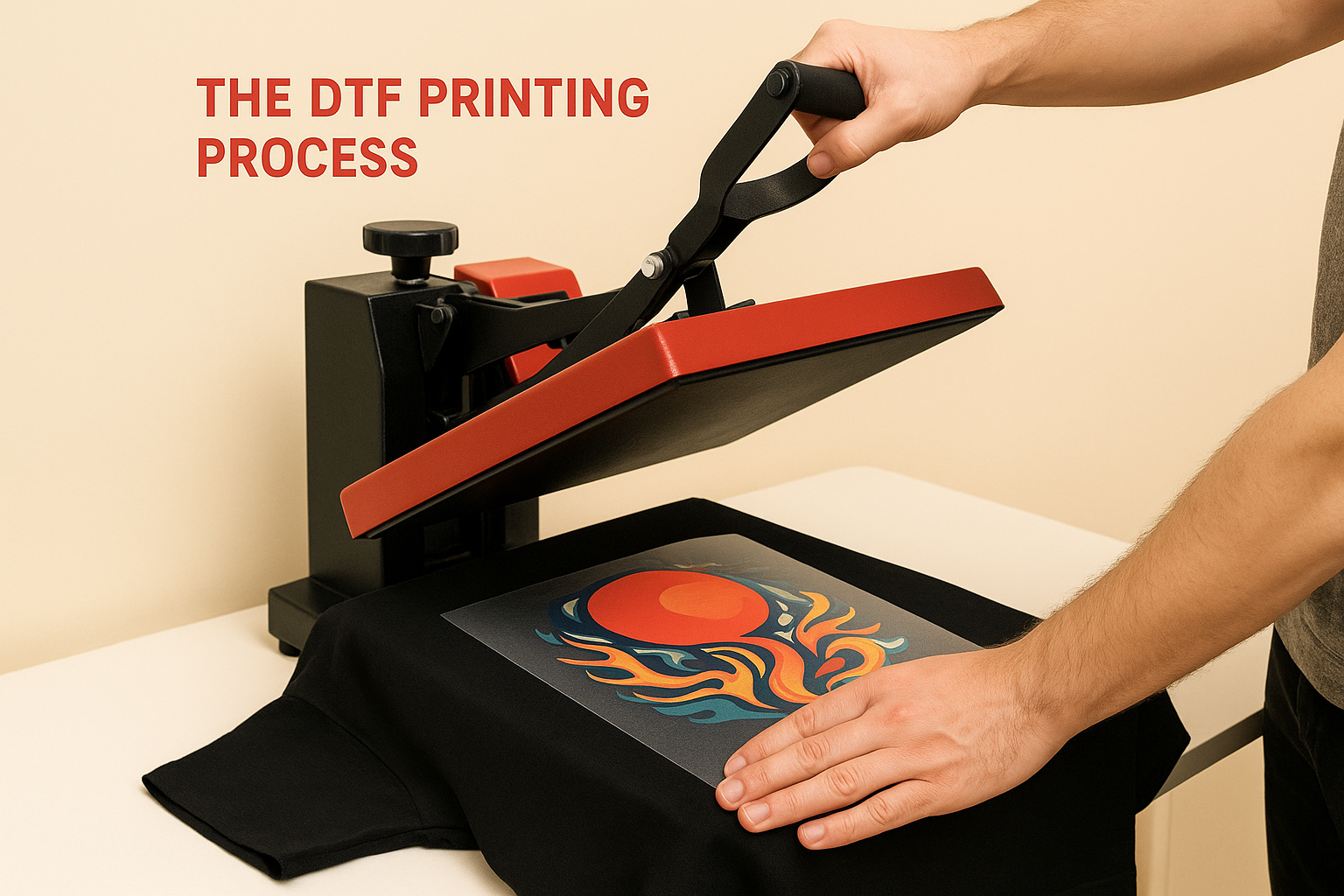
A properly applied DTF transfer can withstand well over 50 wash cycles without significant fading when cured and pressed correctly.
When DTF is the right choice
DTF is the stronger option when you’re printing on cotton, blended fabrics, or dark-coloured garments, which covers the bulk of Canadian workwear, uniforms, and branded apparel orders. It also handles short runs and single pieces without any additional setup costs, so you’re not penalised for ordering small quantities.
In the dtf transfers vs sublimation comparison, DTF stands out for raw versatility. Here are the situations where it makes the most practical sense for your project:
- You need to print on cotton, nylon, or mixed-fibre garments
- Your base fabric is dark or strongly coloured
- Your order is a small run or a single custom piece
- Your design includes fine lines, small text, or complex multicolour artwork
- You want a durable, wash-resistant finish across a mix of fabric types
How sublimation works and when to use it
Sublimation printing uses heat and pressure to convert dye-based ink into a gas, which then bonds permanently with the polyester fibres in a garment. Unlike DTF, there is no adhesive layer sitting on top of the fabric. The ink literally becomes part of the fibre structure, which is why sublimated prints feel soft to the touch and never crack or peel.
The sublimation printing process
The process starts by printing a design onto specialised sublimation transfer paper using dye-based sublimation inks. You then place that paper face-down onto the polyester garment and run the whole thing through a heat press at around 190-210°C. At that temperature, the ink converts to gas and penetrates the open polyester fibres. When the temperature drops, the fibres close back around the ink, locking the colour in permanently. The result is a smooth, breathable print with no raised texture.
Because the ink integrates directly into the fabric, sublimation produces some of the most durable, fade-resistant prints available for polyester garments.
When sublimation is the right choice
In the dtf transfers vs sublimation decision, sublimation wins when you are working with white or light-coloured polyester fabrics and need all-over coverage or photographic-quality gradients. It handles large print areas efficiently because there is no film or adhesive to apply, and the per-unit cost at volume is competitive. However, sublimation will not produce accurate colours on dark-coloured garments because the fabric colour shows through the ink.
Sublimation makes the most practical sense for your project in these situations:
- Your garments are 100% polyester or high-poly blends (65% polyester or above)
- Your base fabric is white or light-coloured
- Your design features gradients, photographic images, or all-over prints
- You are ordering larger runs of performance or sportswear items
- A soft, smooth print finish matters to you or your client
DTF vs sublimation: key differences at a glance
When you set the two methods side by side, the differences become clear fast. DTF transfers offer wider material compatibility and work on virtually any fabric in any colour, while sublimation delivers unmatched softness and durability on white or light polyester. Neither method is universally better, and the right choice depends entirely on what you’re printing on and what the finished product needs to do.
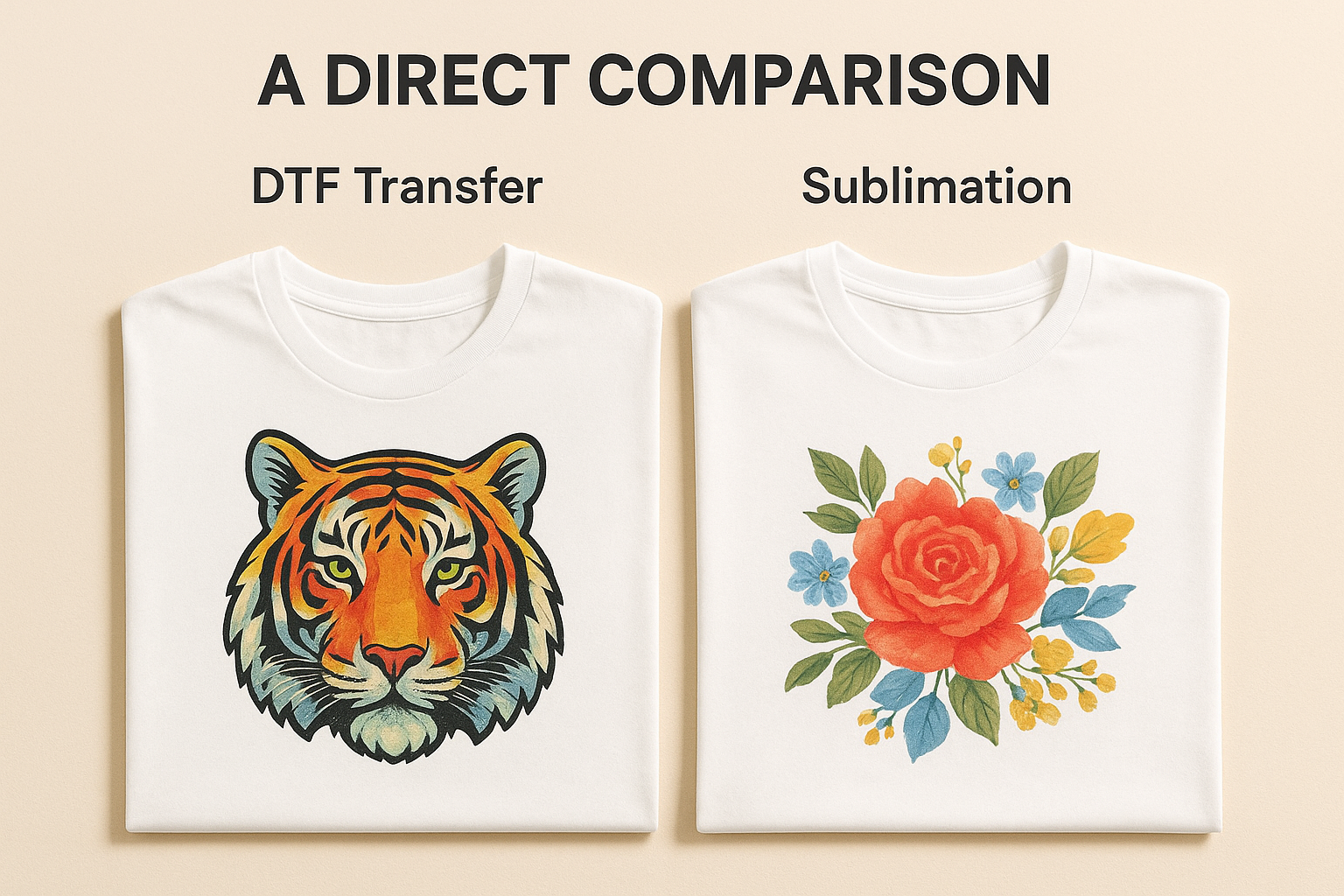
A direct comparison
The table below covers the core factors that matter most when evaluating dtf transfers vs sublimation for a real project. Use it to quickly identify which method fits your fabric type, order size, and design requirements.
| Factor | DTF Transfer | Sublimation |
|---|---|---|
| Compatible fabrics | Cotton, poly, blends, nylon | Polyester (65%+) only |
| Fabric colours | Light and dark | Light colours only |
| Print feel | Slight surface texture | Soft, part of the fabric |
| Durability | 50+ wash cycles | Excellent, ink fuses to fibre |
| All-over printing | Not ideal | Works well |
| Single-item orders | Yes | Yes |
| Per-unit cost at volume | Competitive | Competitive |
Print feel and longevity
Sublimated prints feel like part of the garment because the ink fuses directly into the polyester fibres, leaving no raised surface at all. This makes sublimation the clear choice when a soft, breathable finish matters to the wearer or your client.
For most Canadian businesses working with cotton workwear or mixed-fabric uniforms, DTF transfers are the more practical and flexible choice.
DTF transfers sit on top of the fabric with a thin adhesive layer, which creates a slight texture you can feel when you run your finger across the print. Both methods hold up well with regular washing, but sublimation has a durability edge specifically for polyester garments because the ink integrates into the fibre rather than bonding to its surface.
Costs and how to choose between DTF and sublimation
Cost differences between the two methods are real, but they depend heavily on order volume, garment type, and whether you’re buying equipment or outsourcing production. For most Canadian small businesses, the more relevant question is not which method is cheaper overall, but which one avoids costly mistakes on the specific products you’re ordering.
What each method costs per unit
DTF transfers carry a slightly higher per-unit cost at low volumes because each transfer requires film, ink, and adhesive powder before pressing. At larger quantities, that cost drops significantly. Sublimation printing becomes cost-efficient when you’re running consistent batches of polyester garments, since there’s no adhesive layer to account for and the process moves quickly at scale. However, any savings from sublimation disappear the moment you try to print on the wrong fabric type.
Ordering a sublimation print on a cotton-blend garment does not just produce a poor result, it wastes the entire production cost.
Here’s a practical cost comparison to guide your decision:
| Consideration | DTF Transfer | Sublimation |
|---|---|---|
| Small runs (1-10 units) | Cost-effective | Cost-effective |
| Large runs (50+ units, polyester) | Competitive | More efficient |
| Cotton or dark fabric orders | Only viable option | Not suitable |
| All-over print coverage | Less efficient | More efficient |
How to make the final call
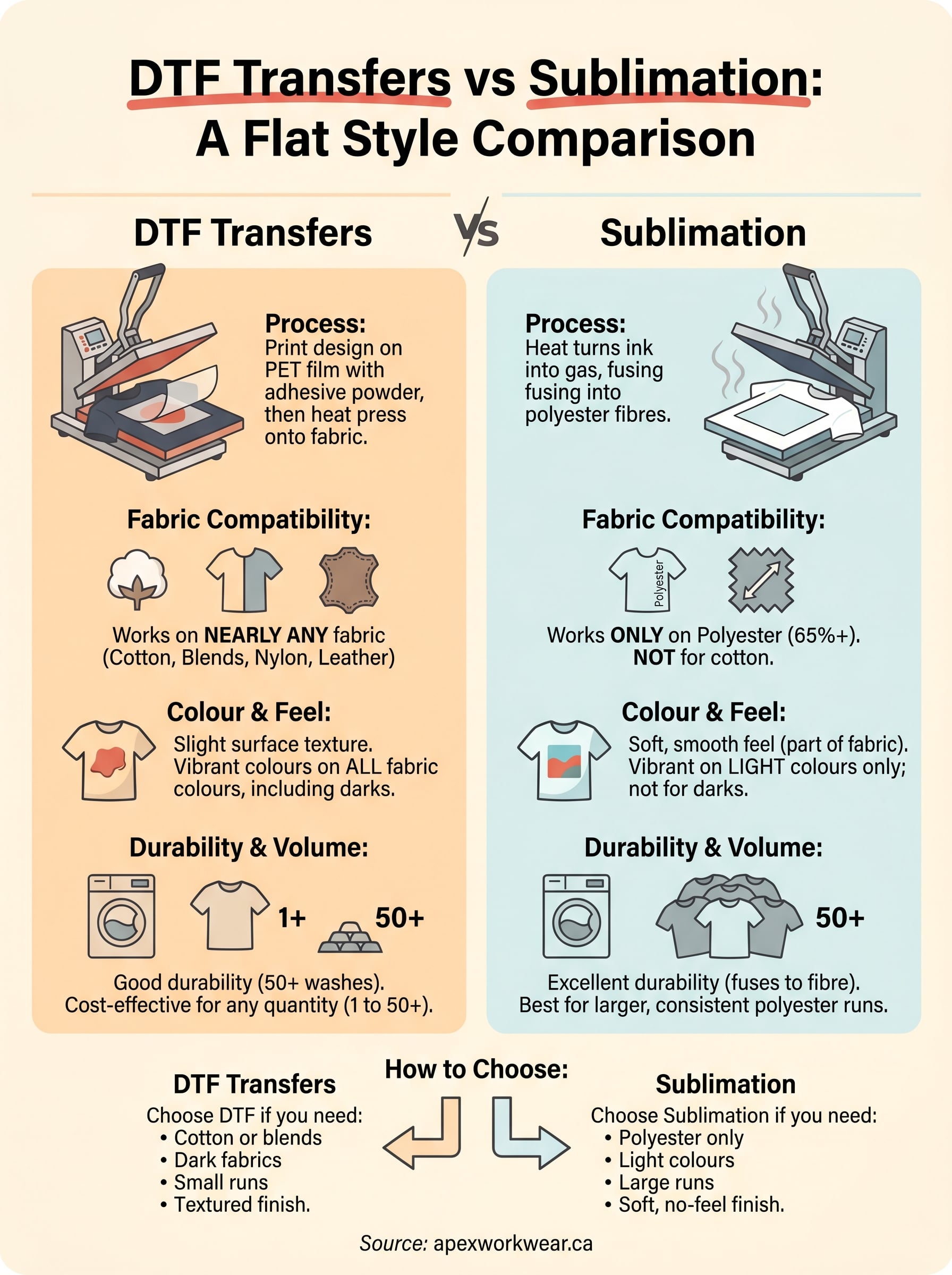
Your fabric choice should drive the decision in the dtf transfers vs sublimation comparison before anything else. If your order involves cotton, dark colours, or mixed fabrics, DTF is the only method that delivers a professional, lasting result. If you’re ordering white or light-coloured polyester performance wear in volume, sublimation is the stronger fit.
When you’re unsure, the safest starting point is to confirm your garment’s fibre content and colour before selecting a print method. Getting that detail right upfront saves you from reprints and avoids unnecessary costs on your order.
Quick recap
The dtf transfers vs sublimation decision comes down to two core factors: your fabric type and your fabric colour. If you’re printing on cotton, dark garments, or mixed fibres, DTF transfers are the only method that produces a reliable, durable result. If your order involves white or light-coloured polyester performance wear, sublimation delivers a softer finish with excellent long-term durability.
Both methods produce high-quality, professional results when matched to the right garment. Getting that match right upfront saves you from reprints, wasted production costs, and a finished product that doesn’t meet your expectations. Your fabric choice drives the decision more than any other factor, including price.
Ready to place an order or need help deciding which method suits your project? Get a free quote from Apex Workwear and our team will review your design and garment details to point you in the right direction. Getting expert input before you order takes minutes and saves you from a costly mistake.