You have seen the term on product tags or heard it from a print shop, and you still are not sure what it means for your order. What is DTG printing? It stands for direct-to-garment printing, and it is one of the most common methods used today for custom t-shirts, hoodies, and other apparel.
In simple terms, DTG printing uses a specialised inkjet printer to apply water-based ink straight onto fabric, much like printing a photo onto paper. There is no screen, no stencil, and no minimum order to worry about, which makes it a strong fit for detailed designs and small batch runs.
This article breaks down exactly how the process works, from pre-treatment to curing, and shows you where it fits compared to screen printing and DTF transfers. By the end, you will know whether DTG is the right choice for your next custom apparel project, or whether another method will serve you better.
Why DTG printing matters for your brand
Understanding what DTG printing brings to a small business goes beyond the technical process. It changes how you can approach branding, testing, and ordering apparel in the first place. For a contractor who needs five branded polos this month and fifteen next month, or a startup that wants to test a logo before committing to a full production run, DTG removes the financial and creative barriers that used to make custom apparel a headache.
Full colour detail without the setup cost
Because the printer applies ink digitally, you get photorealistic detail and unlimited colours in a single pass, without paying extra for each additional shade. A gradient, a client’s headshot, or a detailed mascot logo prints just as easily as a single-colour design. Traditional methods charge more as colours increase, since each colour needs its own screen or layer. DTG skips that step entirely, which matters if your brand relies on a logo with fine text, shading, or photographic elements that would otherwise cost a fortune to reproduce accurately.
DTG lets you print a five colour logo for the same price as a one colour logo, because the printer treats every design the same way.
No minimum orders means no financial risk
Ordering custom apparel used to mean committing to dozens or hundreds of units just to make the setup cost worthwhile. With direct to garment printing, that pressure disappears. You can order a single hoodie for a new hire, a dozen shirts for a pop-up event, or a hundred polos for a company-wide rollout, all using the same process and without paying a setup fee that only makes sense at volume. This is exactly why Apex Workwear offers no minimums on many of its custom apparel products, so small businesses in the GTA can order exactly what they need.
That flexibility pays off in a few concrete ways:
- Test before you commit. Print a small batch of a new design and gauge reaction before ordering more.
- Match your actual headcount. Order for the team you have today, not the team you hope to have in a year.
- Reduce waste. Unused inventory sitting in a closet costs money and looks bad if the branding changes.
- Support seasonal or one-off events. A single trade show or charity run does not need a 50-piece minimum.
Quick turnaround keeps your branding on schedule
Speed matters just as much as flexibility when you are working against a launch date, a trade show, or a new hire’s first day. Since DTG requires no screens to burn or films to expose, a shop can move from approved artwork to finished garment in a matter of days rather than weeks. Apex Workwear ships most orders within 5 to 7 business days, with rush options for tighter deadlines, which keeps your custom t-shirt printing project from becoming the bottleneck in a bigger marketing push.
A cleaner process for a brand that cares about its image
Finally, the ink itself says something about your brand. DTG uses water-based inks that soak into the fibres of the shirt rather than sitting on top like a plastisol print, which means the finished garment feels softer and lighter. For businesses that market themselves as modern, detail-oriented, or environmentally conscious, that softer hand feel and cleaner production process reinforce the message on the label just as much as the logo printed on the front.
How DTG printing works, step by step
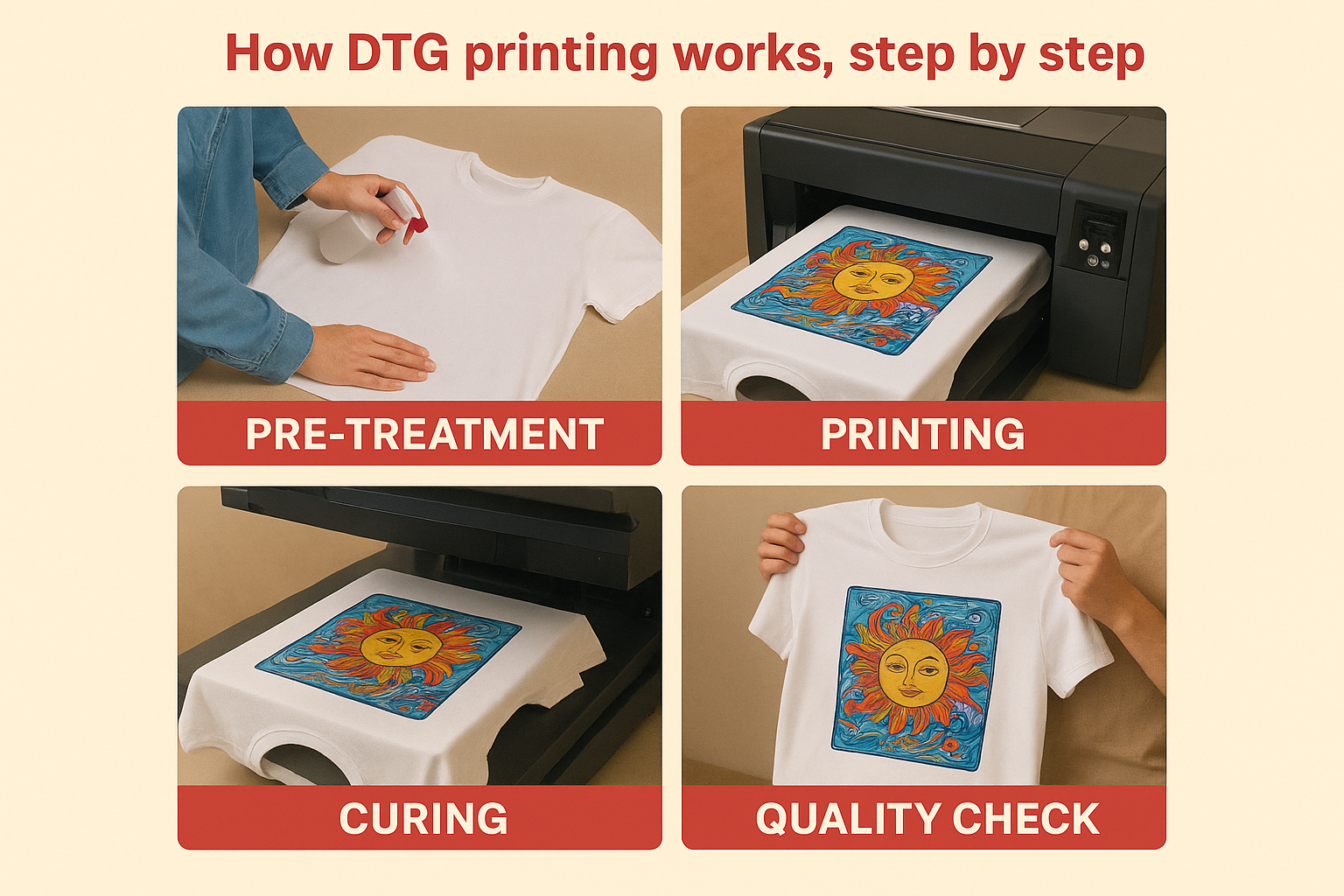
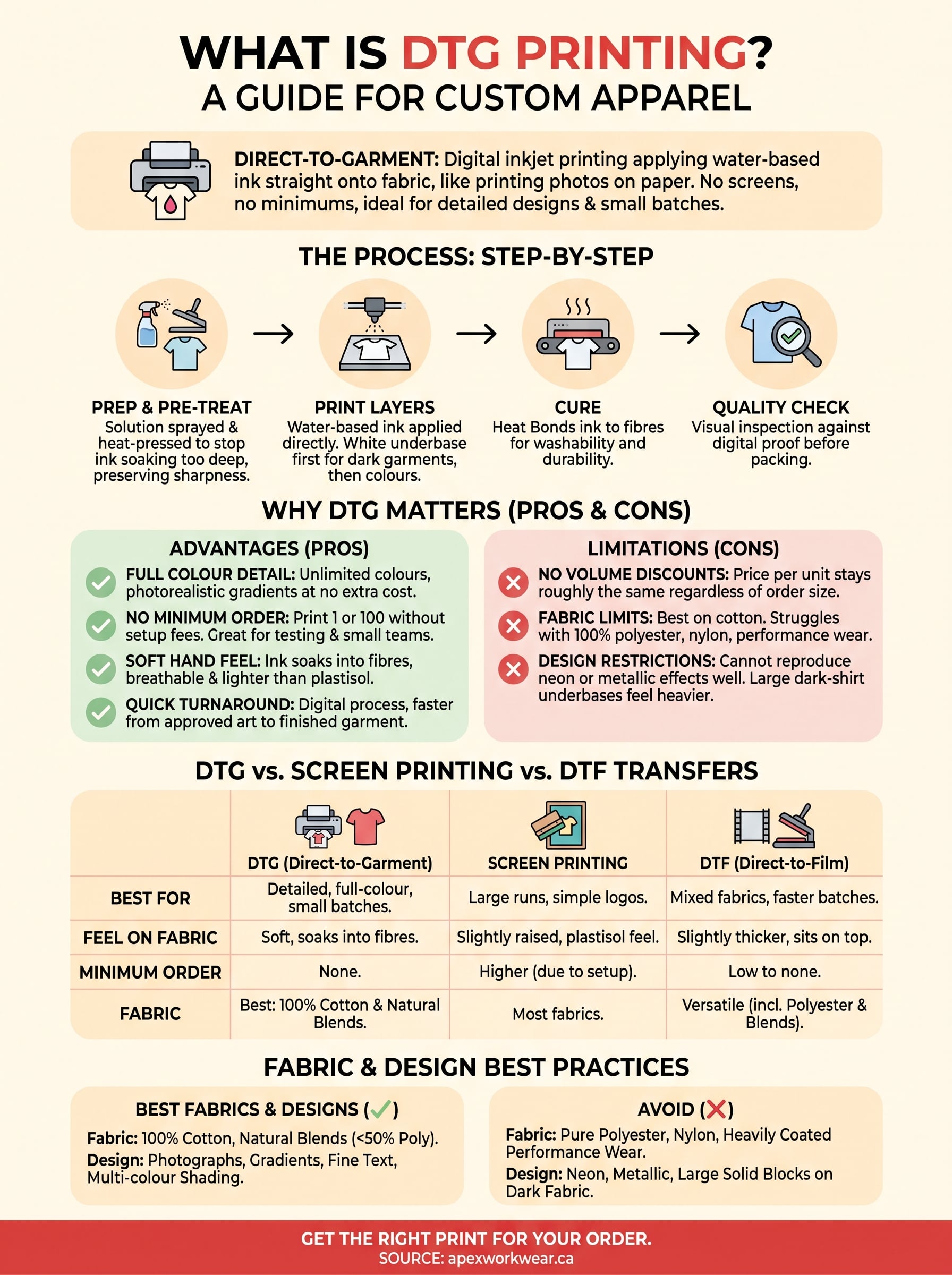
Every DTG job follows the same basic sequence, whether it is a single hoodie or a hundred-piece order. Knowing the steps helps you understand why the finished print looks and feels the way it does, and why certain fabrics or designs work better than others.
Preparing the garment and file
First, the printer’s software receives your artwork file and separates it into the layers the machine needs to reproduce colour and detail accurately. Cotton garments then go through a pre-treatment stage, where a liquid solution is sprayed onto the printing area and heat-pressed to dry. This step matters more than most people realise, since it stops the water-based ink from soaking too far into the fibres and losing sharpness.
A garment that skips proper pre-treatment will almost always print duller and fuzzier than one that has been prepared correctly.
Loading and printing
Next, the shirt is loaded flat onto a platen, a tray built specifically to hold fabric steady under the print head. The printer then applies water-based ink directly onto the fibres in layers, starting with a white underbase on dark garments so colours stay vibrant, followed by the coloured layers on top. This is the stage where direct to garment printing earns its name, since the ink goes straight onto the fabric rather than onto a film or transfer paper first.
Curing the print
Once printing finishes, the garment passes under a heat press or through a conveyor dryer to cure the ink. Curing is not optional. Without enough heat, the ink stays soft and washes out within a few cycles instead of bonding permanently to the fibres.
Quality check and packing
Finally, a quick inspection catches any misprints, colour shifts, or placement errors before the order goes into folding and packing. A good print shop checks colour accuracy against your approved digital proof at this stage, not after the box has shipped.
| Stage | What happens | Why it matters |
|---|---|---|
| Pre-treatment | Solution sprayed and heat-pressed onto fabric | Keeps ink from soaking too deep, preserves sharpness |
| Printing | Ink applied in layers, white underbase first on dark shirts | Produces full colour, photorealistic detail |
| Curing | Heat press or conveyor dryer bonds ink to fibres | Makes the print washable and durable |
| Quality check | Visual inspection against the proof | Catches errors before shipping |
Understood together, these steps explain why DTG suits detailed, full-colour designs but takes a little longer per unit than a method built purely for speed at high volume.
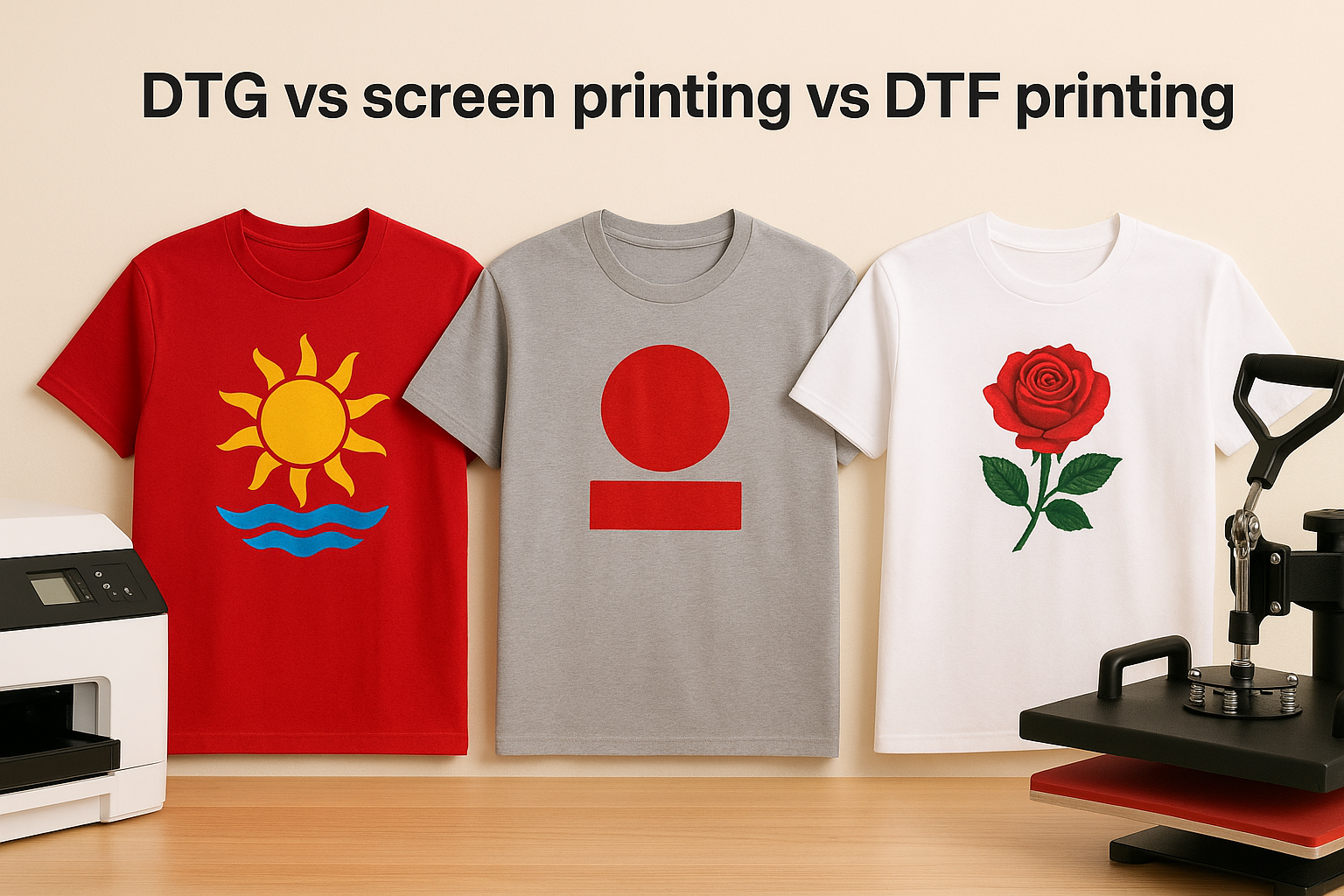
DTG vs screen printing vs DTF printing
Picking the right print method comes down to your order size, your design, and your budget, and DTG is only one option on the table. Screen printing and DTF (direct-to-film) transfers both solve problems that DTG struggles with, so it helps to see how they stack up side by side before you commit to a supplier or a technique.
Screen printing for large, simple runs
Screen printing pushes ink through a mesh stencil, one screen per colour, which makes it the cheapest option once you cross into large quantities. Setting up screens costs money upfront, so a 50-piece order of a two-colour logo often beats DTG on price per unit. The trade-off is flexibility: adding a fourth or fifth colour raises the price fast, and reprinting a different design means burning new screens from scratch. If your team wears the same logo year after year in bulk, screen printing usually wins on cost.
DTF transfers for mixed fabrics and speed
DTF prints the design onto a film first, then heat-presses it onto the garment, which means the fabric itself never touches the printer. That makes DTF printing a good fit for polyester, blends, and fabrics that DTG cannot handle well, since the transfer sits on top rather than soaking into the fibres. It also allows faster batch production than DTG for mixed orders, though the finished print has a slightly thicker feel than a true DTG print.
Choose DTG for detail and softness, screen printing for volume and cost, and DTF for fabric flexibility.
Comparing the three methods
| Method | Best for | Colour limits | Feel on fabric | Minimum order |
|---|---|---|---|---|
| DTG | Detailed, full-colour designs | Unlimited | Soft, soaks into fibres | None |
| Screen printing | Large runs, simple logos | Priced per colour | Slightly raised, plastisol feel | Higher, due to setup |
| DTF | Mixed fabrics, faster batches | Unlimited | Slightly thicker, sits on top | Low to none |
Fabric type often settles the decision before price even comes into it. Since DTG performs best on cotton and natural blends, a polyester team jacket or a nylon bag might steer you toward DTF regardless of design complexity. Meanwhile, a startup ordering a hundred identical hoodies in one or two colours will usually save money with screen printing, even accounting for the setup fee. Working with a shop that offers all three methods, rather than one that only pushes a single technique, means you get an honest recommendation based on your actual order instead of whatever machine happens to be sitting idle that week.
Choosing the best fabrics and designs for DTG
Getting a great DTG print starts long before the garment reaches the printer. Fabric choice and artwork both shape the final result more than most first-time buyers expect, and knowing the limits upfront saves you from a disappointing reprint later.
Fabric matters more than people think
Natural fibres absorb water-based ink far better than synthetics, which is why 100% cotton remains the gold standard for DTG. Cotton-polyester blends can still work, though anything above roughly 50% polyester starts to resist the ink and can leave prints looking patchy or faded after a few washes. Pure polyester, nylon, and heavily coated performance fabrics are generally a poor match for DTG since the ink has nothing porous to bind to. If your team needs branded gear for a specific fabric type, it is worth asking your supplier which garments in their catalogue are rated for DTG before you finalise an order.
If the fabric cannot absorb the ink, no amount of curing will save the print.
Colour and fibre content checklist
Before sending artwork off for production, run through a short checklist to avoid surprises:
- Confirm the blend. Ask for the exact cotton-to-polyester ratio, not just "cotton-feel" marketing language.
- Check the base colour. Dark garments need a white underbase, which adds a step and slightly affects the final texture.
- Avoid oversaturating dark shirts. Very large, dense designs on black or navy fabric can feel stiffer once cured.
- Test a sample first. For orders over 50 pieces, a single test print catches fabric issues before they multiply.
Designs that shine under DTG
DTG rewards artwork that would be expensive or impossible with other methods. Photographs, gradients, fine text under 6 point size, and multi-colour logos with soft shading all print with accuracy that screen printing simply cannot match without a huge setup cost. This is also where DTG printing earns its reputation among creative agencies and event coordinators who need one-off designs for a single campaign or client, since there is no penalty for complexity.
Where DTG struggles is with very large solid blocks of colour, particularly on dark fabric, since the white underbase needed underneath can make the print feel heavier than a simple one or two colour screen print. Neon or metallic effects also fall outside what DTG inks can reproduce, so a design leaning on those finishes usually needs a different process. A quick conversation with your print shop about the artwork and fabric together, rather than choosing one and hoping the other cooperates, is the easiest way to avoid a reprint.
Weighing the pros and cons of DTG printing
Every printing method comes with trade-offs, and being honest about them upfront saves you from a mismatched order later. DTG printing solves real problems for small batches and detailed artwork, but it is not the right fit for every fabric, budget, or timeline. Looking at both sides together gives you a clearer picture than a sales pitch focused only on the benefits.
The advantages that stand out
Businesses choose DTG for a specific set of reasons, and most of them come back to flexibility and finish quality:
- No minimum order. Print one shirt or a hundred without a setup fee changing the math.
- Unlimited colours. Photographic detail and gradients cost the same as a single colour design.
- Soft hand feel. Water-based ink soaks into the fibres instead of sitting on top.
- Fast proofing. Digital files go straight to print, so approved artwork can ship within days.
The real advantage of DTG is not just quality, it is the freedom to order exactly what you need without paying a premium for small quantities.
Where DTG falls short
Setbacks show up mostly around fabric and volume. Polyester, nylon, and heavily coated performance wear resist water-based ink, which rules DTG out for a lot of athletic and outdoor gear. Pricing also works against you at scale, since direct to garment printing charges roughly the same per unit whether you order ten shirts or ten thousand, unlike screen printing, which gets cheaper as volume climbs. Durability sits in the middle of the pack too: a well-cured DTG print holds up to dozens of washes, but it will not outlast a plastisol screen print on heavy-duty workwear that gets washed daily for years.
A quick side-by-side
| Factor | DTG strength | DTG limitation |
|---|---|---|
| Order size | No minimum, ideal for small runs | No price break at high volume |
| Design | Unlimited colours, photorealistic detail | Struggles with metallics or neon |
| Fabric | Excellent on cotton and natural blends | Poor on polyester and nylon |
| Feel | Soft, breathable finish | Heavier feel under large dark-shirt underbases |
| Turnaround | Fast for small to mid orders | Slower per unit than screen printing at scale |
Weighed against each other, these factors point to a simple rule: match the method to the order, not the other way around. A shop that offers DTG alongside screen printing and DTF, and tells you honestly which one fits your project, saves you money and disappointment in equal measure.
The takeaway on DTG printing
So, what is DTG printing when you boil it all down? It’s a digital printing method that soaks water-based ink straight into fabric fibres, giving you full-colour detail with no minimum order and no setup fee standing in your way. That combination makes it the right call for small batches, detailed logos, and cotton garments, while screen printing and DTF still hold their own for bulk orders or synthetic fabrics.
None of that matters much on paper, though. What matters is getting a print shop that recommends the right method for your actual project instead of pushing whatever machine is free that day. Apex Workwear runs all three techniques in-house across the GTA, backs every order with a digital proof, and ships most jobs within 5 to 7 business days. If you’re ready to see samples and pricing for your own design, get a free quote from Apex Workwear and find out which method fits your order best.