If you’ve been searching for Printful screen printing, you’ve probably noticed that clear answers are hard to come by. Printful is known for print-on-demand services like direct-to-garment (DTG) and embroidery, but screen printing is a different process entirely, and whether Printful actually offers it matters if you’re planning a bulk order for your business, team, or event.
At Apex Workwear, we handle custom apparel printing for businesses across Canada every day, so we understand the difference between print methods and why choosing the right one affects your cost, quality, and turnaround time. We’ve put this guide together to give you a straight answer on what Printful does and doesn’t offer when it comes to screen printing, what you can expect to pay, and where to look if Printful isn’t the right fit.
Below, we’ll break down how Printful’s printing methods actually work, whether screen printing is part of their catalogue, realistic cost expectations, and how to get a quote, whether that’s through Printful or through a Canadian provider like us that specialises in bulk custom apparel with fast turnaround.
Does Printful offer screen printing in 2026?
Yes, Printful does offer screen printing, but it works very differently from their standard print-on-demand model. If you’ve been searching for printful screen printing expecting the same no-minimum, automated setup they use for direct-to-garment (DTG) printing, you’ll need to adjust your expectations. Screen printing through Printful operates as a separate workflow with its own rules around minimums, artwork, and order size.
What Printful actually offers
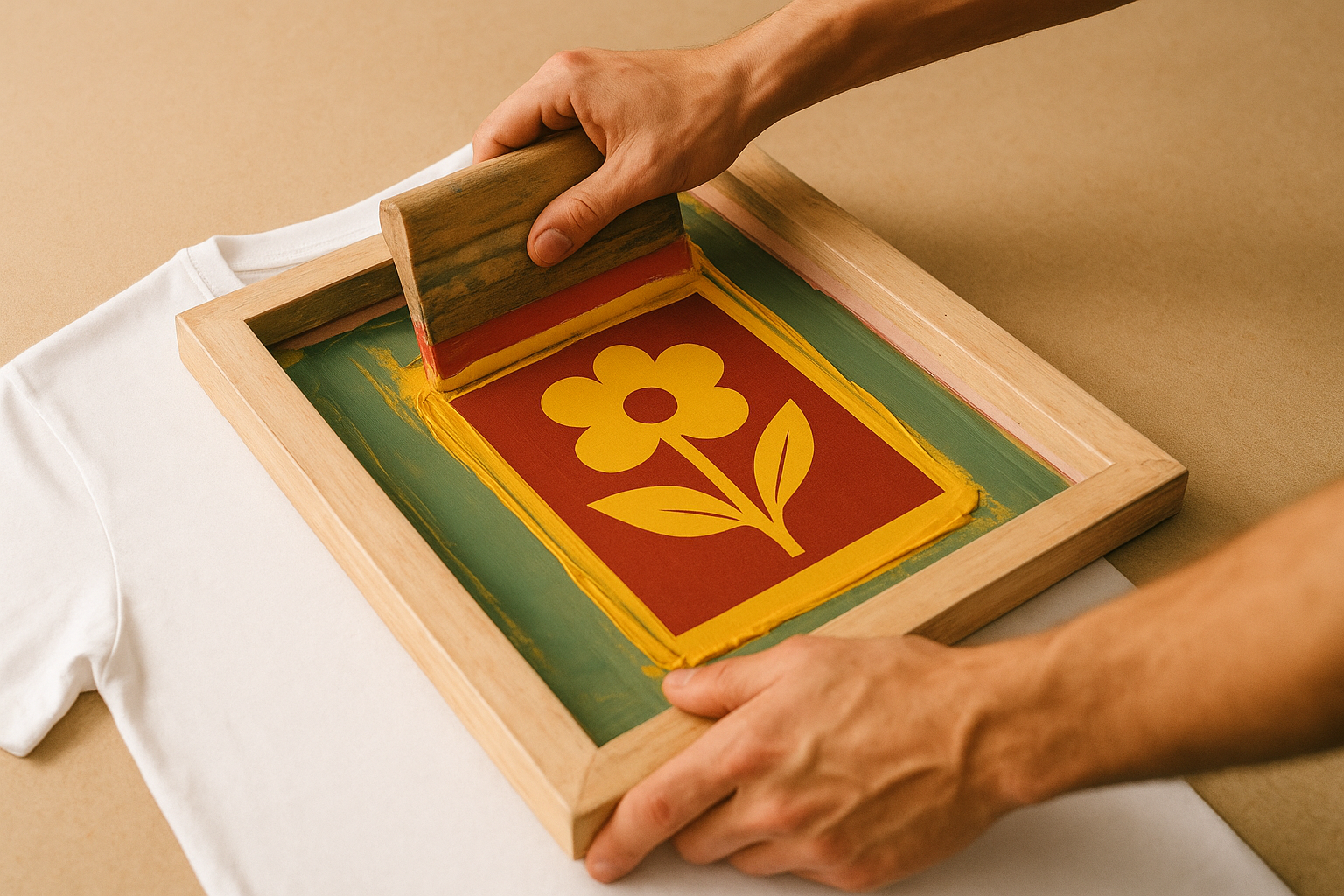
Printful added screen printing to serve customers who need bulk custom apparel at a lower per-unit cost. Unlike DTG, which prints each garment individually on demand, screen printing requires setting up physical ink screens for each colour in your design, which only makes financial sense when you’re printing the same design across a large quantity of items. Printful handles this through a dedicated bulk ordering process rather than their standard automated storefront system.
Screen printing through Printful is not the same as adding a product to your store and enabling print-on-demand. It requires direct contact with their team and a separate quoting process.
You won’t find screen printing listed alongside their regular product catalogue. To get a quote, you need to contact Printful’s sales or support team directly. This means turnaround times and pricing are not fixed upfront, and the process looks more like working with a traditional print shop than using a self-serve platform.
The limitations to know upfront
The biggest limitation is that screen printing through Printful requires a minimum order quantity, and that minimum is typically higher than what most small businesses need. If you’re ordering fewer than around 25 to 50 pieces of the same design, screen printing likely won’t be available to you through their platform. For smaller runs, Printful’s standard recommendation is DTG or direct-to-film (DTF) printing, which carry no minimums but come with a higher cost per unit.
Your design also plays a major role in whether screen printing is even viable. The method works best with bold, simple artwork using a limited number of ink colours. Highly detailed images or photographic prints don’t transfer well to screen printing, and that constraint applies regardless of which provider you use.
How Printful screen printing works for bulk orders
Printful screen printing for bulk orders follows a manual process rather than an automated one. You start by reaching out to their team directly, either through their contact form or by emailing their sales support. From there, a representative reviews your design, confirms the order quantity, and builds a custom quote based on your specific requirements.
The quoting and approval process
Once you submit your enquiry, Printful’s team evaluates your artwork and determines how many ink screens are needed. Each colour in your design requires a separate screen, which is why single or two-colour logos cost significantly less than multi-colour artwork. You’ll receive a quote that outlines the per-unit price, any setup fees for the screens, and the estimated production timeline.
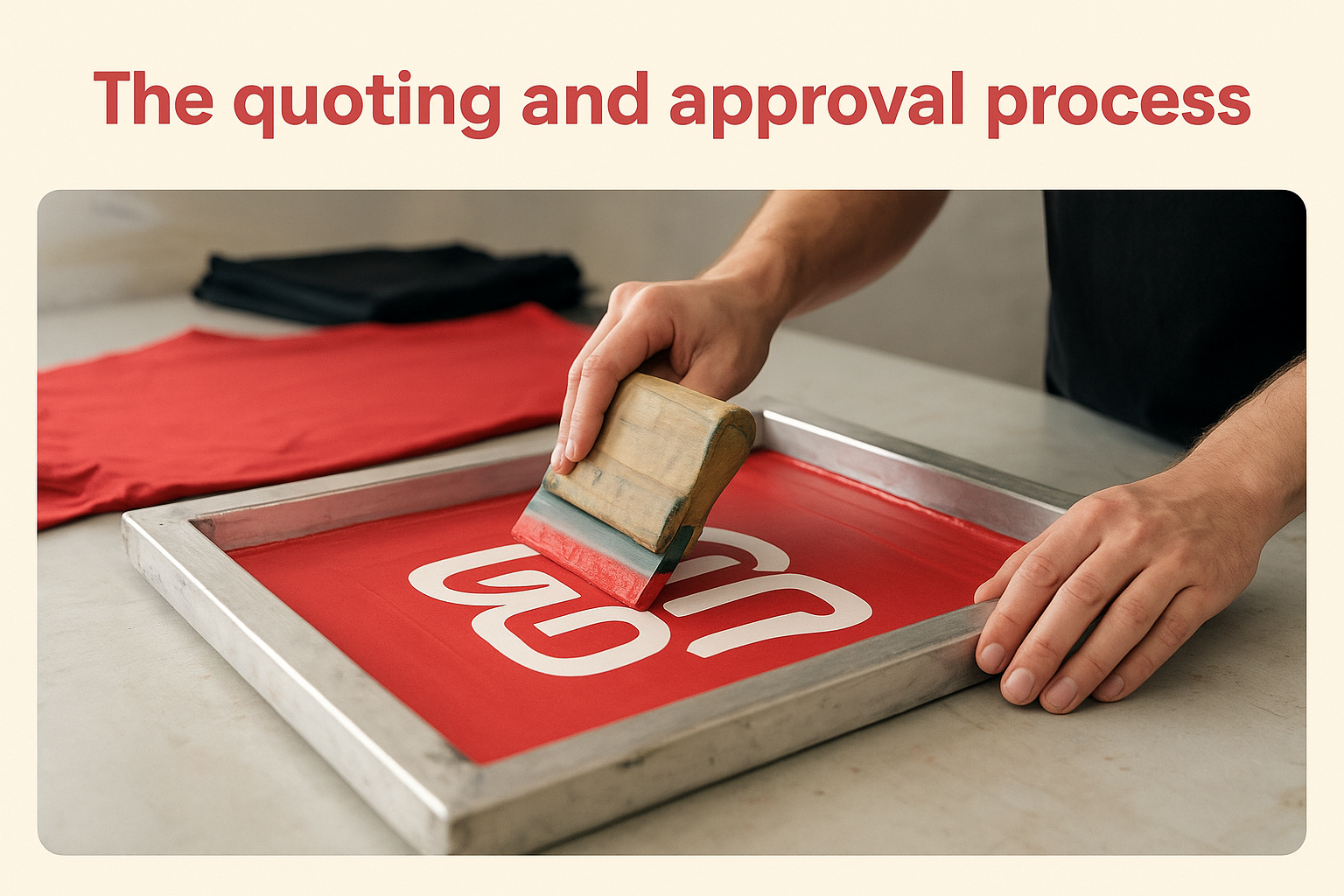
The screen setup fee is a one-time cost per design, so the more units you order, the lower that cost becomes per garment.
What happens after you approve the quote
After you approve the quote and submit print-ready artwork, Printful creates physical ink screens and runs a test print before full production begins. This pre-production step adds time to your order, which is why bulk screen printing through Printful typically takes longer than their standard DTG fulfilment. You’ll usually receive a digital proof or sample confirmation before they print the full run, giving you a chance to catch any issues with colour or placement before committing to the entire order.
Costs, minimums, and what changes the price
Printful screen printing does not come with a published price list. Every order is quoted individually, which means the cost you receive depends on several factors including your design, the garment type, and how many units you order. That said, there are some general patterns that can help you plan a budget before you contact their team.
Minimum order quantities
Printful typically requires a minimum of 25 to 50 units for screen printing, though this can vary based on the garment and design complexity. Smaller quantities rarely make sense for screen printing because the cost of producing the physical ink screens gets spread across fewer items, pushing the per-unit price too high to be competitive with DTG. If your order falls below that threshold, their team will likely redirect you to DTG or DTF options instead.
The screen setup cost is fixed regardless of quantity, so ordering 100 pieces instead of 25 can cut your per-unit price significantly.
What drives the price up or down
Several variables directly affect what you’ll pay per unit. Understanding these before you submit your enquiry saves time and helps you structure your order more cost-effectively.
- Number of ink colours: Each colour requires a separate screen, so a four-colour design costs more to set up than a two-colour one
- Garment choice: Premium blanks like heavyweight hoodies cost more than standard cotton tees
- Print location: Adding a back print or sleeve print alongside a chest print increases the screen setup cost
- Total quantity: Larger orders reduce the per-unit cost considerably
Artwork rules and design limits for screen printing
Your artwork determines whether Printful screen printing is even possible for your order. Screen printing applies ink through a physical stencil, so the process has hard limits on what it can reproduce accurately. Understanding these rules before you submit your design saves you from delays or having to rework your artwork after the fact.
Colour count and file format
Screen printing works best with simple, bold designs using a maximum of six colours, though most cost-effective orders use one to three. Each colour needs its own screen, so a five-colour logo adds five separate setup steps to your order. Gradients, colour blends, and photographic images do not translate to screen printing because the method deposits solid layers of ink rather than mixing colours at a microscopic level like DTG does.
If your design relies on subtle colour transitions or shading, screen printing is the wrong method regardless of which provider you use.
For file format, Printful requires vector artwork saved as an AI or EPS file, or a high-resolution PNG with clean, separated colour layers. Low-resolution images or rasterised files with soft edges will get flagged during the review process.
Placement and size restrictions
Print placement affects both quality and cost, and screen printing has tighter placement constraints than DTG. Standard chest prints work well, but curved surfaces like sleeves or collars can cause ink to spread unevenly. Printful’s team will confirm which garment areas are printable during the quoting process, so always ask before finalising your design layout.
Screen printing vs DTG, DTF, and embroidery
Choosing between print methods comes down to your order size, design complexity, and budget. Each method has a specific use case, and picking the wrong one can cost you more per unit or give you a result that doesn’t match what you had in mind. Here’s how the main methods compare.
When screen printing makes more sense
Screen printing produces sharper, more vibrant colours than DTG on standard cotton, and the ink sits on top of the fabric rather than soaking into it, which gives prints a bolder look that holds up through repeated washing. If you’re ordering 50 or more pieces of the same design and your artwork uses a limited number of solid colours, screen printing is usually the most cost-effective option.
Printful screen printing becomes the right choice when your per-unit cost matters more than flexibility, and your order is large enough to absorb the screen setup fees.
When DTG, DTF, or embroidery wins
DTG is ideal for small runs or one-off orders because there are no setup costs and no minimums. It handles photographic images and complex colour gradients far better than screen printing, making it the go-to for detailed artwork. The trade-off is a higher cost per unit at scale and slightly less durability on cotton over time.
DTF sits between screen printing and DTG, working well for small-to-medium runs with multi-colour designs. Embroidery is its own category entirely, suited to logos on hats, polos, and jackets where a premium, textured finish matters more than print detail.
Key takeaways
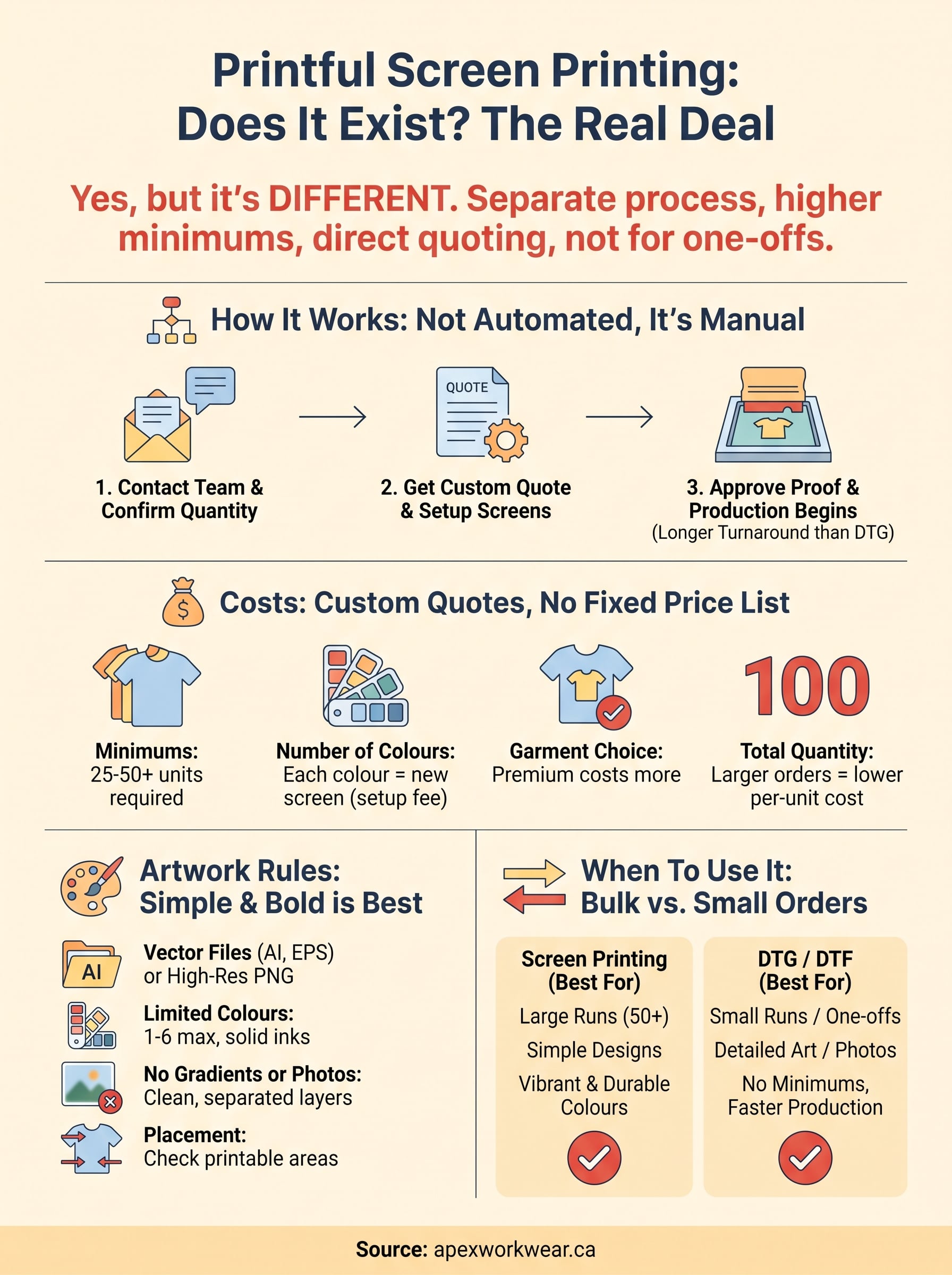
Printful screen printing exists, but it’s not the self-serve, no-minimum experience you get with their standard DTG products. You need to contact their team directly, meet a minimum order quantity of roughly 25 to 50 pieces, and submit clean vector artwork with a limited colour count before they’ll build a quote for you. The process looks far more like working with a traditional print shop than using their standard platform.
If your order fits that profile, screen printing delivers strong, durable prints at a lower per-unit cost than DTG at scale. If it doesn’t, DTG or DTF are more flexible options that still produce solid results for smaller runs with no setup fees to worry about.
For businesses across Canada looking for bulk custom apparel with straightforward pricing and fast turnaround, a dedicated local provider often makes more sense than navigating a platform built around print-on-demand. Get a custom apparel quote from Apex Workwear and find out what your order costs with no obligation.